
News Analysis
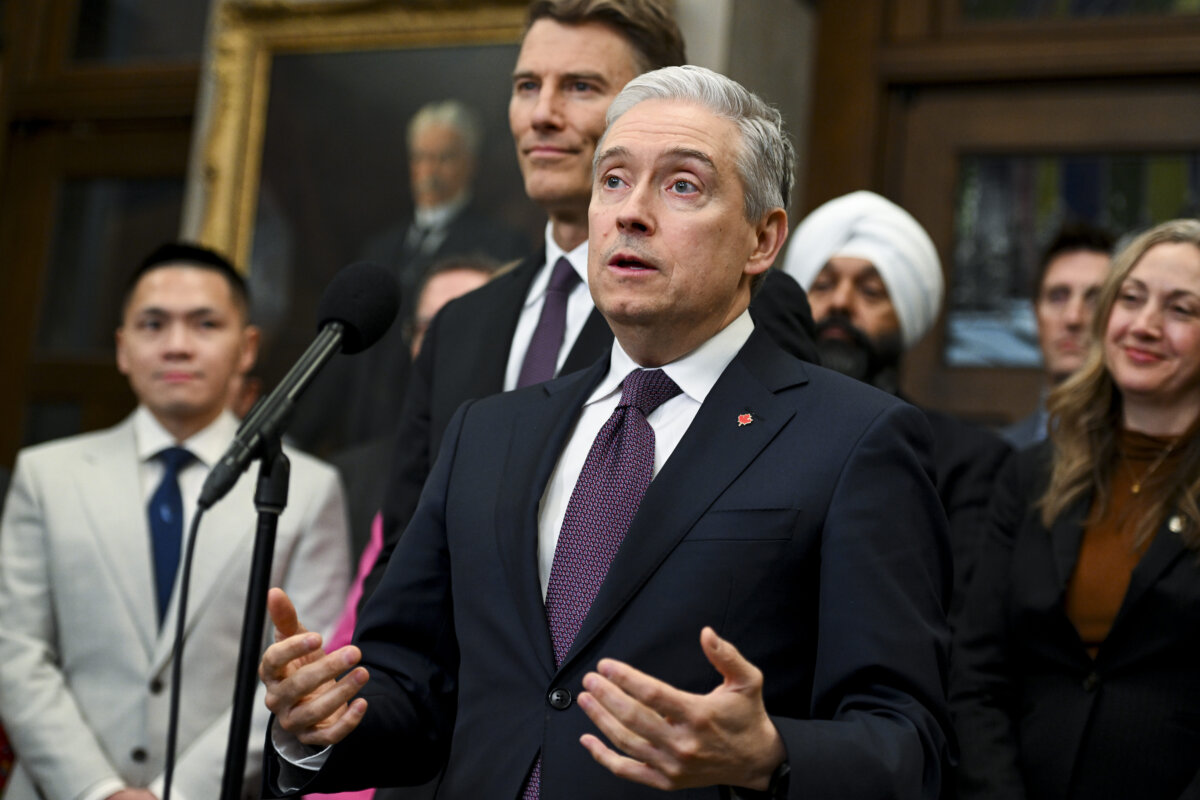
Finance Minister François-Philippe Champagne will visit China this week as Ottawa pursues closer ties with Beijing.
Champagne, who once played a crucial role in cabinet strengthening Canada against security threats posed by China, will now focus on improving trade between the two countries as part of the high-level visit.
The minister will be in China from March 31 to April 4, meeting with business leaders and senior officials in finance and banking.
The visit aims to increase partnerships and investments as part of Canada’s strategy to diversify trade and double non-U.S. exports within a decade.
Champagne finds himself playing a key role in the rapprochement with China, after erecting a number of safeguards to protect Canada from Chinese spying and takeovers during his time in the cabinet of former Prime Minister Justin Trudeau.
The trip follows Prime Minister Mark Carney’s January visit to China, where he said he is pursuing a new “strategic partnership” with Beijing.
As Trudeau’s industry minister, Champagne oversaw a number of policy changes such as Canada’s decision to ban Chinese telecommunications giants from the 5G wireless infrastructure, the tightening of the Investment Act to better prevent takeovers of strategic sectors by state-owned companies, and the hardening of rules to prevent China from siphoning Canadian research and intellectual property.
Trudeau had pursued a pro-China policy early in his term but the initiative ended with the Meng Wanzhou affair, leading to a freeze in diplomatic relations.
Canada executed a U.S. extradition warrant against the Huawei executive in late 2018 and in apparent retaliation China arbitrarily detained Canadian citizens Michael Kovrig and Michael Spavor for over 1,000 days. Champagne served as foreign affairs minister during part of this time period.
Champagne now says Canada and other countries have found a “strategic path forward” to engage with China, and that his government is doing so with “eyes wide open.”
Ottawa has so far released limited details about Champagne’s trip. Carney said on March 30 the visit is part of the financial and economic dialogue between Ottawa and Beijing, which the two parties agreed to hold regularly during the prime minister’s visit in January.
EV Deal
During Carney’s China visit, a number of agreements and memoranda of understanding (MOUs) were signed, including on tariffs, energy, and law enforcement cooperation.
The deal on tariffs involved Canada slashing its 100 percent duty to 6.1 percent on as many as 49,000 Chinese electric vehicles (EVs) in the first year. In exchange, China removed or reduced its tariffs on some Canadian agricultural and seafood products until the end of 2026.
The 100 percent tariff on Chinese EVs was put in place when Champagne was industry minister in October 2024. The move closely followed similar measures introduced by the U.S. administration under then-President Joe Biden.
China retaliated in March 2025 by slapping tariffs on Canadian agricultural and seafood products, around the same time as U.S. President Donald Trump began implementing a global tariff strategy.
Champagne said at the time that Ottawa would not consider removing the tariffs on Chinese EVs, because they had been imposed for “good reasons.”
“We would never be a back door to cheap Chinese vehicles which are overly subsidized and where they don’t respect labour law and environmental laws,” Champagne said in March 2025.
The decision has been criticized by China watchers and security experts, worried about China’s access to Canada’s nascent EV sector, as well as concerns that China-made EVs may include data-gathering and surveillance capabilities.
There were a little over 115,000 new registrations of battery electric vehicles in Canada in 2025, according to Statistics Canada, meaning 49,000 Chinese EVs sold in Canada would represent a 42 percent market share.
The deal on Chinese EVs started materializing with the world’s largest EV maker, Chinese BYD, preparing its entry into the Canadian market. The company is also studying the possibility of building a plant in Canada or purchasing an established global automaker.
Ontario Premier Doug Ford raised doubts about the viability of Chinese carmakers building factories in Canada after the deal was announced, given that most of the vehicles made in Canada are destined for the U.S. market. He also said companies have to produce 220,000 vehicles annually to break even.
“Guess what folks, 80 to 90 percent of those vehicles [produced] go south of the border, so I’m not too sure if Trump wants Chinese spy vehicles coming across the border, but I’m betting the answer is no,” Ford said in January.
The United States has maintained its 100 percent tariff on Chinese EVs, with officials raising the concern expressed earlier by Champagne about the risks of dumping and distortion in the local market.
Meanwhile, Carney said allowing Chinese EVs in Canada will improve affordability in the sector. In announcing the deal in mid-January, the prime minister said it would “drive considerable Chinese investment in Canada’s auto sector, creating good careers in Canada and accelerating our progress towards a net zero future and the auto industry of the future.”
Security Concerns
Amid concerns from politicians and experts about the security risks posed by Chinese EVs, Public Safety Minister Gary Anandasangaree said the vehicles would comply with Canadian privacy laws.
Chinese companies are required by law to help the state collect intelligence and EVs are loaded with sensors able to collect a swathe of information on their users and surroundings.
“EVs that do come into Canada will be subject to Canadian laws similar to Tesla and other models, the gathering of information and misuse of any information will not be permitted,” Anandasangaree said in late February.
China expert Margaret McCuaig-Johnston on March 12 told a House of Commons committee studying Ottawa-Beijing trade relations that Chinese EVs could put Chinese dissidents at risk given their potential for data collection.
At a House committee meeting on March 26, this time on the topic of federal EV policies, McCuaig-Johnston said Champagne is among the best placed in cabinet to understand the risks posed by China, given his extensive experience on the topic. She said that “nothing has changed” since last year when Champagne had said Chinese EVs posed an economic risk to Canada.
Controversy arose after Liberal MP Michael Ma challenged McCuaig-Johnston’s testimony, questioning her claims about forced labour in the Chinese EV supply chain and asking whether she had personally witnessed such practices in China.
Conservatives and human rights advocates criticized Ma’s interaction with McCuaig-Johnston. “Why is this MP carrying water for the Chinese regime?” Tory MP and industry critic Raquel Dancho said on social media.
Following public backlash, Ma later apologized, saying his line of questioning had “inadvertently came across as dismissive of the serious issue of forced labour.” The MP, who defected from the Conservatives in December and travelled with Mark Carney to China in January, declined to say whether he believes forced labour exists in China when later pressed by a reporter.
Conservatives have pressed the Liberals on other China-related issues since Carney’s trip to Beijing, including a secret MOU on law enforcement cooperation. Tories have called for the terms of the MOU to be released but Ottawa has so far refused.
 Friends Read Free
Copy
Facebook
Tweet
Friends Read Free
Copy
Facebook
Tweet