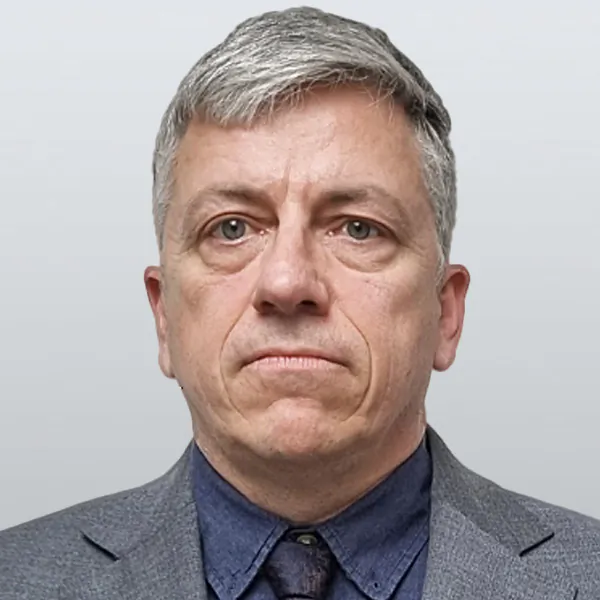
Hungarian Prime Minister Viktor Orban faces a challenge to retain power in the upcoming election on April 12, as the opposition Tisza party was projected on April 8 by pollsters Median as winning a two-thirds majority in parliament.
Orban and his conservative Fidesz party are facing the biggest challenge to their rule in 16 years as Tisza, which is led by the prime minister’s former ally, Peter Magyar, seeks to improve relations with the European Union, of which Hungary is a member.
Tisza could win 138–142 seats in the 199-member parliament, according to an analysis of Median’s five most recent opinion polls, conducted in late February and March.
The poll suggested Fidesz would win 49–55 seats, and nationalist party Our Homeland could win up to six seats.
Median said its polls were based on a sample size of 5,000 and were conducted by three separate call centers.
But other polls have Fidesz faring much better against Tisza.
A poll conducted by the Center for Fundamental Rights think tank, and published on April 1, said Fidesz was set to take 50 percent of the vote, and Tisza 42 percent.
A political party in Hungary needs 133 seats, or 66 percent, to obtain a parliamentary supermajority and enable it to amend the constitution and change laws.
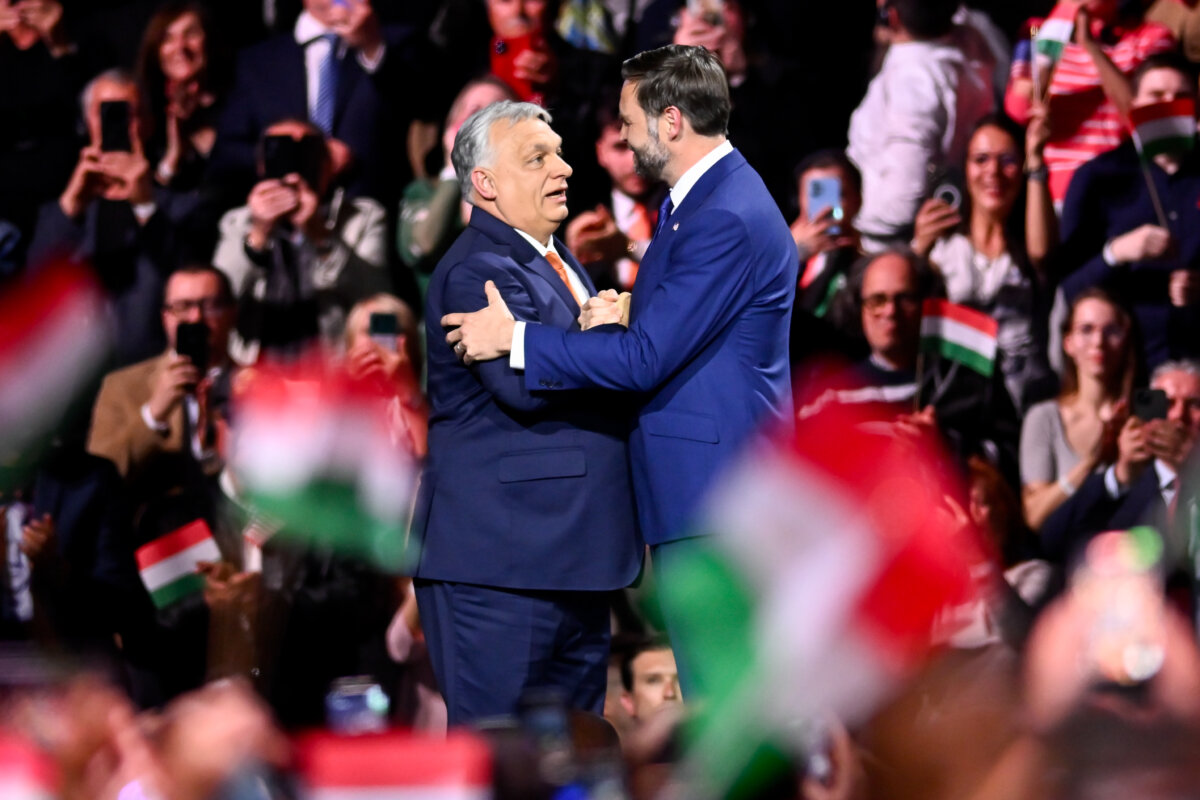
U.S. Vice President JD Vance appeared at an election rally with Orban in the Hungarian capital, Budapest, on April 7 and gave his and President Donald Trump’s full endorsement of the incumbent, adding that they support him in his battles with the EU.
“I admire what you’re fighting for,” Vance said. “I am here because President Trump and I wish for your success, and we are fighting right here with you.”
Vance also praised Orban for the strong stand he had taken against mass migration.
Orban Wants to ‘Save Western Civilization’
“Freedom-loving Americans and Hungarians must unite and save Western civilization,” Orban said at the rally. “To do this, we must fight the progressives that nest in Brussels.”
On April 8, Vance described remarks Ukrainian President Volodymyr Zelenskyy had recently made as “completely scandalous.”
On March 5, Zelenskyy had said, in a veiled reference to Orban after Hungary blocked a 90 billion euro ($105 billion) EU loan to Ukraine, that he would give the address of the individual responsible for blocking the loan to the Ukrainian Armed Forces so they could “call him and speak with him in their own language.”
Vance criticized the Ukrainian leader’s remark as “completely scandalous.”
“You should never have a foreign head of government … threatening the head of government of an allied nation,” he said.
Hungary and Ukraine have been at loggerheads over the Druzhba pipeline, which brings oil from Russia, crosses Ukrainian territory, and has been out of action for more than two months.
Hungary and neighboring Slovakia both blame Ukraine for the prolonged halt to supplies for their refineries, while Kyiv says the outage was caused by a Russian drone strike hitting pipeline equipment in Western Ukraine on Jan. 27.
On April 8, Russia also accused the EU of helping Orban’s political opponents.
“Many forces in Europe, many forces in Brussels, would not like Orban to win the elections again,” Kremlin spokesman Dmitry Peskov said.
He was being asked about a leak, published by Bloomberg, of a conversation last year between Orban and Russian President Vladimir Putin, in which the Hungarian leader allegedly said, “In any matter where I can be of assistance, I am at your service.”
“This is well-known, it’s obvious to the naked eye, and, of course, they’re playing into the hands of those forces that politically oppose Orban and believe that publishing such materials could harm him,” Peskov said.
The Associated Press and Reuters contributed to this report.
 Friends Read Free
Copy
Facebook
Tweet
Friends Read Free
Copy
Facebook
Tweet