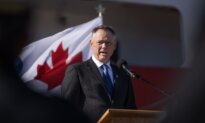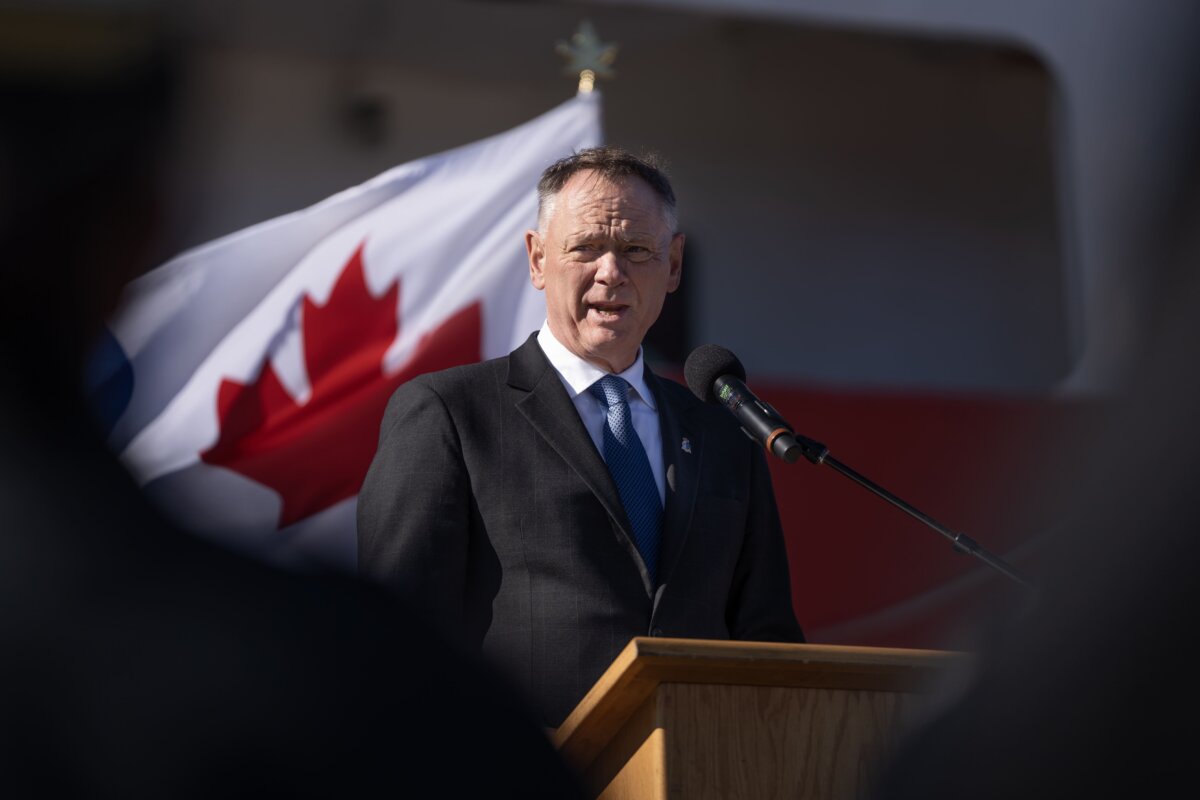

Canada’s defence minister said the country will be purchasing military equipment from the United States in order to send it to Ukraine, with a value of $200 million.
Defence Minister David McGuinty said in a statement that the “package of critical military capabilities” will be sourced under NATO’s Prioritised Ukraine Requirements List (PURL) in partnership with other NATO allies.
“By contributing to this PURL package in partnership with our Allies, we are ensuring Ukraine receives the advanced capabilities it urgently needs to defend its sovereignty and protect its people,” McGuinty said on Dec. 3.
The PURL initiative, launched in August, is meant to support Ukraine’s military needs in its war with Russia. Canada has contributed around $892 million to PURL, and $6.5 billion in overall military assistance since February 2022, and nearly $22 billion in overall funding to Ukraine since the start of the war.
At the meeting of NATO ministers of foreign affairs on Dec. 3 in Brussels, Belgium, Foreign Affairs Minister Anita Anand also announced that Ottawa would provide $35 million in funding for NATO’s Comprehensive Assistance Package (CAP) for Ukraine.
“Canada stands firmly, shoulder to shoulder, with Ukraine in the short and the long term,” Anand said.
Canada has provided a total of $180 million to the CAP, which aims to enable Ukraine to purchase equipment like medical supplies and communications tools, invest in logistics support and long-term capacity building, and enhance its interoperability with NATO forces.
The Liberal government’s Budget 2025 also includes $6.2 billion over five years to expand the country’s defence partnerships, which includes expanded military assistance to Ukraine.
Peace Discussions
Ottawa’s latest announcement on support for Ukraine comes as U.S. President Donald Trump is continuing to push for an end to the war between Ukraine and Russia.
In August, Trump met with Russian President Vladimir Putin in Alaska to discuss ending the Russia-Ukraine war, but the meeting ended early without an agreement being announced.
Ukrainian President Volodymyr Zelenskyy and several European leaders then met with Trump to discuss an end to the war. Trump said following the meeting that several countries could provide Ukraine with security guarantees, and that a trilateral meeting between himself, Zelenskyy, and Russian President Putin could soon be arranged.
No trilateral meeting has taken place since, as Zelenskyy rejected Putin’s offer for the two leaders to meet in Moscow and Russia continued attacks against Ukraine. A proposed second meeting between Trump and Putin in Budapest was also called off on Oct. 31.
Moscow has pushed for Ukraine to cede the regions of Kherson, Zaporizhzhia, Donetsk, and Luhansk that Russia currently occupies, and announced it had annexed in September 2022, while Kyiv has rejected these demands. Trump previously suggested that Ukraine should cede some territory in the Donbas region in order to end the war.
The White House confirmed in November that it had been drafting a 28-point peace plan to end the war, which required Ukraine to make territorial concessions, reduce its armed forces, and give up on its plans to join NATO. The European Union has since introduced an alternative plan.
Zelenskyy said on Dec. 1 that the peace plan looked “better” following discussions between Kyiv and Washington, but said the potential ceding of territories to Russia remained “the most complicated” issue in the discussions.
The latest meeting between the U.S. Special Envoy Steve Witkoff, Trump’s son-in-law Jared Kushner, and Russian President Vladimir Putin on Dec. 2 did not result in an agreement. Putin’s top foreign policy aide Yuri Ushakov said the meeting was “constructive,” but that there was “still a lot of work to be done.”
Fighting between Russia and Ukraine has continued, with Moscow launching drone and missile attacks around the country’s capital on Nov. 29 that killed at least three people and left dozens wounded, and Kyiv hitting two oil tankers from Russia’s “shadow fleet” as they travelled through the Black Sea near Turkey.
 Friends Read Free
Copy
Facebook
Tweet
Friends Read Free
Copy
Facebook
Tweet