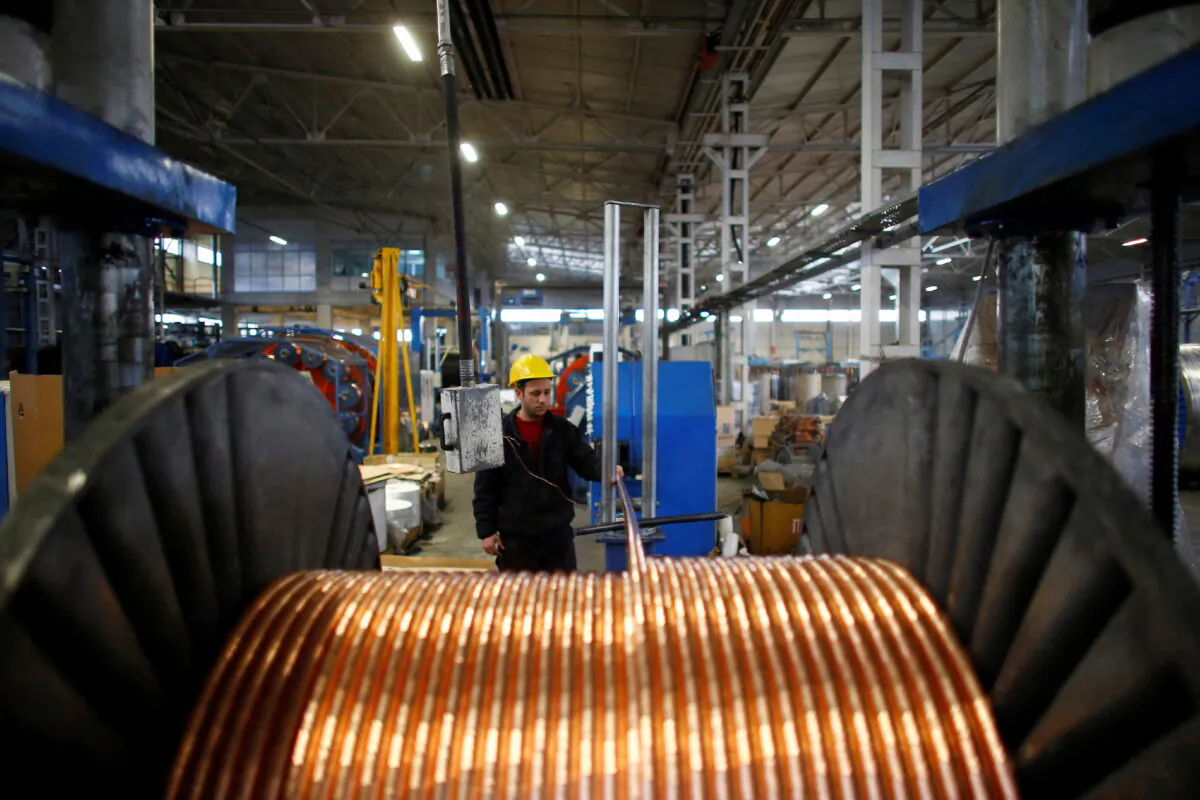

Industry Minister Mélanie Joly says Canada will “fight against” a proposed 50 percent tariff on all copper imports coming into the United States.
The new tariff, announced July 9 by U.S. President Donald Trump, is set to take effect on Aug. 1, potentially having a considerable negative impact on Canadian copper producers, as over half of Canada’s copper exports go to the United States, according to the last available trade figures.
“We’ll fight against it. Period,” said Joly, who made the comments on the sidelines of a July 10 meeting with the Vancouver Board of Trade, though declining to give details on what Ottawa’s response to a copper tariff will be.
“Every day we are in a tariff war, and we are defending ourselves,” she added.
According to the latest statistics available from the federal government, 52 percent of Canada’s copper exports in 2023 went to the United States, followed by 17 percent to China and 12 percent to Japan. In the same year, Canada exported $9.4 billion in copper, representing around 1 percent of its $965.1 billion exports of goods and services.
CEO of the Mining Association of Canada Pierre Gratton said the tariff is “very concerning” for Quebec’s copper industry in particular, adding that “we need to find out what this means, whether our trade talks include copper, and how it will be applied.”
Ottawa has said it aims to reach a new trade deal with Washington by July 21, although U.S. envoy to Canada Peter Hoekstra said last week he couldn’t confirm the deadline. Trump has extended the deadline for countries to reach new trade deals with the United States from July 9 to Aug. 1.
Prime Minister Mark Carney warned in May that more “unjustified” tariffs could be coming. In his remarks, Carney said that Canada’s “top priority” is to make a new deal with the United States as well as to “strengthen our collaboration with reliable trading partners and allies around the world.”
Canada is currently subject to a 25 percent tariff on all products that don’t fall under the United States-Mexico-Canada Trade agreement. It has also been hit with blanket 50 percent tariffs on steel and aluminum.
Canada has applied a set of counter-tariffs in retaliation, but has since dropped some of them, with two remission orders granted in mid-April to shore up the auto manufacturing and public safety sectors in Canada.
The United States is one of the world’s top copper miners, producing about 1.1 million tons annually. Chile remains the largest copper producer, with 5.3 million tons, followed by the Democratic Republic of the Congo (2.84 million), Peru (2.76 million), and China (1.83 million). The United States consumes about twice as much as it produces, resulting in the country’s dependence on copper imports, mainly from Chile.
Copper is key in the production of electronics, computer chips, industrial machinery, and cars, as well as military technology and telecommunications. U.S. Commerce Secretary Howard Lutnick has said the purpose of the proposed copper tariffs is to increase domestic production.
 Friends Read Free
Copy
Facebook
Tweet
Friends Read Free
Copy
Facebook
Tweet