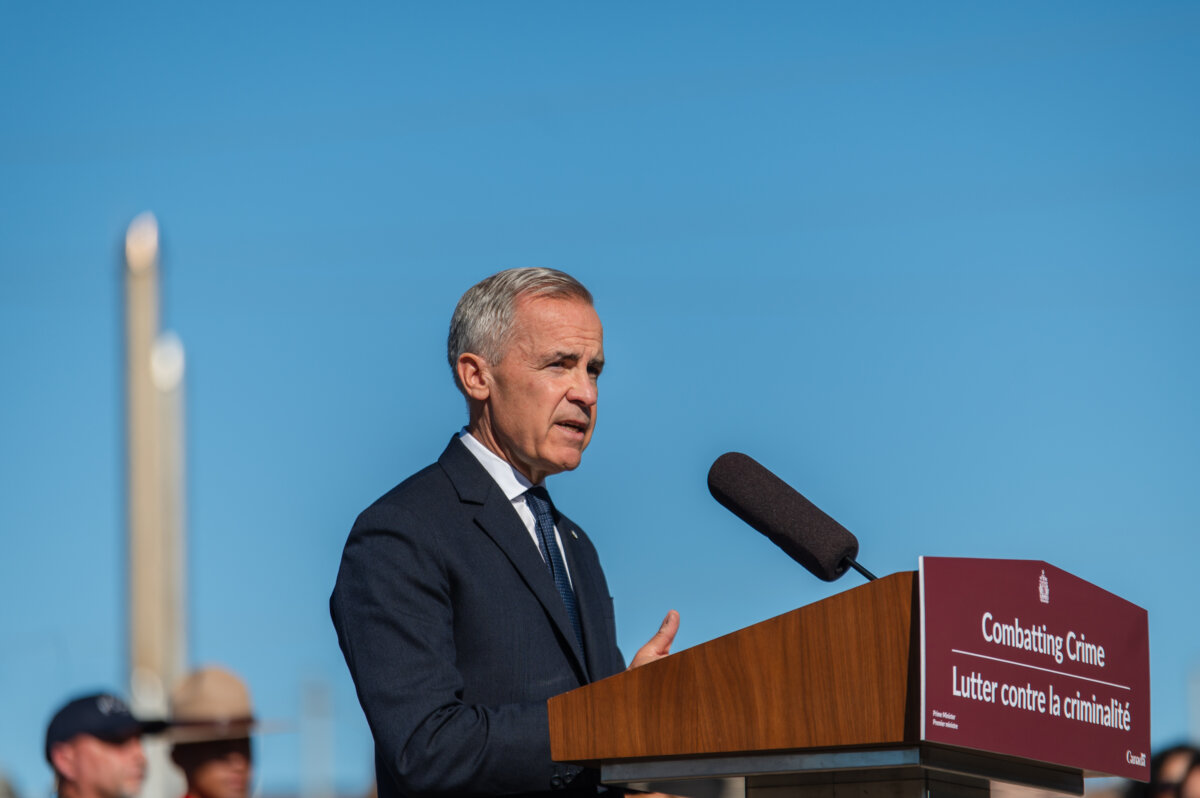

Prime Minister Mark Carney says the Liberal government will table bail reform legislation next week that targets violent and repeat offenders.
Building on a promise the Liberals made during the last election, Carney said the legislation will target those accused of serious crimes such as violent auto theft, breaking and entering, human trafficking, violent assault, and sexual assault.
“These new measures will keep violent criminals and repeat offenders off our streets. They will protect the people we love, and they will deliver the justice that Canadians deserve,” Carney said during an Oct. 16 press conference at the RCMP Toronto Airport detachment in Etobicoke, Ont.
According to a statement from the Prime Minister’s Office, the legislation will introduce “reverse-onus bail” for major crimes, meaning the accused will be required to prove why they should be released from detention, rather than Crown prosecutors needing to prove they should be detained.
The bill will also allow for consecutive sentencing so that multiple crimes result in more jail time, impose harsher penalties for organized retail theft, and restrict conditional sentences for a number of sexual offences.
Speaking to reporters on Oct. 16, Carney said under current laws, someone convicted of sexual assault can be eligible for house arrest “in the very community where their victim lives.”
“That is not justice. Our legislation will put an end to this. If you commit sexual assault, you will serve your sentence in a correctional facility,” the prime minister said.
Carney also announced that as part of Budget 2025, set to be tabled on Nov. 4, $1.8 billion will be allocated over four years to increase federal policing capacity, and an additional 1,000 RCMP personnel will be hired. The PMO said the funding will raise the RCMP’s cadet recruitment allowance to $1,000 per week, and will dedicate 150 new personnel to tackle financial crimes like money laundering, online fraud, and organized crime.
“Financial crimes take many forms, and they are rising with devastating impacts on millions of Canadians—retired Canadians who spent a lifetime saving carefully are losing thousands of dollars in seconds, sometimes just for answering a call from the wrong person,” Carney said.
When asked by reporters if he was concerned that aspects in the bill could be struck down by the Supreme Court, Carney said the measures follow the rulings of the court and do not infringe on the rights of Canadians.
The Conservative Party had introduced a motion in the House of Commons on Oct. 6 to pass its own bail reform legislation. The Tories’ “Jail Not Bail Act” would eliminate the current requirement for judges to release those accused of crimes under the least onerous conditions. It would also introduce a new major offences category making it more difficult to release those accused of major crimes to receive bail, and require judges to consider the full criminal history of a person before granting them bail.
The motion failed to pass, with the Liberals, NDP, and Bloc Québécois voting against it. A Conservative motion calling for anyone convicted of three serious offences to be denied bail or parole also failed in the House of Commons on Sept. 18.
Conservatives have been critical of the Liberal government’s criminal justice laws, and have repeatedly referenced Statistics Canada data showing violent crime in Canada has increased sharply over the past decade. The Tories have also highlighted ongoing cases of individuals being accused of committing serious crimes while out on bail for prior offences.
The Tories have blamed the Liberals’ Bill C-75, which directed judges in adjudicating bail to primarily focus on releasing the accused as quickly as possible and on the “least onerous conditions.” The Tories have also criticized Bill C-5 for removing mandatory minimum sentences for some serious crimes, instead allowing for parole or house arrest.
 Friends Read Free
Copy
Facebook
Tweet
Friends Read Free
Copy
Facebook
Tweet