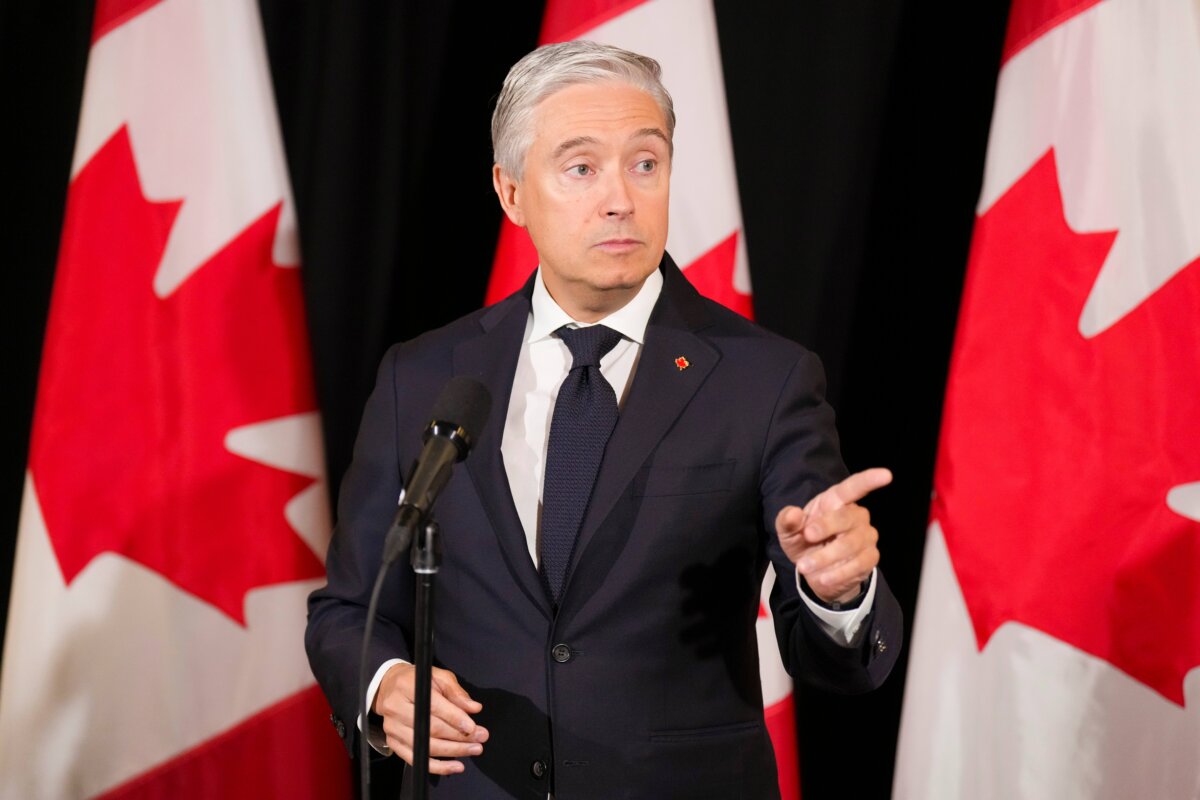

Finance Minister François-Philippe Champagne says the federal government will introduce its budgets in the fall from now on, which he said will facilitate better financial planning for federal departments and businesses.
While federal budgets have typically been introduced in the springtime, Champagne said the decision to introduce it in the latter part of the year better aligns with the priorities of businesses, investors, as well as the provinces and territories.
“This change will provide the certainty and predictability needed to plan ahead and ensure projects can begin as soon as construction season starts – helping every level of government make smarter, faster investment decisions,” Champagne said in a statement on Oct. 6.
Meanwhile, the government’s fiscal update, which is typically introduced in the fall to update Canadians on the government’s financial situation, will now be introduced in the spring.
Champagne said in his opening statement before the finance committee on Oct. 6 that introducing the budget before the main estimates will make the process more transparent. He said the introduction of the budget in the fall will “more closely align with construction season” and provide increased predictability for businesses, investors, and policymakers.
The change would mirror a similar move by the UK government in 2017, when it transitioned to introducing budgets in the autumn in order to simplify the process and give the government more time to explain changes that would take effect in April of the following year.
Champagne said the upcoming federal budget, set to be introduced on Nov. 4, is a “serious plan to address this new economic landscape and the rising cost of living.” The finance minister said the government will be making “ambitious investments” in workers and industries across Canada.
Speaking to reporters ahead of the finance committee meeting, Champagne also said introducing budgets in the fall is “pretty much the norm” in G7 countries, and such a move “aligns better with the budget cycle that we see in a number of G7 countries.”
The Conservative Party has been critical of the Liberal government for not tabling a budget this past spring, with Leader Pierre Poilievre warning in May that the move could spook investors and send a negative message to credit rating agencies.
Questions on Fiscal Anchors
During the finance committee meeting, Conservative MP Jasraj Singh Hallan asked Champagne what the government’s fiscal anchors are. The finance minister replied that the federal government will be balancing its operating budget within the next three years, and that it will have a declining deficit-to-GDP ratio over the same period.
Singh Hallan noted that Parliamentary Budget Officer Jason Jacques told the government operations committee on Sept. 16 that the government did not appear to have any fiscal anchors. Jacques said he believed “everyone should be concerned” by this.
Champagne responded to Singh Hallan by saying that “different parliamentary budget officers have a different view than the one you’re referring to,” and that Canada has the lowest debt-to-GDP ratio and deficit-to-GDP ratio in the G7. Former Parliamentary Budget Officer Yves Giroux recently projected this year’s federal deficit could be between $60 billion and $70 billion.
Prior to the 2024 Fall Economic Statement, then-Finance Minister Chrystia Freeland had said the government would meet its fiscal anchor of a 42.1 percent debt-to-GDP ratio for the fiscal year, but did not say whether it would meet its other anchor of keeping the deficit below $40.1 billion.
Freeland resigned the day the document was set to be tabled, and the statement showed that Ottawa overshot the deficit fiscal anchor by more than $20 billion, but kept the anchor of a declining debt-to-GDP ratio.
 Friends Read Free
Copy
Facebook
Tweet
Friends Read Free
Copy
Facebook
Tweet