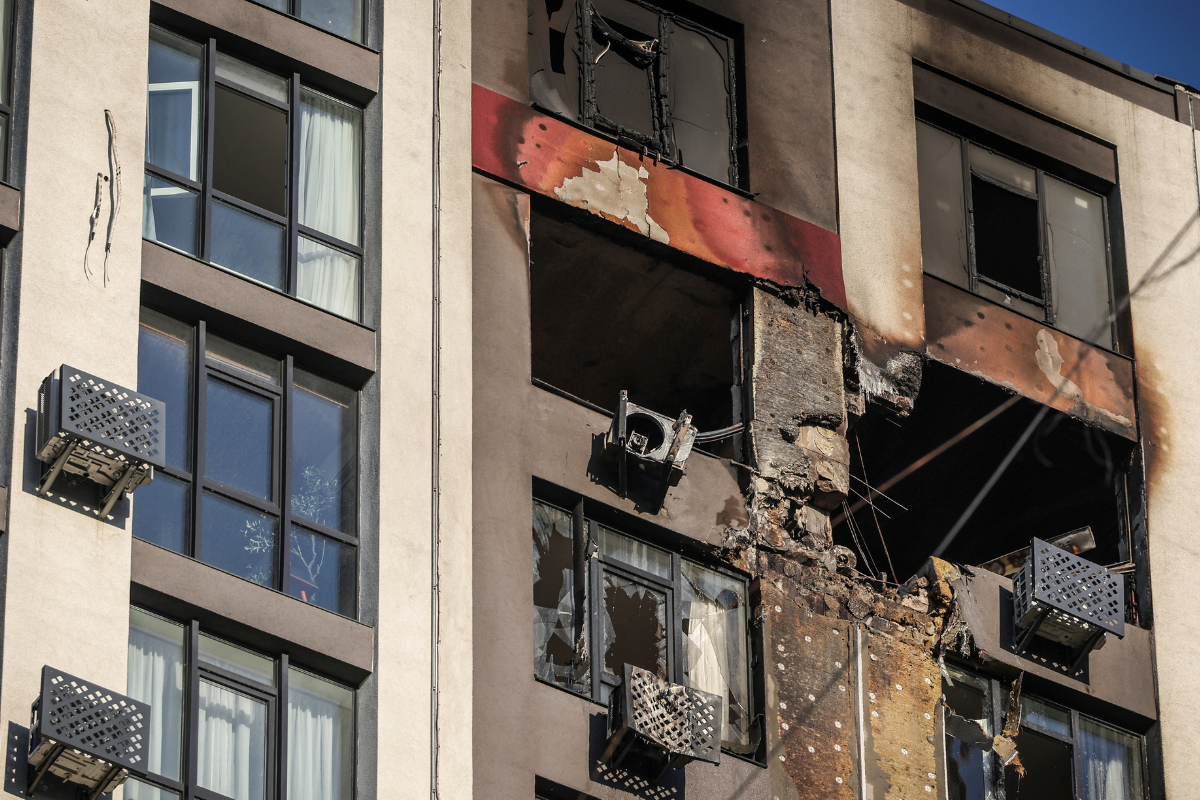

Russia conducted strikes overnight across several areas in Ukraine in retaliation for what it said was a deliberate attack on civilians in Russian-held Luhansk in eastern Ukraine.
The Russian Defense Ministry said on June 2 that it had struck key military targets, such as airfields and fuel and transport facilities. It said it used drones and hypersonic missiles to attack several regions, including Kharkiv, Kyiv, and Zaporizhzhia.
“Overnight, in response to terrorist acts of the Kyiv regime, the armed forces of the Russian Federation carried out a massive strike using high-precision long-range air-, land-, and sea-based weapons,” the Defense Ministry said.
Ukrainian authorities said the attacks on the Ukrainian capital Kyiv and other cities had killed at least 11 people and wounded more than 100.
Ukrainian President Volodymyr Zelenskyy said in a June 2 post on X that the main strikes were on Kyiv, with dozens of residential buildings and civilian infrastructure damaged. A four-story apartment block in Dnipro was also struck, and part of the building “was essentially demolished.”
Russia also struck energy facilities in the Kharkiv region as well as critical infrastructure in the city of Kharkiv and in the regions of Chernihiv, Kharkiv, Khmelnytskyi, Kyiv, Mykolaiv, Poltava, Sumy, and Zaporizhzhia, Zelenskyy said.
“In total, overnight Russia launched 656 attack drones and 73 missiles of various types at our people—ballistic, cruise, and anti-ship missiles,” Zelenskyy said.
“A large-scale attack and an absolutely clear statement from Russia: if Ukraine is not protected from ballistic and other missile strikes, these attacks will continue,” he said, adding that Europe needs its own anti-ballistic defense system.
The assaults followed threats from the Kremlin this past week that Russia would begin to carry out “systematic strikes” in retaliation for a Ukrainian drone attack on a student dormitory in Luhansk that killed 21 people. Ukraine had said it had not targeted the students and was aiming at a drone command center.
Kyiv and Moscow both deny deliberately targeting civilians.
Ukraine Hitting Russian Refineries
On June 1, Zelenskyy said that Ukraine’s military is now capable of hitting Russian logistics throughout parts of occupied areas of Ukraine, creating fuel shortages in the east of the country and in Crimea.
Ukrainian forces have also ramped up strikes in Russia, as well, targeting Moscow’s oil industry.
Zelenskyy said in his nightly video address that from January to May, the Ukrainian military had struck 15 Russian oil refineries.
The Institute for the Study of War said this past week that its analysis of Russia’s battlefield performance shows that “the character of the war is shifting in favor of Ukrainian forces, at least for now” and that the war is not in a stalemate.
The think tank stated in its report, published on May 25, that Russia’s rate of advancement is “plummeting,” while Ukraine is “starting to regain more ground than it is losing for the first time since 2023.”
The report also said that Ukraine has regained an overall drone advantage and has been “conducting a coherent campaign to suppress and destroy Russian air defenses since late 2025, in order to shape the battlefield as part of more sophisticated campaign planning.”
“Ukraine’s success in blunting Russian advances and reversing Russian gains in some sectors of the line, in tandem with Ukraine’s limited reintroduction of elements of tactical mechanized maneuver, may nevertheless mark the beginning of a new phase of the war,” the report reads.
Negotiations Before Winter
Earlier, Zelenskyy said that he wanted to press on with peace negotiations before winter sets in to take advantage of Kyiv’s strategic gains.
Zelenskyy said in an interview with CBS’s “Face the Nation,” recorded on May 29 and aired two days later, that Russia began to lose the battlefield initiative in December 2025.
“They couldn’t occupy territories more during one month than they lose during the same month,” the Ukrainian president said.
“So now we have this period of time before the winter. … We have, before the winter, we need to find a way, [a] diplomatic way, to sit and to speak.
“But it depends [on] the pressure on Putin, the pressure in his society, and I think that is increasing, the pressure by sanctions—not to lift them, to put more. It’s good, it’s [a] diplomatic way.”
Zelenskyy’s chief of staff, Kyrylo Budanov, said on May 31 that he believed that agreeing on a deal to end the war by winter was a “realistic” outcome.
“This is the president’s instruction: to try to end this war as soon as possible … preferably before winter,” Budanov told reporters at a press conference. “In my opinion, this is absolutely correct, timely, and realistic.”
Reuters contributed to this report.
 Friends Read Free
Copy
Facebook
Tweet
Friends Read Free
Copy
Facebook
Tweet