
Rising federal debt-servicing costs could push the government into “a danger zone,” Ottawa’s fiscal watchdog says.
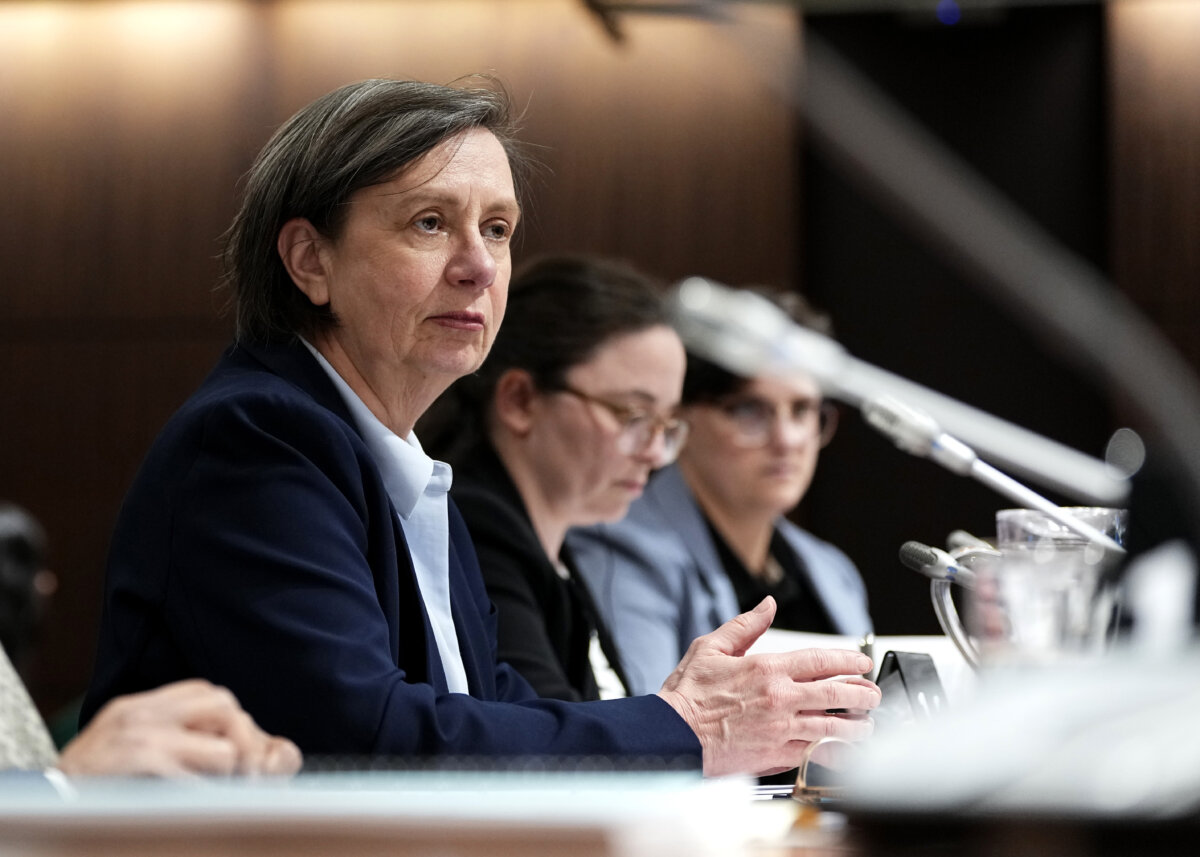
Parliamentary Budget Officer Annette Ryan made the comments about the federal government’s spending trajectory during an Oct. 7 appearance before the Senate finance committee, which was first reported by Blacklock’s Reporter.
Ryan told the committee that the share of federal revenue used to service the debt is rising rapidly, from 10 cents of every dollar in revenue to 14 cents within a few years. She cautioned that if the trend continues, debt-servicing costs of 18 or 20 cents per revenue dollar would put the government in “a danger zone.”
In response to questions from senators, Ryan challenged the government’s position that increased deficit spending would reliably drive economic growth. She also voiced concerns about Ottawa’s decision to move away from the debt-to-GDP ratio as its primary fiscal anchor.
“I think it’s straightforward to say that a fiscal rule based on a debt-to-GDP ratio would be more prudent,” she said in response to a senator’s question. “You get a declining debt-to-GDP when you essentially have revenues surpassing expenditures through time based on your GDP and population. That really is at the core of prudence.”
Ryan called the government’s position that increased investment would boost GDP over the medium term a “very ambitious assertion,” arguing it carried significant risks and was “the opposite of prudence.”
The warning follows a September 2026 report from Ryan’s office which says the new budget framework from Mark Carney’s Liberal government contains inconsistent and “contradictory” definitions for some spending categories.
The government’s Capital Budgeting Framework distinguishes between day-to-day operating expenses and spending classified as capital investment, as part of its strategy to increase investment while restraining operating spending. Finance Minister François-Philippe Champagne introduced the framework last fall, and it was formally implemented in Carney’s first federal budget in November 2025.
Carney said last month that the federal government expects to balance its operating budget in 2027-28.
The budget officer’s report said Ottawa’s approach to categorizing spending in its Capital Budgeting Framework falls short of the stricter standards applied in other regions, like the United Kingdom.
“Canada is not the first jurisdiction to tie a fiscal anchor to a capital-versus-operating split,” Ryan said, adding that while the UK has a similar framework, it also “pairs it with a debt rule and a capital definition aligned to international national accounts standards.”
The report also found that classifying certain operating costs as capital spending makes the government’s day-to-day operating balance appear healthier on paper.
When the PBO adjusted the government’s calculations using more traditional definitions, it projected that Ottawa would miss its 2028–29 operating-budget balance target and achieve balance in 2029–30.
Finance Ministry spokesperson John Fragos said in a media statement last month that the government remains committed to balancing its operating budget ahead of schedule.
“A persistent commitment to fiscal prudence, discipline, and spending efficiency—underpinned by the government’s $60 billion in savings—has moved up balancing the operating budget agenda by a whole year despite today’s report purporting otherwise,” he said in the statement responding to the PBO report.
The Canadian Press contributed to this report.
 Friends Read Free
Copy
Facebook
Tweet
Friends Read Free
Copy
Facebook
Tweet