
ARLINGTON, Va.—A U.S. Marine Expeditionary Unit is set to reposition to the Middle East amid ongoing military operations against Iran, a U.S. official familiar with the matter has told The Epoch Times.
Other media outlets first reported that the 31st Marine Expeditionary Unit (MEU), consisting of around 5,000 Marines and sailors, had received orders to head to the Middle East.
The 31st MEU is currently operating near Japan, aboard the USS Tripoli amphibious assault ship, and the USS San Diego and USS New Orleans amphibious transport dock ships.
Such a force could bring additional land, amphibious, and aerial combat and support capabilities to the region.
As an amphibious assault ship, the USS Tripoli is akin to a small aircraft carrier and can launch specialized fighter aircraft. In recent weeks, the ship has been photographed operating with the Marine Corps’ short-takeoff variant F-35B Lightning II stealth fighter jets.
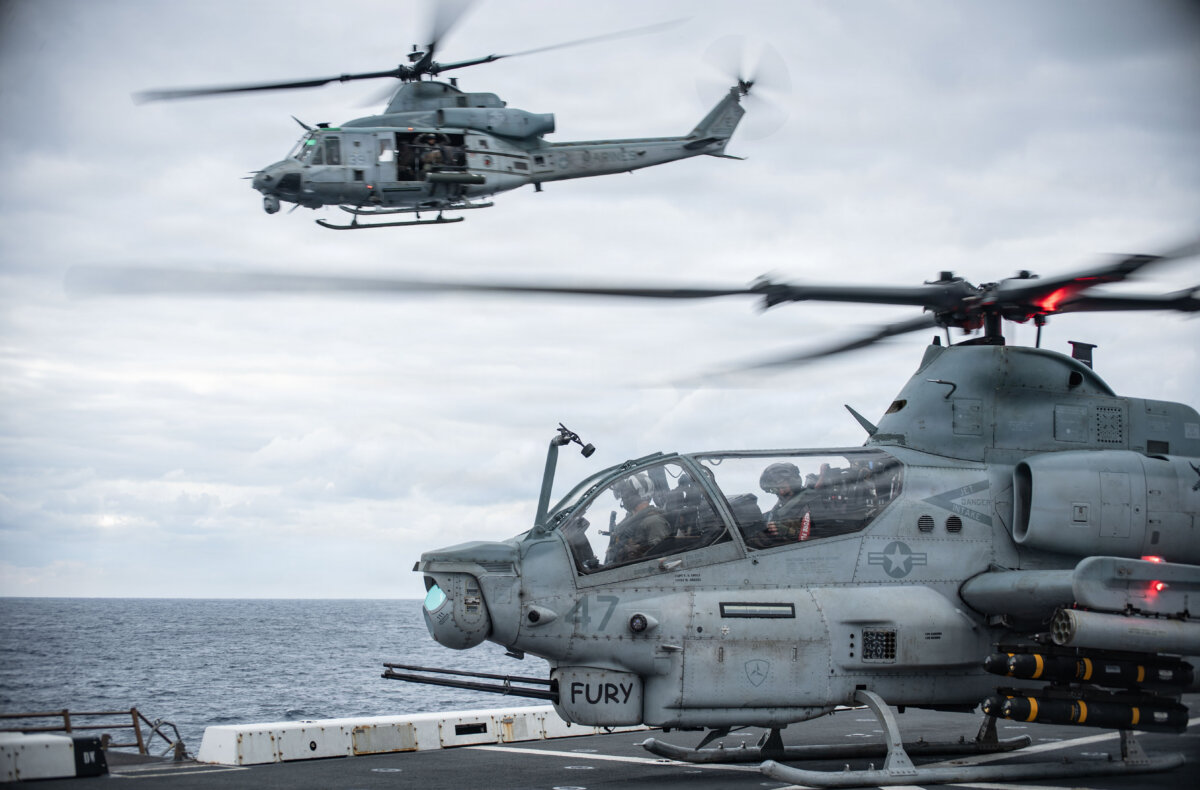
The three ships supporting the 31st MEU are also capable of launching a variety of attack and troop transport helicopters, as well as amphibious landing craft.
Last month, Marines from the 31st MEU conducted amphibious training in partnership with Japan’s Ground Self-Defense Force.
At the start of the U.S. military operations against Iran, between 40,000 and 50,000 U.S. forces were operating across the Middle East.
President Donald Trump had directed two U.S. carrier strike groups to the region and amassed numerous other strike and support assets.
The ongoing U.S. military operations against the Iranian regime have consisted largely of airstrikes and attacks from long-range weapons. Thus far, no U.S. ground troops have entered the fray, but the Trump administration has not ruled out such an option.
Following a closed-door intelligence briefing on March 10, Sen. Richard Blumenthal (D-Conn.) said, “We seem to be on a path toward deploying American troops on the ground in Iran.”
When asked about Blumenthal’s comments and the potential for U.S. ground troops becoming involved in the fighting, White House press secretary Karoline Leavitt said Trump “does not rule options out as commander in chief,” but cautioned against trusting “anything that a Democrat on Capitol Hill says right now about the president’s thinking.”
During a Pentagon press briefing on March 13, Secretary of War Pete Hegseth described Iranian forces as having been deeply crippled in the first two weeks of joint U.S. and Israeli strikes.
Hegseth said Iran has no air defenses, no air force, and no navy. He also said Iranian missile launches are down 90 percent from their height early on in the conflict, while launches from explosive-laden Iranian one-way attack drones are down 95 percent.
Despite these losses, Iranian forces have still managed to carry out several recent attacks.
Gen. Dan Caine, chairman of the Joint Chiefs of Staff, said Iranian forces had used surface-to-surface missiles to target shipping at the northern end of the Persian Gulf, near Kuwait.
Chase Smith contributed to this report.
 Friends Read Free
Copy
Facebook
Tweet
Friends Read Free
Copy
Facebook
Tweet