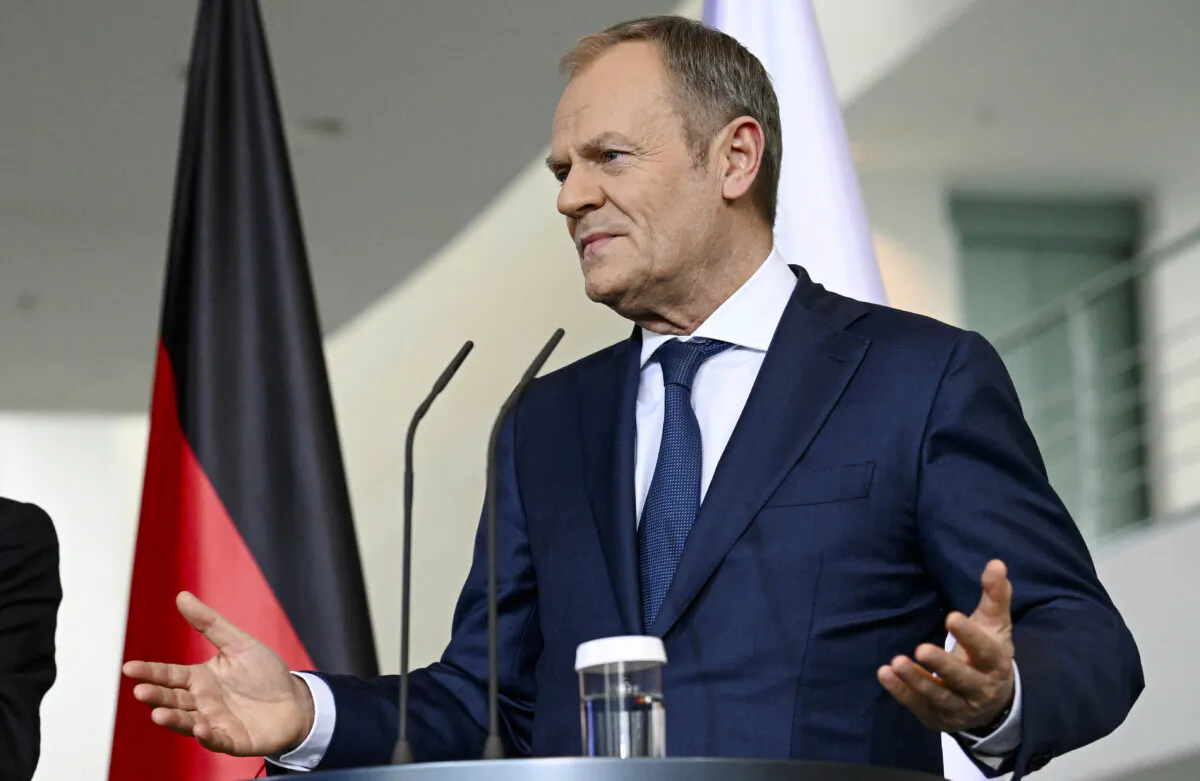
Poland will introduce controls along its German and Lithuanian borders on July 7, Prime Minister Donald Tusk said on July 1.
“We have decided to restore temporary border controls between Poland and Germany and Poland and Lithuania,” he said, according to Polish broadcaster TVP.
“I warned the Germans back in March; I talked about it several times with the new chancellor.
“I said that Poland’s patient position after Germany introduced unilateral controls is exhausted.”
Tusk’s government has come under fire from opposition parties, including from incoming Polish President Karol Nawrocki, for accepting illegal immigrants being sent back from Germany.
Regarding the Lithuanian border, Tusk said that the country’s border with Belarus is “not as tight as the Polish one.”
“The stream of illegal migration organized by Russia and Belarus goes through Belarus, Latvia, and Lithuania, with which Poland has an open border,” he said.
Poland has long accused Moscow and Minsk of trying to orchestrate a crisis in the country—and in the European Union more broadly—by facilitating illegal immigration across the bloc’s eastern flank.
The Polish prime minister has previously called for Berlin to do more to help secure the EU’s external border.
Separately, outgoing Polish President Andrzej Duda also lambasted Germany for its approach to migrants.
“We cannot allow the law to be broken, for migrants to be brutally pushed into our country,” he said, noting that it was a problem for the government in Berlin, media outlet Onet Wiadomosci reported.
Poland’s move means that it has joined several other EU states, including Belgium, the Netherlands, and Germany, which have brought in border controls despite being members of the passport-free Schengen travel zone.
Back in February, Berlin announced that it was extending its temporary border controls for six months.
German Chancellor Friedrich Merz said on July 1 that the country wants to preserve the Schengen system, which allows passport-free movement, but this could only work if it were not abused by criminals who smuggle migrants.
“We know that the Polish government also wants to impose border controls with Lithuania in order to limit illegal border crossings from Lithuania to Poland,” Merz said at a press conference.
“So, we have a common problem here that we want to solve together.”
According to the EU, the Schengen area “guarantees free movement to more than 450 million EU citizens,” as well as non-EU nationals living in the bloc or visiting as tourists, exchange students, or for business purposes.
It makes up 25 of the 27 EU member states, with Ireland and Cyprus being the only EU countries not in the zone, as well as four non-member states: Iceland, Norway, Switzerland, and Liechtenstein.
Lithuanian Foreign Minister Kestutis Budrys said on July 1 that Warsaw had informed him of the decision.
“Yesterday, I received a message from Polish Foreign Minister Radosław Sikorski that the Polish government intends to adopt a decision today to apply enhanced checks at the Lithuanian–Polish border, as well as at the Polish–German border,” he said.
Poland’s move to tighten its borders follows a new law enacted in March that suspends illegal immigrants’ rights to claim asylum.
That legislation introduced temporary restrictions of up to 60 days on the right to submit an application for international protection for those who have crossed the border into NATO and EU member states illegally.
In the recent Polish presidential election, held across two rounds in May and June, the candidate backed by Tusk, Warsaw Mayor Rafal Trzaskowski, lost out to conservative historian Karol Nawrocki, who espoused a much harder line on illegal immigration.
“I stand firmly behind the Polish uniform,” Nawrocki said of the situation at the border on July 1 in a clip posted to X.
“I know how hard the work is that they do, whether it’s border guards or Polish soldiers. But the current dramatic situations regarding illegal migrants were caused by the government of Prime Minister D. Tusk.”
 Friends Read Free
Copy
Facebook
Tweet
Friends Read Free
Copy
Facebook
Tweet