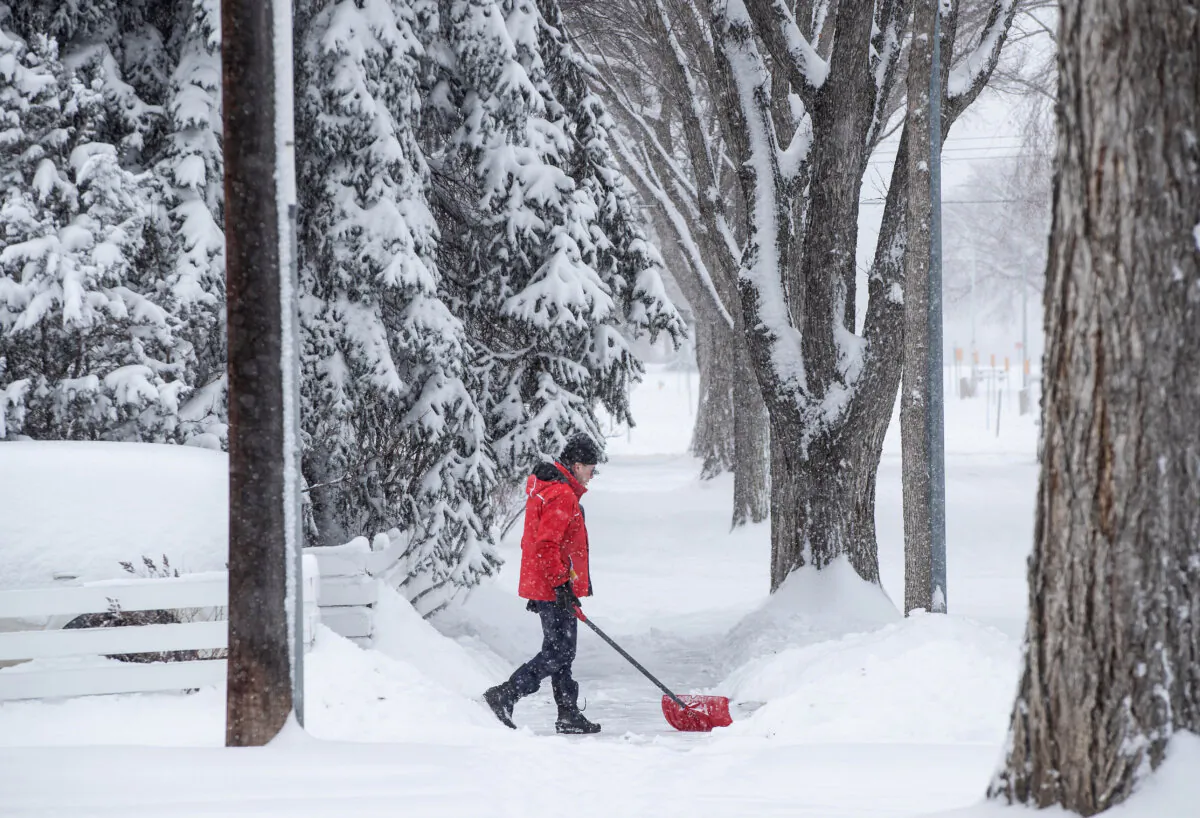

Police in Calgary are advising drivers to stay off the road as a winter storm blows through the prairie provinces, bringing blowing snow and reduced visibility.
Calgary police issued a warning around noon local time, saying there were many road closures in effect.
“Due to extreme winter storm conditions, police are advising motorists not to travel,” the police service said in a social media post.
Environment and Climate Change Canada (ECCC) issued a blowing snow advisory for the City of Calgary, saying there would be “near zero visibility,” particularly outside the city centre.
“Consider postponing non-essential travel until conditions improve. If driving, turn on your lights, slow down and maintain a safe following distance,” the ECCC said.
The agency said that conditions for Calgary were expected to improve in the evening.
Calgary International Airport said it temporarily suspended flights due to the heavy snow and reduced visibility, adding it expected to have at least one runway operating by late afternoon.
“Maintaining a safe operation is Calgary Airports’ top priority. In a winter storm we clear the runways, taxiways and aprons of snow and ice to ensure aircraft can land, take-off, and taxi safely,” spokesperson Mackenzie Murphy said in a statement provided to The Epoch Times.
Murphy recommended that travellers check with airlines to see if their flight is on time before the leave for the airport.
Snow Storm
Environment Canada said parts of Northern Alberta, including Edmonton, were expected to see up to 30 centimetres of snow on the morning of Dec. 17.
The agency says that snow fall will be heavy at times with “rapid accumulation” that could impact commutes. Heavy snow is expected to end in Edmonton later in the day.
Environment Canada also issued a blizzard warning for parts of Saskatchewan, saying the storm would bring “gusty winds and visibility frequently near zero” as parts of the province are expected to see up to 20 centimetres of snow with wind gusts between 70 kilometres and 90 kilometres per hour.
“A strong Alberta Clipper will bring heavy snow and strong, gusty winds leading to blizzard conditions over portions of southern Saskatchewan beginning Wednesday morning,” Environment Canada said.
The agency said parts of southern Saskatchewan could also see one to two millimetres of freezing rain, making roadways and walkways slippery. It said that travel during the storm will be “dangerous” and “likely impossible due to near-zero visibility,” adding that road closures were possible.
RCMP advised drivers to check the weather and road conditions before they leave, and consider delaying travelling if possible.
“If travel is necessary, stay on roads that have recently received road maintenance,” Mounties said, noting that current information on road conditions is available online here.
Environment Canada’s blizzard warning extends into southern Manitoba, where the Parkland region is expected to see snowfall starting in the afternoon and into the evening as the storm moves over southwestern Manitoba, the Interlake and Red River Valley.
Residents were advised to avoid travelling and being outdoors during the storm.
Cities Prepare
Edmonton said it was declaring a phase one parking ban for arterial roads, collector roads, bus routes, and roads within business improvement areas starting at 7 p.m. on Dec. 17, due to the expected snow.
The city said in a release the move was necessary to facilitate the clearing by plows and graders, and would be in effect for three to five days. Vehicles parked on roadways included in the ban could be fined up to $250.
The City of Regina says it has snow crews ready to respond “as soon as the snowfall starts.” The city said that during a storm its crews work around the clock, seven days a week, to keep roads clear.
The city also recommends drivers take some precautions if they are travelling during the storm, including slowing down, allowing extra time to travel, use headlights, avoid sudden braking, and keep a distance from vehicles in front of them. Drivers are also advised to be cautious around city snowplows, and stay at least three and a half metres behind plowing equipment.
The City of Saskatoon said it also would have snowplows and sanding trucks on the road during the storm to keep high-speed and arterial routes clear, but warned drivers to avoid non-essential travel.
“Even with treatments, some areas can be slippery in windy, snowy and very cold weather. If going out is essential, drivers should be aware of the potential for rapidly changing road conditions and adjust their driving accordingly,” the city said.
Drivers were advised to watch for blue and amber flashing lights on the roads and to give maintenance equipment space to operate safely.
Winnipeg said its snow crew was also monitoring road conditions and were ready to apply sand or salt to improve traction. The city said it would make snow clearing decisions based on how much snow falls.
 Friends Read Free
Copy
Facebook
Tweet
Friends Read Free
Copy
Facebook
Tweet