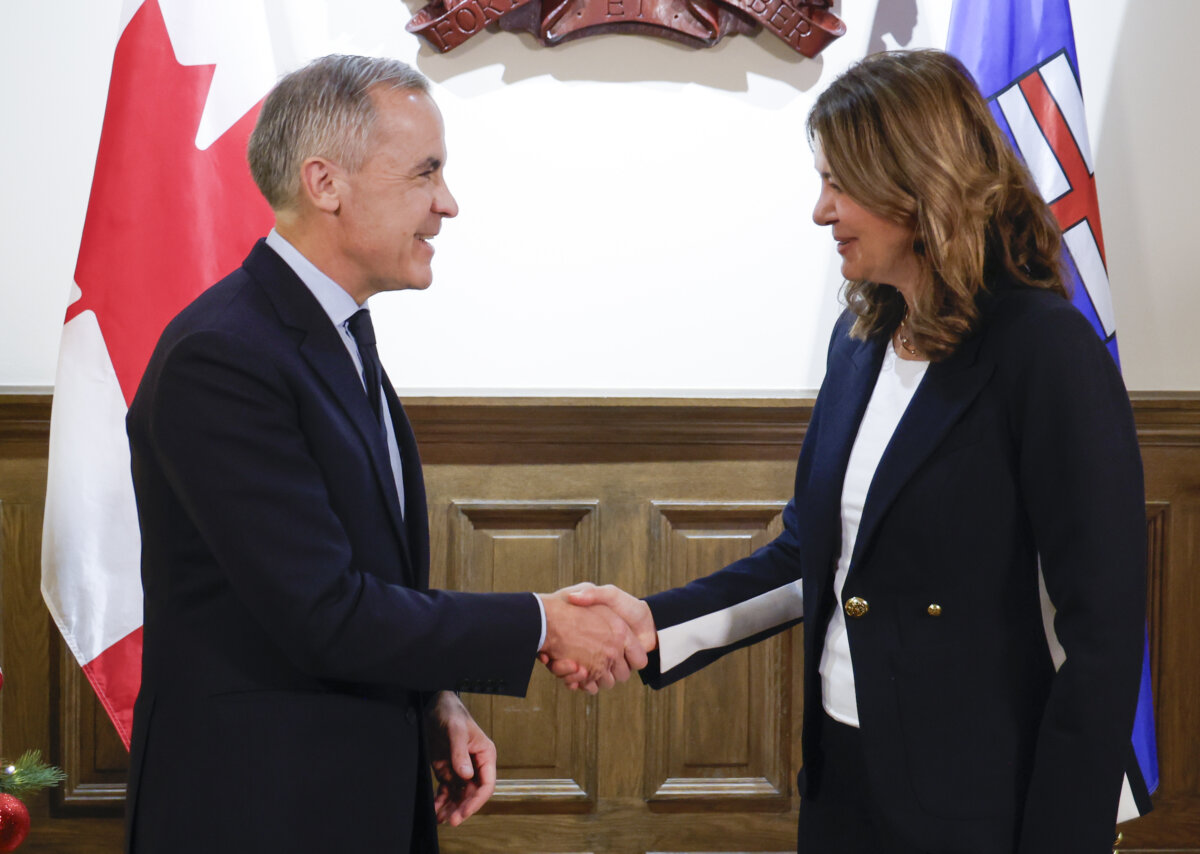

Prime Minister Mark Carney and Alberta Premier Danielle Smith have signed a sweeping agreement to pave the way for building a new pipeline to the West Coast and to remove some Trudeau-era energy policies in exchange for additional emission-reduction commitments from the province.
Carney told reporters on Nov. 27 in Calgary that the agreement would create “an energy transition,” with the core of the agreement being to prioritize the building of a pipeline to B.C. to ship oil to Asia. He said this would make Canada “stronger, more independent, more resilient, more sustainable.”
The memorandum of understanding (MOU) pairs the pipeline project to the proposed Pathways Alliance carbon capture project. The terms of the agreement also commit Ottawa to potentially adjusting the West Coast tanker ban if a pipeline project is approved as a project of national interest under the Building Canada Act.
The MOU also removes the oil and gas emissions cap introduced by the Trudeau government that Alberta had said in effect acts as a limit on production. It also suspends Alberta’s requirements under the Clean Electricity Regulations, objected to by the province due to its high dependence on gas generation for electricity. In exchange, the province has agreed to an increase of the industrial carbon tax and a commitment to reduce methane emissions from the oil patch by 75 percent from 2014 levels by 2035.
Carney said ultimately the pipeline’s construction will depend on a private proponent stepping forward, and it also needs to respect the interests of B.C. and First Nations. He added that the pipeline would be built in partnership with the indigenous peoples of Alberta and British Columbia, and would include “unprecedented opportunities for indigenous ownership” and associated economic benefits.
Smith said at the press conference that it was a “great day for Albertans” and that the agreement would “unleash an incredible amount of investment and allow us to work together on important nation-building projects.” She said the agreement will also remove the emissions cap on the oil sector.
“It’s the first step, I think, of what will be a few more steps we have to take together. But I’m very pleased that the prime minister has heard our concerns and responded to them,” she said.
Terms
The Prime Minister’s Office said that the federal government will give a “clear and efficient approval process” for the construction of a new pipeline, which would be constructed by the private sector with “Indigenous Peoples’ ownership and benefits.”
As a prerequisite for the pipeline, a $16.5 billion Pathways Alliance carbon-capture project to reduce emissions must also be constructed, which the PMO said would allow Alberta to export “some of the lowest carbon-intensity oil produced in the world.”
The MOU states that Canada will not implement its cap on oil and gas emissions, which the Liberal government had said in its latest budget may not be “required” due to emerging technologies such as carbon capture and storage. The Clean Electricity Regulations in Alberta will also be suspended pending a new carbon pricing agreement.
The MOU also requires Alberta to increase its industrial carbon pricing system to a minimum of $130 a tonne. Alberta froze its industrial carbon price at $95 per tonne through 2026 back in May, putting it out of sync with the federal government’s backstop price, set to increase to $110 per tonne in 2026 and $170 a tonne by 2030. Smith had said following a meeting with Carney in October that she was open to adjusting it.
The MOU will also require a 75 percent reduction in methane emissions over the next decade.
The MOU states that following consultations with B.C. and indigenous stakeholders, Alberta will present its pipeline plan to the Major Project’s Office (MPO) for expedited review by July 1, 2026. If approved, it says Ottawa may make an “appropriate adjustment” to the oil tanker moratorium “if necessary.”
The tanker ban, enacted in 2019, prohibits oil tankers carrying more than 12,500 metric tons of crude oil from docking or loading at ports on B.C.’s northern coast.
Earlier this year, the federal government passed the One Canadian Economy Act, which enables the government to streamline federal approval processes to have major projects built faster, with the aim of speeding up approval times from five years to a maximum of two years.
Carney announced the first five major projects being referred to the MPO for consideration in September. A pipeline was not included in the five projects, but the government outlined six projects that were “at an earlier stage and require further development,” which included the Pathways Plus carbon capture and storage project.
On Nov. 26, Carney responded to a question from reporters about caucus members that might be displeased with the building of a pipeline by saying the MOU was primarily about “building an economy.” He added that the caucus is “diverse” and was “very open and engaged in dialogue.”
A day earlier, Finance Minister François-Philippe Champagne said the pipeline would be the “nexus between economic security, energy security, and national security.” He added that Canada has “a lot of technologies” that can be used to develop its natural resources in a “sustainable” manner.
Reactions
A 2020 decision from the Supreme Court of Canada held that Ottawa has legal authority over oil shipments between provinces. However, Carney said in June that Ottawa wouldn’t “impose” any projects on provinces and consent from First Nations would be needed in order to build a pipeline to British Columbia.
Coastal First Nations President Marilyn Slett said this week that a pipeline to the province’s northern coast would “never happen.”
Slett, who represents eight First Nations in the province, said in a release that any MOU between Ottawa and Alberta cannot “override our inherent and constitutional rights and title.” She also said Ottawa had not been transparent about its negotiations with Alberta over the pipeline, and that “such conduct is not honourable and is fundamentally at odds with Canada’s constitutional, legislative and international obligations to coastal First Nations.”
Carney also previously said that Ottawa would not overrule a province’s opposition to pipeline construction. While B.C. Premier David Eby said back in June that Alberta’s desire for a pipeline was “many years off” and there was no proponent, he said on Nov. 21 that he was open to a potential proposal for a pipeline through the province. However, Eby said he does not support an end to the ban on oil tankers operating off B.C.’s northern coast.
Eby criticized Alberta for negotiating with Ottawa on the pipeline without involving B.C. “We are and have been engaging with Alberta on their concerns about being able to access global markets… but I’m a bit challenged by the approach they’re taking to our province right now,” Eby said.
Eby also said he told Carney during a phone call on Nov. 24 that it was “unacceptable” for Ottawa and Alberta to be negotiating a possible pipeline through his province without involving his government.
Conservative Leader Pierre Poilievre said in a statement the MOU does not promise that a pipeline will be built, but that “seven months from now, a pipeline proposal will be referred to a federal office for two further years of study.” He noted the prime minister will give the B.C. government the power to veto the pipeline, which he said “violates the Constitution.”
“We are happy to see that the Alberta Premier forced the prime minister to flip-flop on some of his other costly environmental policies that he supported until a few weeks ago. But the deal does not bring a new pipeline to the Pacific; it brings higher taxes, long delays and more dependence on the U.S.,” Poilievre said
The Tory leader called for Carney to “get out of the way,” get rid of the industrial carbon tax, and grant a permit for Alberta to build a pipeline.
 Friends Read Free
Copy
Facebook
Tweet
Friends Read Free
Copy
Facebook
Tweet