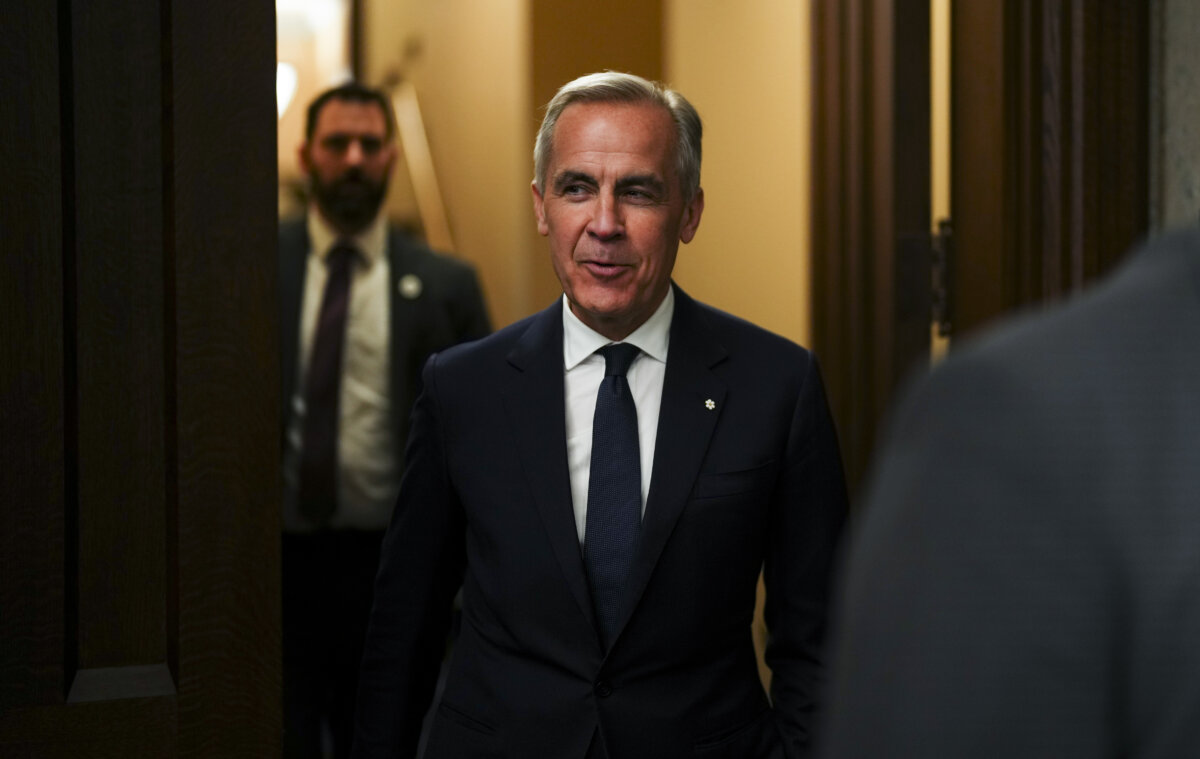

Prime Minister Mark Carney says Ottawa won’t overrule a province’s opposition to pipeline construction, as he will seek consensus from all relevant stakeholders before the project gets the green light.
Carney made the comment during a June 6 press conference, where he outlined his government’s plan to eliminate federal trade barriers and advance nation-building projects through the introduction of the One Canadian Economy Act, also known as Bill C-5.
Carney said the bill consists of two parts. The first will create “one Canadian economy out of 13” with the removal of “federal barriers to internal trade and labour mobility.” The second part supports the development of major projects that align with national interests, contingent on discussions with provinces, territories, and indigenous peoples.
Asked by a reporter if he would impose a pipeline project that has been identified as being in the national interest but for which a province objects, Carney said, “No.”
“Simply no. We must have a consensus of all the provinces and the indigenous people … If a province doesn’t want it, it’s impossible. It’s not the choice of the federal government,” he said in French.
Carney’s remark echoed comments he made in an interview last month, in which he said he would support pipeline development only if there is a “consensus” for their construction. The prime minister subsequently met with provincial and territorial premiers on June 2 to discuss infrastructure and energy project priorities, although the meeting concluded without any specific project commitments.
Jason Kenney, former premier of Alberta, said he was “astonished” that Carney “contradicted” the Constitution Act, by “handing provinces a veto over interprovincial pipelines (at least rhetorically.)”
In his June 6 social media post, Kenney argued that interprovincial pipelines fall under federal regulatory authority. He pointed to Section 92(10)(c), which grants the federal government jurisdiction over such works when declared to be “for the general Advantage of Canada or for the Advantage of Two or more of the Provinces.”
Pipeline Stances
Building pipelines has been a top priority for Alberta Premier Danielle Smith, who has long advocated for a coast-to-coast pipeline network to carry Canadian natural gas and oil to markets outside the United States.
A day before the first ministers meeting on June 2, Smith met with Carney to reiterate her province’s demands that Ottawa repeal policies such as the Impact Assessment Act (also known as Bill C-69) and lift the “tanker ban” (Bill C-48) from the B.C. coast.
The Impact Assessment Act, which the Alberta government refers to as the “no new pipelines act,” enables the federal government to conduct environmental assessments on resource and infrastructure projects, including pipelines and mine development.
Following the first ministers meeting, Smith told reporters she had pushed Ottawa to support a pipeline running from northwest B.C. to the port of Churchill, Man.
Smith’s plan, however, doesn’t resonate with B.C. Premier David Eby, who signalled recently a lack of interest in a pipeline extending from Alberta to the northern coast of his province.
“It’s not my job to come in and tell Premier Smith that her vision for a north coast pipeline is many, many years off and there’s no proponent,” Eby told reporters in Osaka, Japan, during a trade mission to East Asia on June 3.
Eby, who did not attend the first ministers meeting due to the Japan trip, said his province already has a “massive taxpayer-owned pipeline”—a reference to the Trans Mountain pipeline, which carries crude and refined products from Edmonton to the B.C. coast. That pipeline was purchased by the federal government from Kinder Morgan in 2018 after the company abandoned the project, citing opposition in British Columbia. Eby said there needs to be discussions “about maximizing value from that pipeline.”
Quebec has long opposed the idea of a cross-country pipeline running through its land, though in a May interview, Premier François Legault said there is growing openness among Quebecers to such projects, driven by trade tensions with the United States and tariffs imposed by U.S. President Donald Trump on Canadian goods.
Legault remained noncommittal during the first ministers meeting. He told reporters after the meeting that his government needed to evaluate the economic and environmental impact before agreeing to having a pipeline through his province.
“What I say is that if there’s a project going through Quebec, we’ll study it. That’s all,” he said on June 2.
Jennifer Cowan and Matthew Horwood contributed to this report.
 Friends Read Free
Copy
Facebook
Tweet
Friends Read Free
Copy
Facebook
Tweet