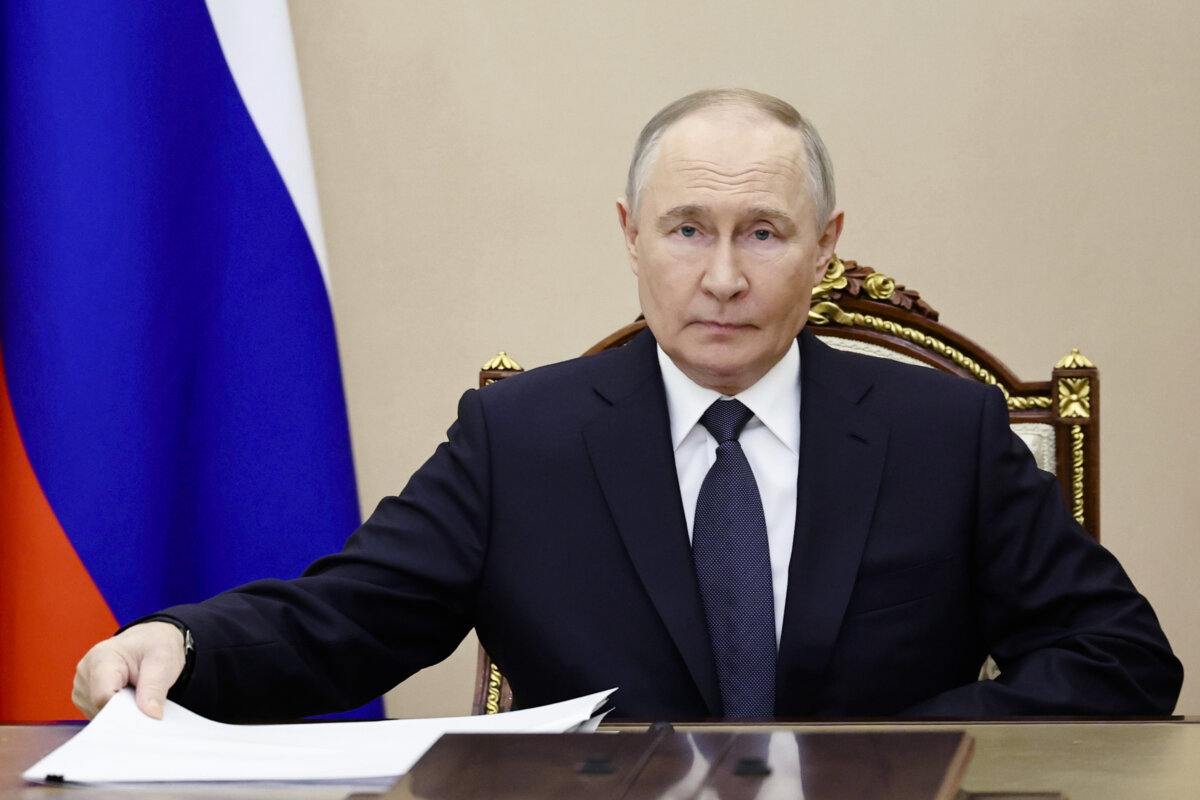
Russian President Vladimir Putin will not attend the upcoming BRICS summit in Brazil in person due to the International Criminal Court’s (ICC’s) arrest warrant against him, a senior Kremlin official said.
“The President will participate in the main events of this summit via video link. This is due to certain difficulties, in the context of the ICC requirements,” Yuri Ushakov, a top foreign policy aide to Putin, said on June 25. “The Brazilian government was unable to take a clear position that would allow our president to take part in this meeting.”
Ushakov noted that Russian Foreign Minister Sergei Lavrov will represent Russia on the ground at the summit, which is scheduled for July 6–7 in Rio de Janeiro.
Putin, a strong proponent of the BRICS bloc—comprising Brazil, Russia, India, China, and South Africa—has championed the alliance as a counterweight to Western-led institutions. His absence underscores the legal and diplomatic challenges posed by the ICC warrant, which was issued in March 2023 on charges of war crimes related to the deportation of children from Russian-occupied areas of Ukraine to the Russian Federation.
The warrant marked the first time the ICC had targeted a sitting head of state from a permanent member of the U.N. Security Council. Although the court has no enforcement arm, its 124 member states—including Brazil—are obligated to arrest individuals under warrant if they enter their jurisdiction.
Some ICC signatories have declined to enforce the warrant. Ahead of Putin’s international visit to Mongolia in September 2024, Russian officials expressed confidence that local authorities would not act on the ICC order, citing advance diplomatic arrangements.
Meanwhile, Dmitry Medvedev, deputy head of Russia’s Security Council and former president, has dismissed the ICC’s warrant as “illegal,” saying in a social media post that only a “madman” would attempt to enforce it.
In 2024, Putin was set to take part in the G20 summit in Brazil after Brazilian President Luiz Inacio Lula da Silva assured that “there’s no way that [Putin] will be arrested” if he attends. However, the Russian leader canceled those plans after da Silva backtracked on his pledge by saying it would be up to the courts to decide whether to carry out the arrest.
Ukrainian officials, meanwhile, have applauded the ICC’s action and criticized countries that fail to uphold the warrant. Ukrainian Foreign Ministry spokesman Heorhii Tykhyi called such refusals a “heavy blow to the International Criminal Court and the international criminal justice system.”
Roughly 120 countries have signed the ICC’s founding treaty since its creation over two decades ago, but several countries—including the United States, Russia, China, India, and Israel—have not ratified the statute and do not recognize the court’s jurisdiction.
The ICC also came under scrutiny last year after issuing arrest warrants for Israeli Prime Minister Benjamin Netanyahu, then-Israeli Defense Minister Yoav Gallant, and top leaders of the Hamas terror group.
The decision to target Netanyahu and Gallant drew strong criticism from U.S. officials, with the House of Representatives passing a bill seeking to sanction the ICC over the arrest warrant.
 Friends Read Free
Copy
Facebook
Tweet
Friends Read Free
Copy
Facebook
Tweet