The Quebec election campaign is entering the home stretch, with advance voting beginning earlier this week and election day set for Oct. 5.
Throughout the campaign, the Parti Québécois (PQ) has maintained its lead in the polls, while latest polling shows the governing Coalition Avenir Québec (CAQ) slipping further below other opposition parties, though no one can predict the outcome until voters cast their ballots as the real test.
The campaign has seen allegations of foreign and domestic interference, strong rebuttals to these charges, the incumbent campaigning on response to the Trump administration similar to other incumbent campaigns in recent elections in Canada, and various parties putting issues such as affordability and immigration at the top of their campaigns.
The Trump Factor
CAQ Leader Christine Fréchette has made the Canada–U.S. trade conflict a centrepiece of her election campaign, stating at one point that U.S. President Donald Trump is her “main opponent.”
Fréchette, who took over as premier from François Legault in April, has presented herself as having the executive experience to deal with the trade dispute, even taking a break from her campaign Sept. 7 to chair a cabinet meeting with her government on Canadian counter-tariffs.
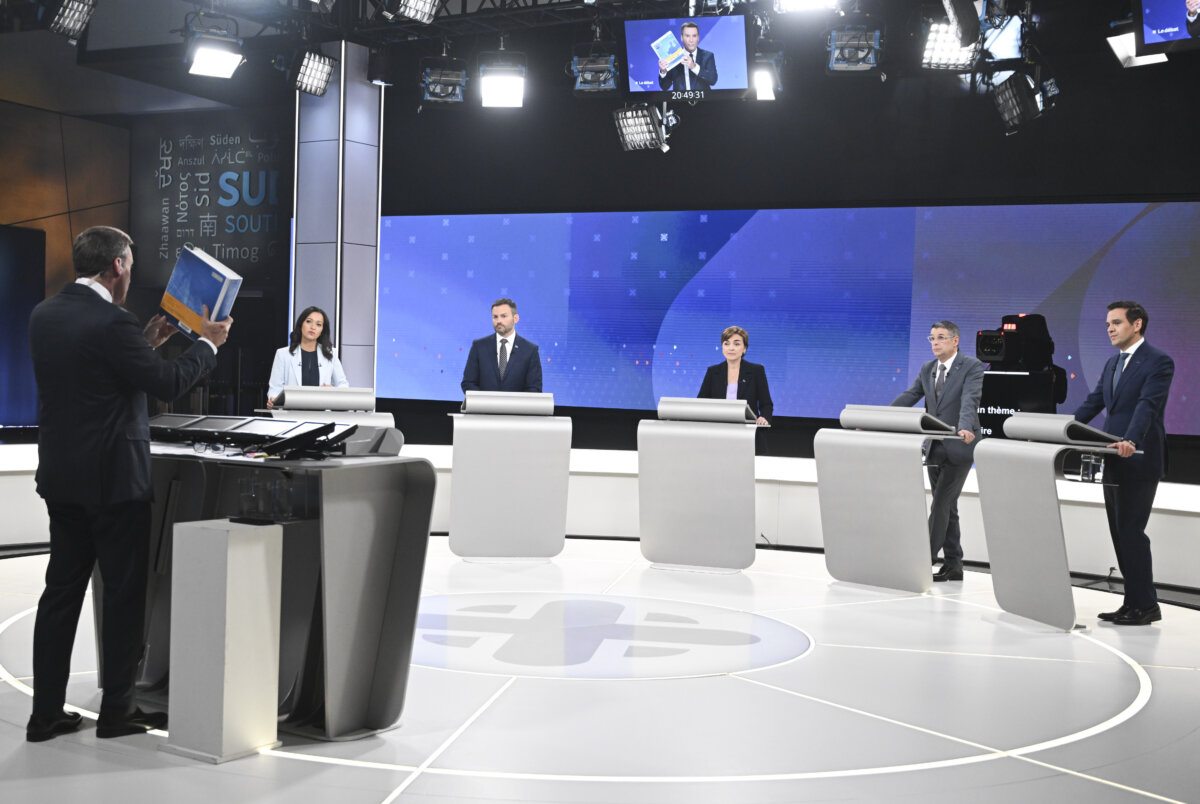
Opposition parties have at the same time criticized her government on that file, with Quebec Conservative Leader Éric Duhaime saying the government hadn’t prepared well ahead of time to be in a better position.
“It’s been two years since Mr. Trump was elected. You waited until the crisis broke out even though you saw it coming,” Duhaime said in French during the final leaders’ debate Sept. 23 in Montreal.
A Leger survey conducted Sept. 25 to 27 put the CAQ at 16 percent support at fourth place among decided voters, down four points from one week prior.
The same poll placed the PQ at the top at 30 percent, followed by the Quebec Liberals at 26 percent, the Quebec Conservatives at 18 percent, and Québec solidaire at 9 percent.
Quebec Independence
Trump has also been key in the separatist PQ campaign, which has promised to hold a referendum on Quebec separating from Canada within its first term.
However, PQ Leader Paul St-Pierre Plamondon has promised to hold off on the referendum while Trump is still president.
Liberal Leader Charles Milliard asked St-Pierre Plamondon during the Sept. 23 leaders’ debate whether this position represented an admission that having a referendum while Canada negotiates with the Trump administration would run counter to Quebec’s interests.
“It’s proof that we are living a very unusual moment with the Americans that is unacceptable on the part of the Trump administration,” St-Pierre Plamondon answered.
Milliard has presented the Liberals as the top choice for federalists, criticizing both Fréchette and Duhaime for voting “yes” in the 1995 referendum on Quebec sovereignty, as well as the pro-independence platform of Québec solidaire. Both Fréchette and Duhaime have indicated they oppose holding a separation referendum.
Interference Claims
The Quebec election campaign has also seen allegations of domestic and foreign interference.
Fréchette said she contacted the Canadian Security Intelligence Service (CSIS) and requested information from Ottawa in the wake of research by the U.S.-based Defense Analyses and Research Corporation published in February suggesting that U.S. support for Quebec independence could be used as a way to weaken Canada.
“I want help from the federal government to shed light on the issue,” she told media on Sept. 25.
Foreign Affairs Minister Anita Anand said she had seen no evidence of American interference, telling media Sept. 25 that “right now I do not have proof.”
Fréchette’s office later the same day stated that it also had received no confirmation of U.S. interference in the election.
St-Pierre Plamondon has questioned the lack of proof brought forward in the allegations by Fréchette as well as the timing of her concerns.
“There was an obligation to act promptly if there is a genuine risk; it was not done by the CAQ,” he said Sept. 25. “If there is no risk and that’s why they didn’t do anything, why are they sending out this information two days before voting?” he added, referring to advance polls that were open in Quebec Sept. 27 to 28.
On Sept. 27, Fréchette said she didn’t realize members of her team had approached journalists about the think tank’s research without letting her know, and said they “should have informed me earlier.”
Earlier in the campaign, St-Pierre Plamondon had made his own accusation of domestic political interference in Quebec’s election, stating that Ottawa was making announcements and issuing releases on Canada–U.S. trade that constituted possible election interference.
“If we add several facts together, several events together, I think we should be concerned about the possibility that we are facing the greatest federal interference in our affairs and our election since 1995,” he said on Sept. 4.
The PQ leader also had said previously that his party may be under surveillance by the federal government, stating it was “very possible” in May this year without providing proof.
Ottawa has denied the accusation and said agencies operate at arm’s length.
“The federal government cannot under any circumstances give such a directive to the RCMP and CSIS. These agencies operate independently,” the office of then-Public Safety Minister Gary Anandasangaree told The Canadian Press on May 13.
Key Election Issues
The election has also seen parties focus on issues related to health care, immigration, affordability, housing, and government spending.
During the Sept. 23 leaders’ debate, the incumbent Fréchette fielded criticism for emergency room wait times and lack of enough family doctors.
Fréchette said that while more progress needs to be made, there has been an improvement in the number of surgeries done in Quebec and an increase in provincial residents who have found family doctors.
Fréchette and Duhaime have backed increased use of private providers in the province, which currently allows private delivery of some publicly insured health services, while the PQ and Québec solidaire say that growing private health-care options in the province could drain resources and personnel from the publicly funded system.
Milliard has said he stands in the middle and described the private sector as “a tool, not an ideology.”
Immigration has also come up as a matter of contention in the election.
The PQ is proposing reducing temporary immigration to between 250,000 and 300,000 non-permanent residents in Quebec over four years as well as establishing a permanent immigration cap of roughly 35,000 people per year.
Duhaime has also said Quebec should lower immigration, stating that Quebec takes in a disproportionate number of asylum-seekers in Canada relative to its population, while Fréchette has said the federal government should give Quebec more authority over the number of temporary immigrants the province takes in and what provinces asylum-seekers go to.
Québec solidaire is proposing 70,000 permanent immigrants annually, while the Liberals have said their eventual level would fall between 45,000 and 70,000.
Affordability and homelessness have also come up as key campaign issues, particularly in the wake of the discovery of a baby and the baby’s mother living at a homeless camp in Montreal in mid-September.
Final Stretch
As the campaign enters its final days, Fréchette has emphasized that her leadership is distinct from that of the CAQ government of former Premier Legault in the eight years before she took over.
Legault’s government experienced several controversies, including delays and major cost overruns in the SAAQclic online vehicle-registration and driver-licensing platform, large government subsidies to the ultimately unsuccessful Northvolt electric vehicle battery plant, and a Health Quebec IT project whose estimated overall cost was later projected at about $1 billion, compared with an earlier $96 million project estimate.
“I am not François Legault. I am Christine Fréchette, and I come with my own way of doing things,” Fréchette said at the first leaders’ debate Sept. 15.
St-Pierre Plamondon said the government “can’t waste money like it’s Monopoly money.” Duhaime has vowed to cut government bureaucracy and use provincial savings to reduce taxes. Milliard has also accused CAQ of fiscal mismanagement but said now is not the time to cut personal income tax rates.
Meanwhile, Québec solidaire has said there should be a new tax on net wealth above $25 million to help finance public services. The party says the measure would raise about $5 billion annually.
According to Elections Quebec’s preliminary voter turnout data based on voter count at each polling station, across all electoral districts 24.56 percent of voters have cast a ballot, with election day set for Oct. 5.
 Friends Read Free
Copy
Facebook
Tweet
Friends Read Free
Copy
Facebook
Tweet