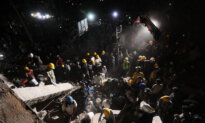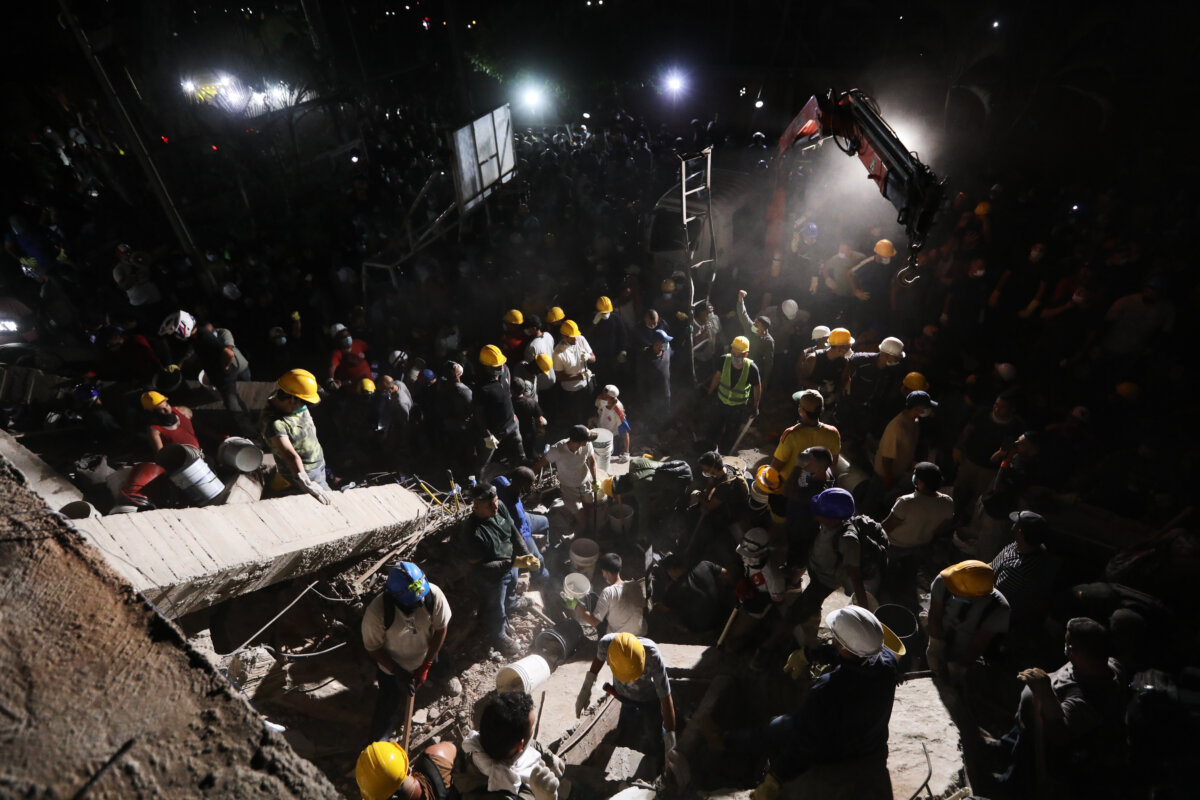
Rescuers are trying to find survivors amid the debris of buildings that collapsed during an Aug. 10 earthquake in Colombia, which has killed at least 179 people.
At least 3,000 people are missing, with many believed to be trapped under rubble.
The mayors of the cities of Cali, Pereira, and Manizales and the governor of Choco province said on Aug. 11 that at least 179 people had been killed in those regions, which were close to the epicenter.
The 7.4 magnitude earthquake struck the coffee-growing regions of western Colombia on Monday morning, and the death toll rose from an initial 74 to 111, and then to 164, with more bodies expected to be found.
It comes a month after twin earthquakes in neighboring Venezuela, where the death toll has now risen above 6,000.
Emergency teams, including soldiers, police officers, and volunteers, worked through the night with excavators, shovels, and sometimes just bare hands.
As the sun rose on Aug. 11, they began digging through around 1,600 multistory buildings and homes that had been wrecked by the quake.
The worst-affected cities were Pereira and nearby Cali, while a cathedral in Manizales was badly damaged.
Mayor Mauricio Salazar of Pereira said the quake had been a tragedy for the whole city.
“But here we are, and we will continue forward with the hand of God,” Salazar said.
The U.S. State Department said on X on Aug. 10 that it would provide $15.5 million in emergency shelter, food, and other aid to Colombia. Several governments in Latin America also offered support.
“We are united in prayer with the Colombian people and stand ready to support President de la Espriella and his government as they assess the needs on the ground,” it said.
Colombian President Abelardo de la Espriella, who was inaugurated last week, said 188 were missing in Cali alone.
He said 1,000 members of the security forces had been deployed to Cali, amid reports of looting. Curfews were implemented in both Cali and Pereira.
New President Offers ‘Solidarity’
“Here, there are no distinctions or ideological divisions when it comes to defending our people or showing solidarity,” de la Espriella told reporters on Monday evening.
He visited the capital of Choco, Quibdo, on Monday night and announced the full deployment of “the entire military and police apparatus.”
“Choco will never again be the ‘land of the forgotten,’” de la Espriella said.
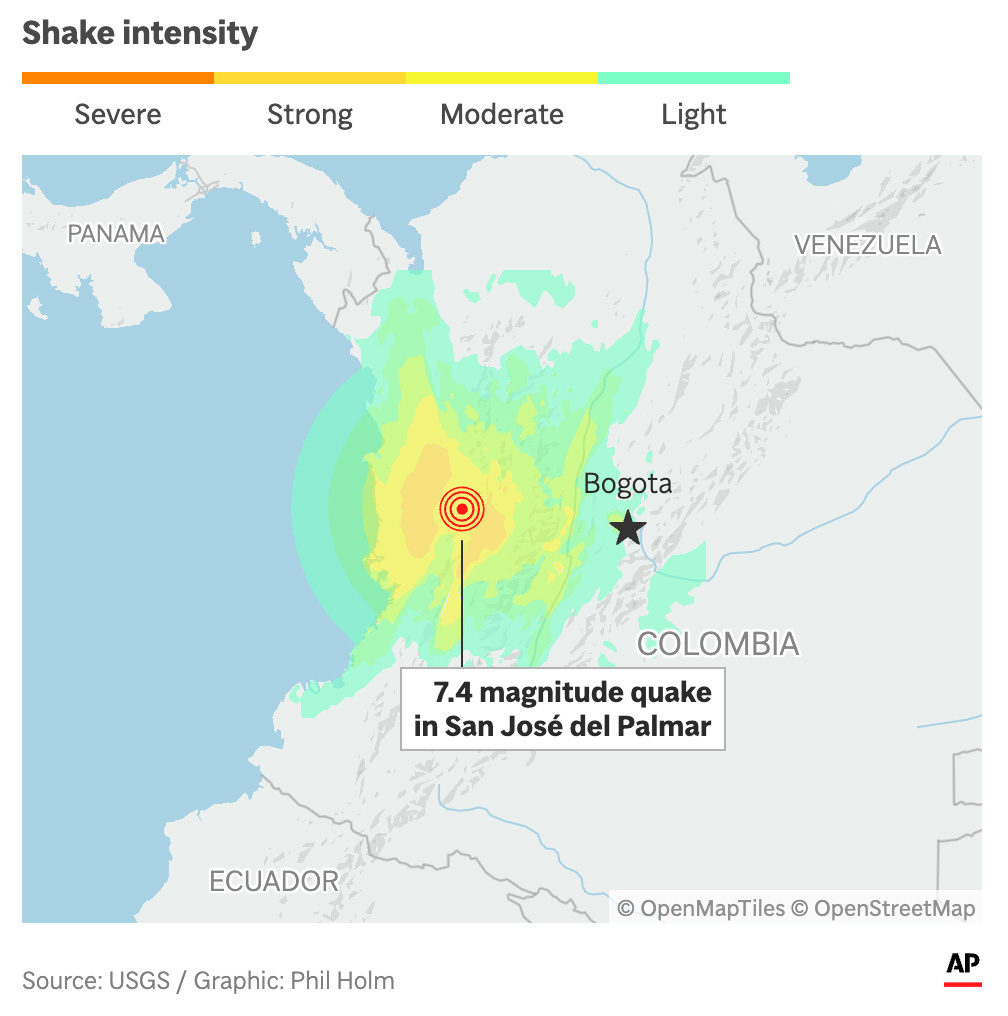 A map shows the epicenter and intensity from a 7.4-magnitude earthquake in western Colombia on Aug. 10, 2026. (AP)
De La Espriella, a 47-year-old lawyer and entrepreneur, is a conservative who was endorsed by U.S. President Donald Trump.
De La Espriella defeated Sen. Iván Cepeda of the ruling left-wing coalition in an election in June.
U.S. Attorney General Todd Blanche represented the United States at de la Espriella’s inauguration on Aug. 7, and the State Department issued a statement on the day offering financial support for his new administration.
“As a cornerstone of this renewed partnership, the United States, working with Congress, intends to announce $1 billion in assistance as part of a security package to support President de la Espriella’s Administration in achieving our shared goals,” the statement said.
Dozens of buildings have been damaged or made insecure in Cali, a city of 2.2 million people, and thousands of residents spent the night on the street.
One of the volunteers, Carmen Yasmin Garcia, told Reuters on the afternoon of Aug. 10 that her group had freed seven people from a collapsed building in Cali, but said four others were still trapped, along with a dog that could be heard barking.
“A moment ago there was scratching but now we can’t hear anything, we still have faith that the dog is alive and we can get these people out,” Garcia said.
“We need people with sticks and spades, the more people lending a hand the better.”
At least 85 people have been reported killed in Cali, and several floors of the city’s hospitals have collapsed, killing some patients and trapping others.
Hospital director Irne Torres Castro told Caracol television that around 600 patients had been evacuated onto the street.
The authorities have reported 66 dead in Pereira, and another 13 people dead in Choco, the province closest to the quake’s epicenter, which is west of the Colombian capital Bogota.
Jens Laerke, a spokesman for the United Nations’ humanitarian office, told a press conference in Geneva that more than 5,000 homes and 24 health facilities had been damaged.
Tarik Jasarevic, a spokesman for the World Health Organization (WHO), also warned of the consequences of the quake.
‘Operational Challenges’
“Damage to water systems has also affected health facilities, creating additional operational challenges,” Jasarevic said. “Now, public health concerns that we have is really first to ensure continuity of essential health services.”
Viviana Dionisio, an expert with Colombia’s National Seismological Network, told the MercoPress news agency the Aug. 10 event was a “tectonic earthquake associated mainly with a subduction mechanism.”
The Nazca tectonic plate, which lies beneath the Pacific Ocean, occasionally slides beneath the South American plate, on which Colombia sits.
Dionisio said it was unrelated to last month’s Venezuelan earthquake, which involved interaction between the South American and Caribbean plates.
Reuters contributed to this report.
 Friends Read Free
Copy
Facebook
Tweet
Friends Read Free
Copy
Facebook
Tweet