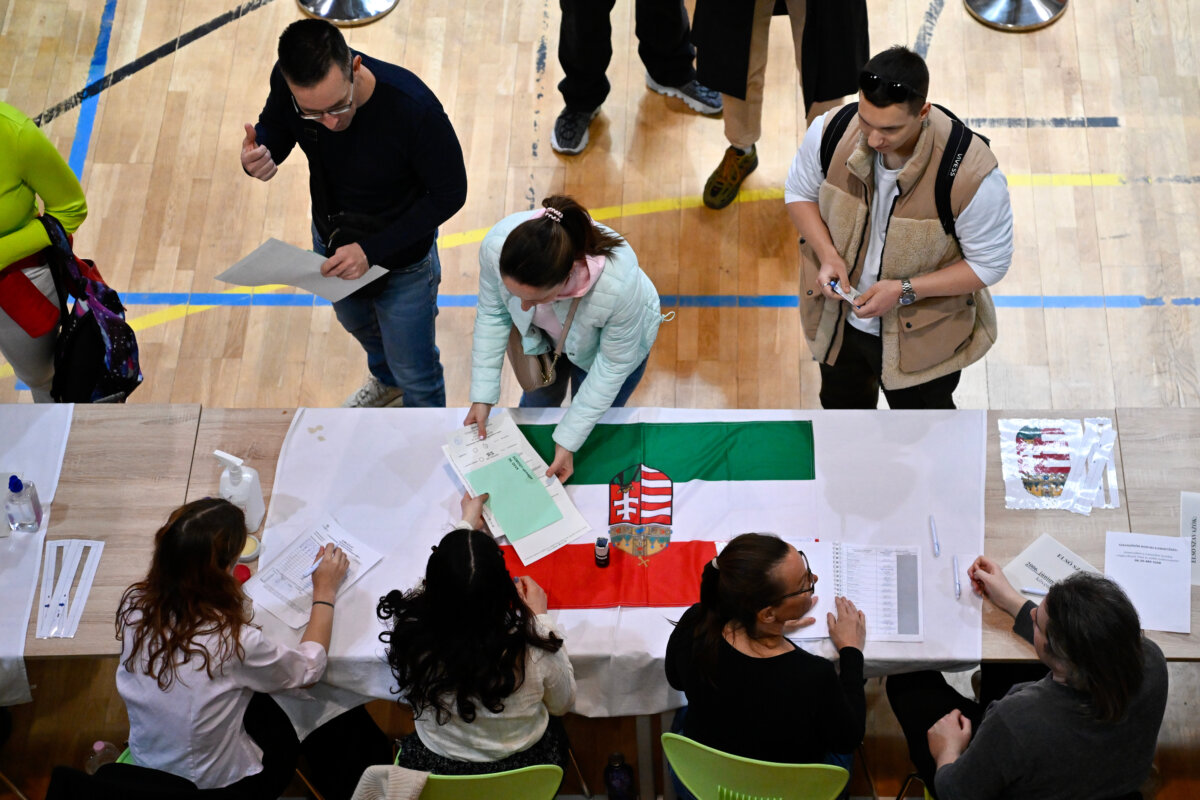

BUDAPEST—Hungary’s April 12 parliamentary elections, which ended 16 years of Viktor Orban’s rule, were monitored by two international observation missions operating from different perspectives.
The Organization for Security and Cooperation in Europe (OSCE) deployed 389 observers from 47 countries.
The Liberty Coalition for a Free and Fair Election (LCFFE), a rival observation effort, drew 86 observers from 15 countries across four continents.
Both missions reported that election-day procedures were broadly followed. On most other questions, they reached different conclusions.
In its report, the OSCE stated that “there was no level playing field, with the ruling party benefitting from systemic advantages that blurred the line between state and party.”
The LCFFE, while discussing some of the same domestic imbalances, incorporated a transnational dimension in its findings, treating EU institutional action and digital platform governance as factors relevant to electoral fairness.
Foreign Interference
The LCFFE devotes a full chapter to foreign interference in the electoral process.
The LCFFE notes that both sides received foreign backing. Orban and his Fidesz Party drew support from Italian Prime Minister Giorgia Meloni, French opposition leader Marine Le Pen, and U.S. President Donald Trump and Vice President JD Vance.
Tisza Party leader Péter Magyar “benefited from public expressions of political alignment” with German Chancellor Friedrich Merz and Polish Prime Minister Donald Tusk.
But the report draws a distinction: “The most tangible and institutionalized pressure has come from representatives of the European Union.” This pressure, it argues, is “categorically different from the various endorsements of, or meetings with, candidates” and “appears to violate specific norms of EU treaty law and customary international law.”
The report cites the European Commission’s activation of its Rapid Response System under the Digital Services Act on March 16, in a country where 65 percent of citizens rely on digital media for news, two opinions of the Advocate General of the Court of Justice of the EU published nine days before the campaign officially began, institutional criticism by EU officials, and the continued withholding of billions of EU funds.
“While such mechanisms are often framed as supporting democratic values, they have also raised concerns about whether they function, in practice, as tools of political pressure,” the report notes.
The LCFFE also points to “possible foreign intelligence service involvement in domestic politics, including the dissemination of recorded communications of government officials through politically engaged actors posing as investigative journalists,” and to grants from the European Commission, and other foreign actors to “NGOs, political activists, and media entities that often align politically with the funders but operate outside the formal campaign finance regime.”
On digital platforms, the LCFFE documents the reported removal of several pro-government pages from Facebook, the country’s most popular platform, and the downranking of posts by Fidesz, Orban, and government ministers before the election, facts communicated by “Facebook online notification.”
The report describes these actions as a potential “in-kind campaign contribution constituting a circumvention of the prohibition on foreign financing of election campaigns.”
Co-chair Jerzy Kwasniewski, in his pre-election interview with The Epoch Times, characterized Hungary as “a testing ground” for these instruments, whose “flaggers and fact-checkers appointed by the European Commission are openly aligned with one side of the political divide.” The methods, he said, had been “trialed in Poland in 2023, refined in Romania, and now implemented here with additional tools.”
“The level of international pressure on this election is unprecedented,” he said.
OSCE Press Conference
The OSCE report characterizes government claims of EU interference as “unsubstantiated.”
At a press conference on April 13, senior OSCE delegation members delivered remarks on their findings and denounced “anti-EU propaganda.”
Sargis Khandanyan, the OSCE’s special coordinator and an Armenian member of parliament, accused Fidesz of using “divisive and inflammatory rhetoric” during its campaign for reelection.
Rupa Huq, the OSCE delegation’s head and a British Labor politician, took aim at Orban’s “scaremongering narrative.”
Pablo Hispan, a Spanish politician heading the Council of Europe’s Parliamentary Assembly delegation, cited “anti-Ukraine and anti-EU propaganda” as having “weakened the conditions for informed voter choice.” He also declared that “today is a great day for Europe,” describing the election as a response to “an extreme populist challenge to liberal democratic values.”
In its report, the OSCE attributes a positive regulatory role to the Digital Services Act, noting that “online campaigning is insufficiently regulated by domestic legislation, although the EU’s Digital Services Act does apply to online activity more broadly.”
It also faults the authorities for insufficient protection of the online space and a “lack of awareness-raising efforts to educate citizens about the risks of disinformation and manipulative content.”
It says that “Facebook accounts associated with the ruling party repeatedly managed to circumvent” Meta’s ban on political advertising. The report does not address accusations regarding downranking of government-affiliated content.
Campaign Resources
During the press conference, Eoghan Murphy, head of the OSCE’s Office for Democratic Institutions and Human Rights mission and an Irish politician, criticized “the lack of an explicit prohibition against the misuse of administrative resources for campaign purposes,” adding that “ruling party messaging was echoed in government information campaigns and by state bodies and by state-owned enterprises.”
The OSCE report also criticizes the removal of campaign spending limits in 2025 and the absence of interim reporting requirements, noting that these gaps “significantly weakened transparency and accountability” and favored the ruling party.
The LCFFE shares these transparency concerns but directs scrutiny toward the opposition.
Citing Tisza’s publicly available quarterly reports from 2025, the LCFFE calculates the average per-donor campaign contribution at over $700, a figure it considers inconsistent with the party’s stated reliance on small individual donations.
Tisza’s 2024 annual financial statement reported approximately HUF 818.9 million (roughly $2.5 million) in private donations “without providing a clear breakdown of the total amount attributable to above-threshold donors or a consolidated summary of donation distribution.”
The LCFFE concludes that “it is not possible to determine from the published statements the extent to which funding is derived from a broad base of small contributors or from more concentrated sources.”
The report also flags Magyar’s Facebook engagement, which it says exceeded the rates of leaders with far larger international followings, a pattern it describes as “statistically difficult, if not impossible, to explain without page promotion, boosted reach, or paid advertising,” given Hungary’s statutory ban on political advertising on social media.
“The relatively low international name recognition of Péter Magyar outside Hungary further complicates this analysis,” the report adds. Tisza did not respond to the LCFFE’s requests for a meeting to discuss these matters, according to the report.
More broadly, the LCFFE notes that “Hungarian law has long prohibited foreign financing of political parties,” but that “evolving mechanisms of influence, particularly through NGOs, media networks, digital platforms, and international institutions regulating free expression, have complicated the distinction between legal domestic political activity and illicit external engagement.”
International Media and Polling
The LCFFE also documents what it describes as one-sided coverage by major Western outlets in the weeks before the vote.
CNN, BBC, Politico Europe, and Deutsche Welle, according to the report, “displayed a marked departure from neutrality”: Orban was “consistently framed as an authoritarian leader facilitating Russian influence inside the EU,” while Magyar and Tisza “were presented as agents of democratic renewal.”
Terms such as “authoritarian,” “illiberal laboratory,” and “democratic backsliding” appeared in news reporting rather than opinion sections, the report notes; methodological controversies surrounding polls were rarely disclosed; and Fidesz support was attributed to media control and clientelism rather than voter preference.
Fox News provided the only major counter-narrative, though the LCFFE describes that coverage as having “uncritically amplified U.S. conservative endorsements of Orban.”
On polling, the report criticizes a double standard: “Institutes publishing results favorable to Fidesz are frequently described as pro-government or biased, whereas those publishing results favorable to Tisza are referred to as “independent.”
The LCFFE also documents what it describes as a sharp rise in hostility toward journalists during the campaign, “ranging from verbal abuse and intimidation to physical assaults and death threats,” directed primarily at “reporters and crews affiliated with government-leaning or perceived ‘neutral’ outlets.”
A journalist from the right-leaning weekly Mandiner was physically assaulted at a Tisza rally in 2025. Several television channels and news organizations were forced to hire private security for their crews, a measure the report calls “unprecedented in Hungary’s post-1989 democratic history.”
The OSCE report also references a “tense operating environment” for journalists, but focuses on independent media’s restricted access to government events. It does, however, note that “Tisza’s centralized communication during the campaign, channeled almost exclusively through the party leader, also hindered media scrutiny.”
In its report, the OSCE also notes that “campaign messages were rarely directed at women, and if so, focused on traditional family or social issues,” regrets the absence of a legislative gender quota, and flags “instances of highly derogatory rhetoric targeting Roma communities” as a matter of serious concern.
Beyond Hungary
Kwasniewski told The Epoch Times that documenting Hungary’s electoral environment mattered “not only for Hungary’s sake, but as a reference for other countries that may face the same pressures in the future.”
He accused the OSCE of selecting its participants “on a liberal basis, with conservatives excluded” and said his group helped provide balance. He added the Liberty Coalition stands ready to deploy observers wherever they are needed: “The market for international election observation has, until now, been dominated by a single ideological current. We are introducing an alternative which is rigorous, professional, and transparent.”
Carla Sands, chair of the Foreign Policy Initiative at the America First Policy Institute, also stressed the necessity of such an initiative to The Epoch Times: “Election interference has continued to spread across Europe and the United States, yet the established observation bodies have not sounded the alarm on any of it,” she noted.
Sands framed her participation in the LCFFE in terms of her experience with American elections. “I watched election interference unfold both domestically and from foreign actors” across the 2016, 2020, and 2024 cycles, she told The Epoch Times.
“I saw disinformation campaigns, the systematic censorship of conservative voices by the major technology companies, and ultimately the banning of a sitting president of the United States from Twitter, Facebook, Instagram, every major social media platform,” she said. “Seeing that happen there convinced me I had to come to Hungary.”
In her view, the problem is structural: a mission that excludes one side of the political debate from the outset “can only produce a one-sided report.” For Sands, the solution lies in genuine pluralism. “What is needed is not just geographic diversity, but ideological diversity,” she argued. “Without it, the credibility of these institutions becomes very difficult to defend.”
The Epoch Times has contacted the OSCE for comment.
 Friends Read Free
Copy
Facebook
Tweet
Friends Read Free
Copy
Facebook
Tweet