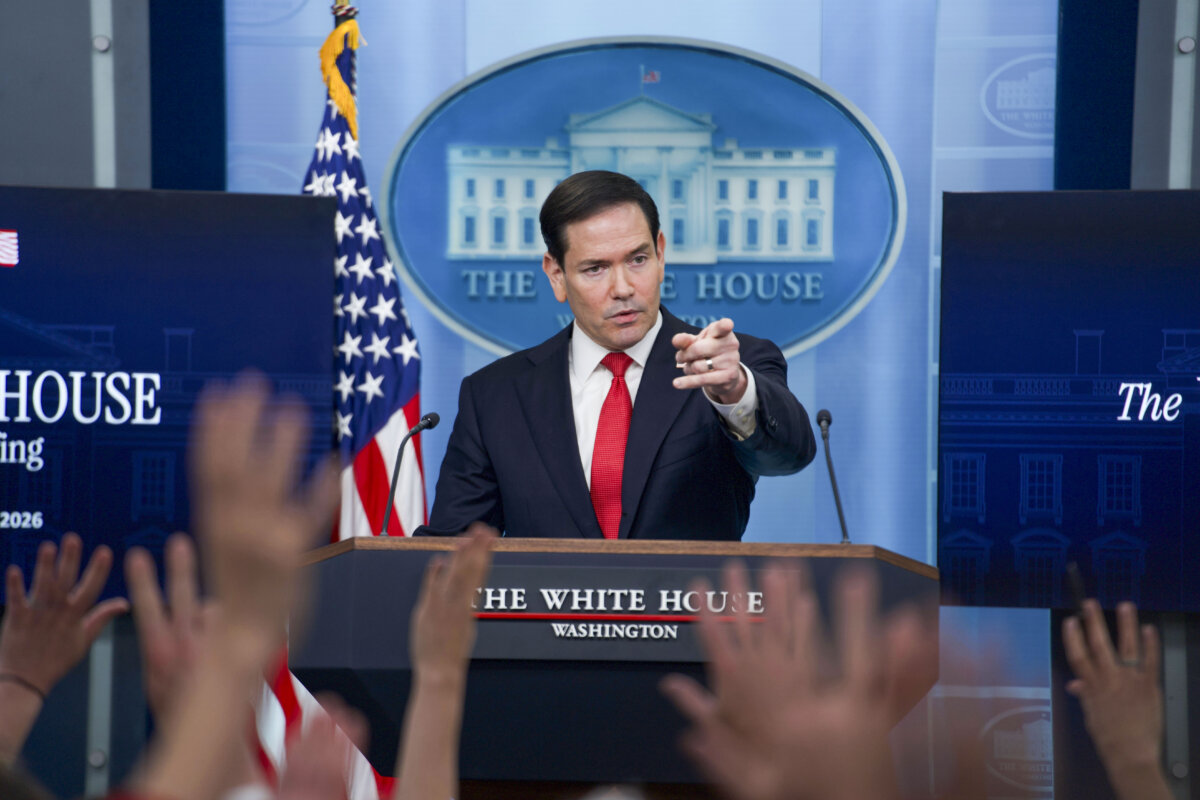
Secretary of State Marco Rubio has blamed the Cuban regime for the country’s ongoing crisis, while pushing back against claims that the United States imposed an oil blockade on the island nation.
Speaking to reporters at the White House on May 5, Rubio suggested that Cuba was no longer receiving oil from Venezuela because Caracas no longer wanted to provide the island nation with “free oil.”
“There’s no oil blockade on Cuba per se,” he said.
“Cuba used to get free oil from Venezuela—used to give them a bunch of free oil. They would take, like, 60 percent of that oil and resell it for cash. It wouldn’t even go to benefit the people.
“So the only blockade that happened is the Cubans have decided, I mean the Venezuelans have decided: ‘We’re not giving you free oil anymore.’ And you can only imagine nowadays the way oil prices are, no one’s giving away free oil, much less to a failed regime.”
Rubio also said the U.S. government sent $6 million in humanitarian aid to Cuba through the Church, as he alleged that the Cuban communist regime had blocked Washington from delivering the aid.
“We’d like to do more,” he said. “They won’t allow us to give their own people more humanitarian aid. And we’re willing to do it through the Church.”
In a post on X, Cuban Foreign Minister Bruno Rodríguez rejected Rubio’s claims, saying that U.S. Donald Trump’s executive order had prevented other countries from exporting oil to the island nation.
“After four months, only one fuel tanker has arrived in Cuba. All our suppliers are being intimidated and threatened in violation of the rules that govern free trade and freedom of navigation,” he said.
Rodríguez also cited Trump’s May 1 executive order authorizing sanctions on individuals operating in Cuba’s energy, defense, and financial sectors, as well as those engaged in “serious human rights abuse in Cuba,” saying it effectively establishes “secondary sanctions in the field of energy.”
Cuba has relied on Venezuela’s oil supply for decades, but supplies had been cut after U.S. forces captured then-Venezuelan leader Nicolás Maduro in a Jan. 3 operation, with interim leader Delcy Rodríguez redirecting oil deliveries to the United States.
Trump signed an executive order late January imposing tariffs on any country that “directly or indirectly provides oil to Cuba,” a move that exacerbated fuel shortages in the Caribbean island nation.
In his order, Trump accused the Cuban regime of aligning itself with “hostile countries, transnational terrorist groups, and malign actors,” including Russia, China, and Iran, as well as U.S.-designated foreign terrorist groups Hamas and Hezbollah.
Cuban officials said on April 20 that the regime was in talks with U.S. officials in Havana, which focused on easing U.S. economic pressure, particularly restrictions affecting the country’s energy supplies.
 Friends Read Free
Copy
Facebook
Tweet
Friends Read Free
Copy
Facebook
Tweet