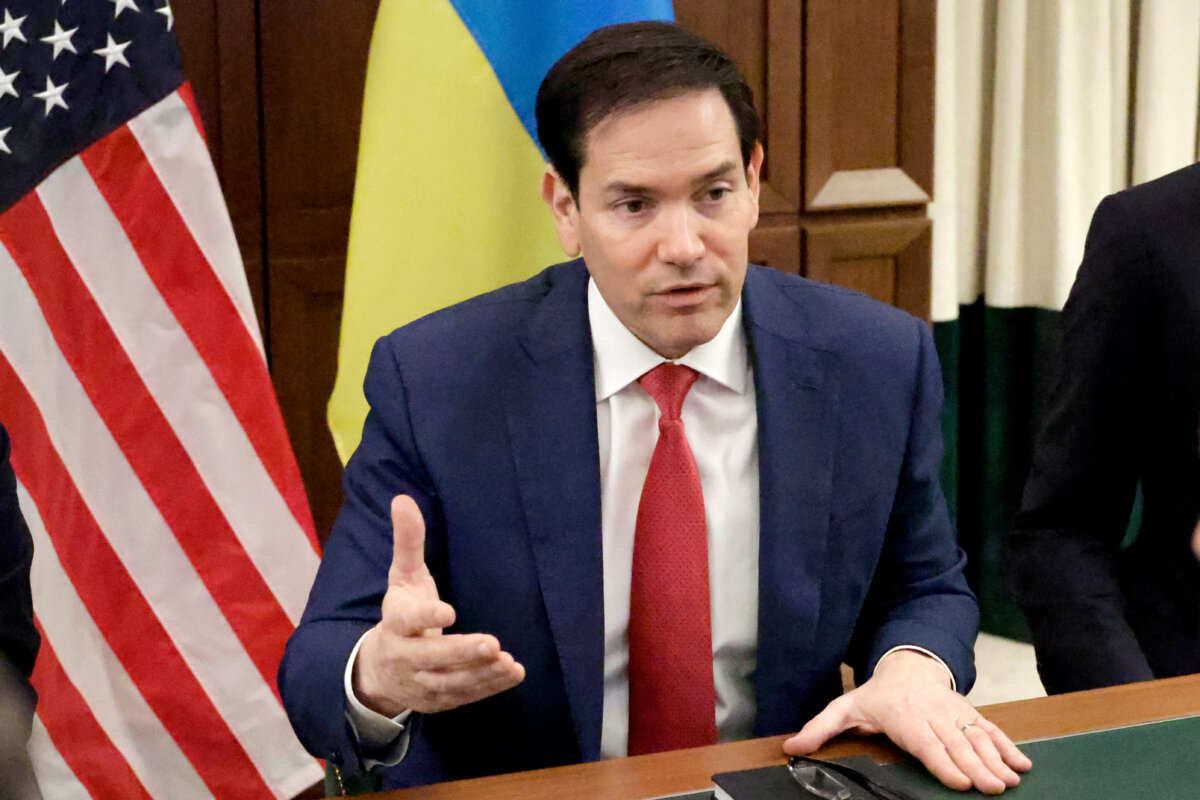

Secretary of State Marco Rubio accused Venezuelan President Nicolas Maduro of not having a legitimate government and called the regime a “transshipment organization” to traffic drugs sourced in neighboring Colombia into other countries.
“The Maduro regime is not a legitimate government,” Rubio told Fox News host Sean Hannity during a Tuesday evening interview. “What it is is a transshipment organization. It allows cocaine and other drugs that are produced in Colombia to be trafficked through Venezuelan territory and—with the cooperation of elements of the regime—are allowed to … leave Venezuela on airplanes and ships headed towards the United States.”
He added that Maduro’s regime “is a source of instability in the entire region” and that 8 million Venezuelan nationals have fled “into neighboring countries as a result of the regime’s activities within their own country, including into the United States.”
“Maduro asked [the Biden administration] that his nephews, convicted drug traffickers, be released from U.S. prisons,” Rubio also said. “He asked that his chief money launderer … be released from U.S. custody before he stood trial. In exchange, he promised to hold free and fair elections. He got the nephews back, the drug dealers, he got the bag man back, and he never did the free and fair elections.”
Rubio’s comment comes as President Donald Trump warned on Tuesday that land strikes in Venezuela are coming soon, and days after the president wrote on social media that the country’s airspace should be considered closed.
Around 20 U.S. military strikes have been carried out targeting vessels in the Caribbean Sea that officials say were transporting drugs into the United States.
“The president has authorized a counter-drug mission in the region,” Rubio said. “The fact that Maduro is upset about it tells you that drugs are coming out of Venezuela.”
In November, the State Department said that Maduro is effectively the leader of a cartel called the Cartel de los Soles and placed the organization on its foreign terrorist organization list, opening up new authorities for the Trump administration. Earlier this year, the U.S. government also designated a Venezuelan gang, Tren de Aragua, as a terrorist organization alongside several major Mexican drug cartels.
The Trump administration has sought to ratchet up pressure on Maduro. The U.S. government does not view Maduro as the legitimate leader of the oil-rich South American nation, and he faces charges of narco-terrorism in the United States.
U.S. forces have conducted bomber flights near Venezuela, and the USS Gerald R. Ford, America’s most advanced aircraft carrier, arrived in the area on Nov. 16. The Ford rounds off the largest buildup of U.S. firepower in the region in generations. With its arrival, the “Operation Southern Spear” mission includes nearly a dozen Navy ships and about 12,000 sailors and Marines.
The Federal Aviation Administration on Nov. 21 sent a warning to airlines regarding a “worsening security situation and heightened military activity in the region,” causing several flights that were headed to Venezuela to be canceled.
Trump has publicly floated the idea of communicating with Maduro and confirmed over the weekend that he had spoken to the Venezuelan leader, although he did not provide details of their call.
“I don’t want to comment on it. The answer is yes,” Trump said while speaking to reporters on board Air Force One on Nov. 30. “I wouldn’t say it went well or badly, it was a phone call.”
Responding to the U.S. pressure campaign, Maduro told CNN last month in an interview that people should “unite for the peace of [the Americas]. No more endless wars. No more unjust wars. No more Libya. No more Afghanistan.”
When asked what he would tell Trump, he said: “Yes peace, yes peace.”
The Associated Press contributed to this report.
 Friends Read Free
Copy
Facebook
Tweet
Friends Read Free
Copy
Facebook
Tweet