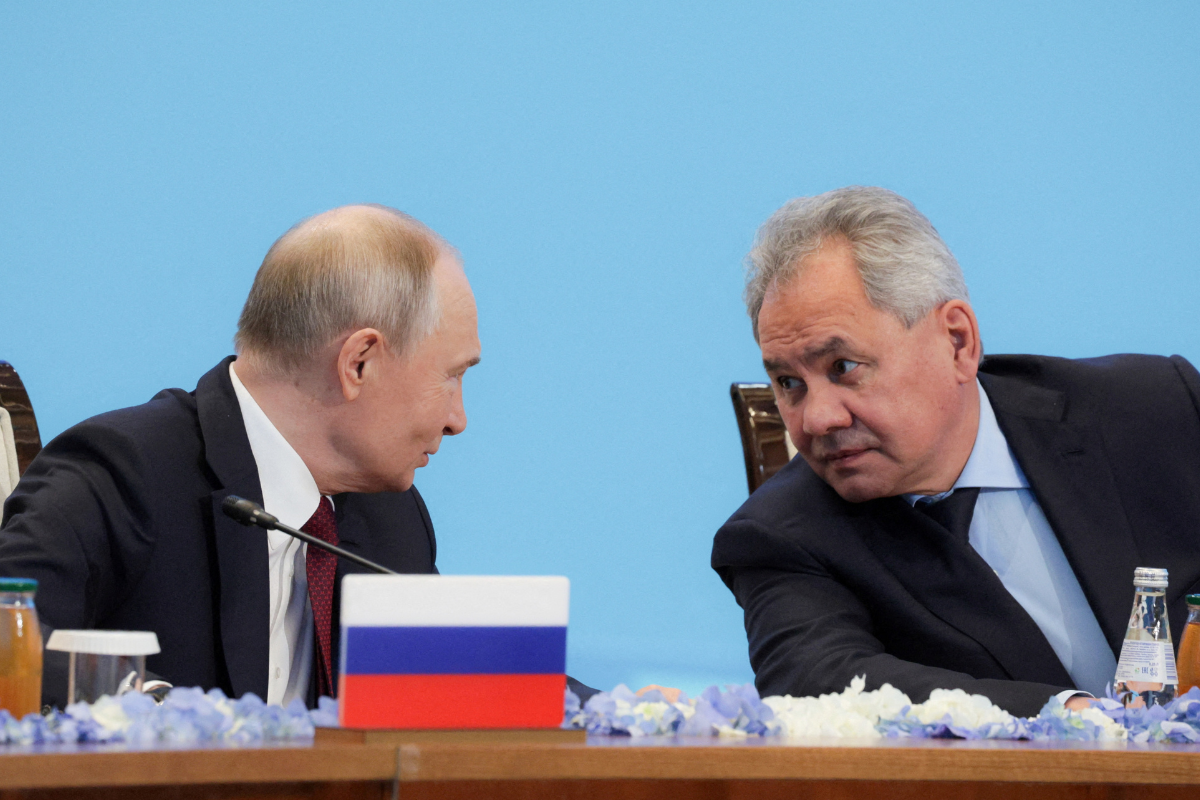

A senior Russian official has said it is establishing a “fully-fledged partnership” with the Afghan Taliban leadership, including political and security contacts.
Russia last year became the first country to formally recognize the Islamist Taliban government that seized power in August 2021 as U.S.-led forces withdrew from Afghanistan at the end of the 20-year conflict.
Russian Security Council Secretary Sergey Shoigu said, according to Russian state news agency TASS on May 14, that Russia “recognized the Islamic Emirate of Afghanistan in July 2025 and established a pragmatic dialogue with the Taliban.”
“We are consistently establishing a full-fledged partnership—from political and security contacts to trade, economic, cultural, and humanitarian cooperation,” Shoigu said in Bishkek, Kyrgyzstan, during a meeting of the Shanghai Cooperation Organization (SCO).
“We are convinced that cooperation with Kabul meets the objectives of the region’s security and economic development,” he said, adding that Moscow believed that the SCO should also resume the activities of its contact group with Kabul.
The SCO is a 10-member grouping that includes China, India, Iran, Pakistan, and several former Soviet states.
Russia–Afghanistan Relations
Russia outlawed the Taliban, designating it as a terrorist organization in 2003. But the ban was lifted in April 2025, months before Moscow formally recognized the Taliban-led government.
Moscow sees a need to work with Kabul as it faces security threats from Islamist militant groups based in several countries, from Afghanistan to the Middle East.
Russia has a long history of involvement in Afghanistan, dating back to the so-called Great Game, when the tsars vied with the British Empire in India for control of the territory.
In 1979, the Soviet Union invaded Afghanistan and fought a long war against the U.S.-backed Mujahideen before withdrawing in 1989.
The Taliban first captured Kabul in 1996 but were ousted in November 2001 by a U.S.-led force that intervened after the Sept. 11, 2001, attacks to root out Osama bin Laden and his al-Qaeda network, which had used Afghanistan as a base.
In August 2021, Kabul fell to the Taliban again, four months after then-U.S. President Joe Biden announced he would withdraw all U.S. troops from Afghanistan by Sept. 11, 2021.
The Ukraine War
Russian Foreign Minister Sergei Lavrov on May 13 said that U.S.–Russia relations were not advancing. He told RT India that aside from regular diplomatic dialogue, “nothing is happening in real life.”
“The sanctions imposed under him have remained in force. Moreover, the Trump administration has adopted its own initiatives in order to punish Russia’s economy,” Lavrov said, according to a transcript provided by the Russian Ministry of Foreign Affairs.
Russia remains under sweeping U.S. sanctions, largely linked to the Ukraine war.
“We appreciate the fact that President Trump initiated dialogue with us and with President Putin,” Lavrov said.
Following his 2024 election victory, U.S. President Donald Trump reestablished dialogue with Russian President Vladimir Putin and has repeatedly promised to end the war in Ukraine through peace.
Among efforts to resolve the conflict was the meeting of the two leaders in Alaska in August 2025 aimed at bringing Moscow and Kyiv into peace talks.
Discussions are ongoing, with Trump saying on April 29 that he discussed a cessation of the war with Putin by phone.
“We had a good talk, I’ve known him a long time,” Trump said. “I had a long talk with President Putin. I suggested a little bit of a ceasefire, and I think he might do that. He might announce something having to do with it.”
More recently, Trump said that the war in Ukraine is “very close” to ending and that he expected Moscow and Kyiv to reach a settlement.
“The end of the war in Ukraine, I really think it’s getting very close,” Trump told reporters on May 12, as he left the White House for a trip to China.
The comments follow similar remarks from Putin days earlier.
“I think it’s coming to an end, but it’s still a serious matter,” Putin told reporters in Moscow on May 9.
Ukrainian President Volodymyr Zelenskyy does not share that optimism, saying on May 11, “Russia has no intention of ending this war. And we are, unfortunately, preparing for new attacks.”
Reuters and Chris Summers contributed to this report.
 Friends Read Free
Copy
Facebook
Tweet
Friends Read Free
Copy
Facebook
Tweet