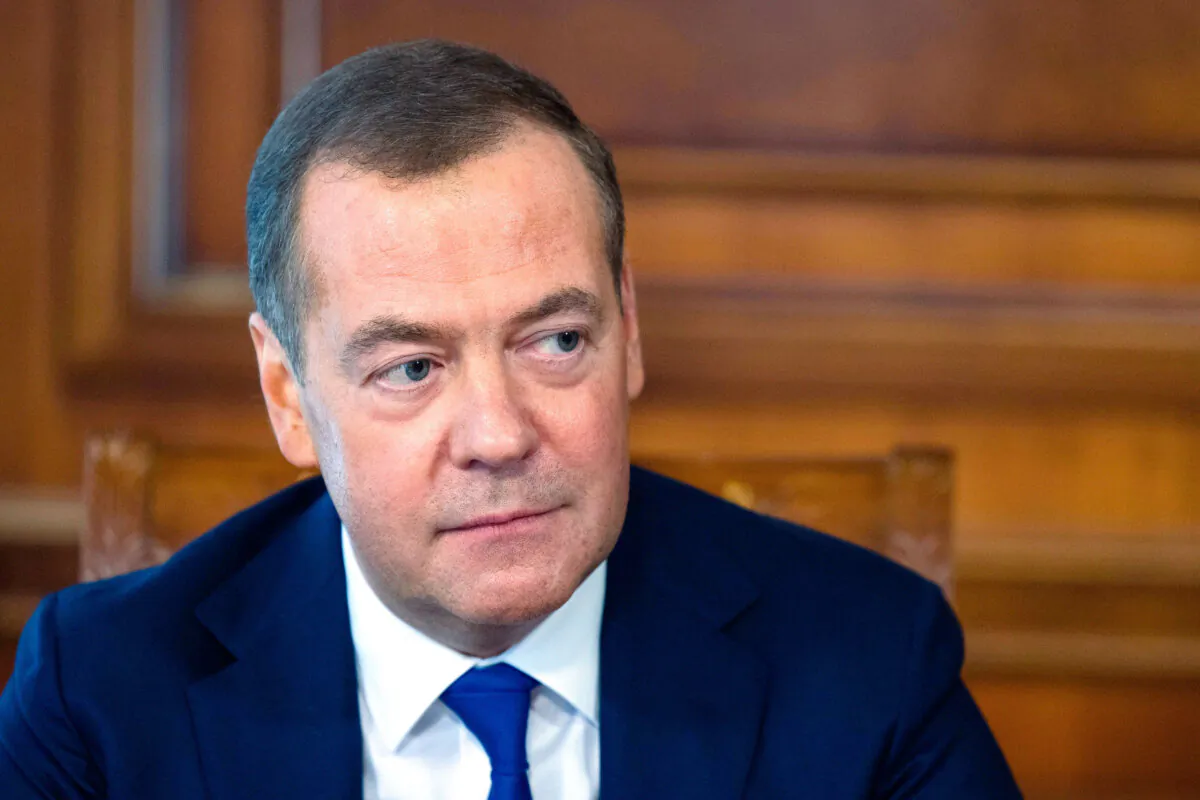
Former Russian President Dmitry Medvedev said his country is not interested in a world war, in comments published on Feb. 2.
“Of course we are not interested in a global conflict,” Medvedev, who now serves as deputy chairman of the Russian Security Council, said during an interview with Russian state news agency TASS. “We are not crazy! Who needs a global conflict?
“Nor were we interested in beginning the special military operation.”
“We have repeatedly warned the West and NATO countries, inviting them to negotiate and asking them to take the interests of the Russian Federation into account, to determine the boundaries of further NATO expansion, and to drop the idea of making Ukraine a NATO member, because we had a territorial dispute over Crimea with Ukraine already back then,” he said.
“But they were just as adamant, saying, ‘No, we will do anything we want and let anybody who wants join [the bloc].’ And here they go, causing a serious global problem!”
The “special military operation” is the Kremlin’s term for its actions in Ukraine, which Kyiv and its allies consider to be a full-scale invasion.
However, the veteran politician also warned that despite the resumption of Moscow’s contact with Washington, which he said made him “rejoice,” “a global conflict cannot be ruled out.”
“I think that the risks are very high and they have not decreased,” he said.
Medvedev said he believes that “the decreasing pain threshold” is the main issue that risks sparking a world war.
“Earlier, when I was young, the leading countries—the Soviet Union, the United States, NATO countries, and the Warsaw Pact—caused shock when they discussed the possibility of nuclear confrontation,” he said.
“They said, ‘This shouldn’t happen, because it should never happen.’ And that was the maxim that all politicians adhered to. It didn’t matter what their orientation—socialist or liberal, Western.”
However, Medvedev said, particularly during the Biden administration, Russia had warned that things could spiral out of control.
“One thing would lead to another,” he said. “One blow—a response. Another blow—a response. And then all this would continue, with the response being global and absolutely destructive for everyone.”
“This is a major global problem now,” Medvedev said about Western reluctance to take Russia’s concerns seriously.
“And that’s why, unfortunately, a global conflict cannot be ruled out. I believe the danger is very high and is not decreasing.”
Medvedev also said that although the expiration of the 2010 New Strategic Arms Reduction Treaty would not necessitate a further deterioration in relations, it should serve as a warning.
“I don’t want to say that [the expiration of the treaty] immediately means a catastrophe and a nuclear war, but it should still alert everyone,” he said. “The clock that is ticking will, in this case, undoubtedly accelerate again.”
The treaty is set to expire on Feb. 5, and without it, the United States and Russia would face each other with no legally binding limits on their deployed strategic nuclear weapons for the first time in decades.
Medvedev said that although counting warheads and deployed delivery systems is a useful method for monitoring the nuclear situation between Washington and Moscow, it does not address the broader issues.
Despite this, he did point to the treaty as a symbol of mutual trust.
“When such a treaty exists, there is trust,” Medvedev said. “When it doesn’t, that trust is exhausted. The fact that we are now in this situation is clear evidence of a crisis in international relations. This is absolutely obvious.”
The United States and Russia together possess nearly 90 percent of the world’s nuclear weapons.
Russia has about 5,459 nuclear warheads and the United States has about 5,177, according to the Federation of American Scientists. The figures include both active warheads and retired weapons awaiting dismantlement.
On Jan. 15, Russia said it was still waiting for a response from Washington on whether the two countries can extend or replace the last remaining nuclear arms control treaty between them.
U.S. President Donald Trump, who previously described the extension as a “good idea,” said in an interview with The New York Times published on Jan. 8 that “if [the treaty] expires, it expires.”
“We’ll do a better agreement,” he said.
Reuters and Evgenia Filimianova contributed to this report.
 Friends Read Free
Copy
Facebook
Tweet
Friends Read Free
Copy
Facebook
Tweet