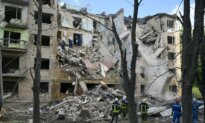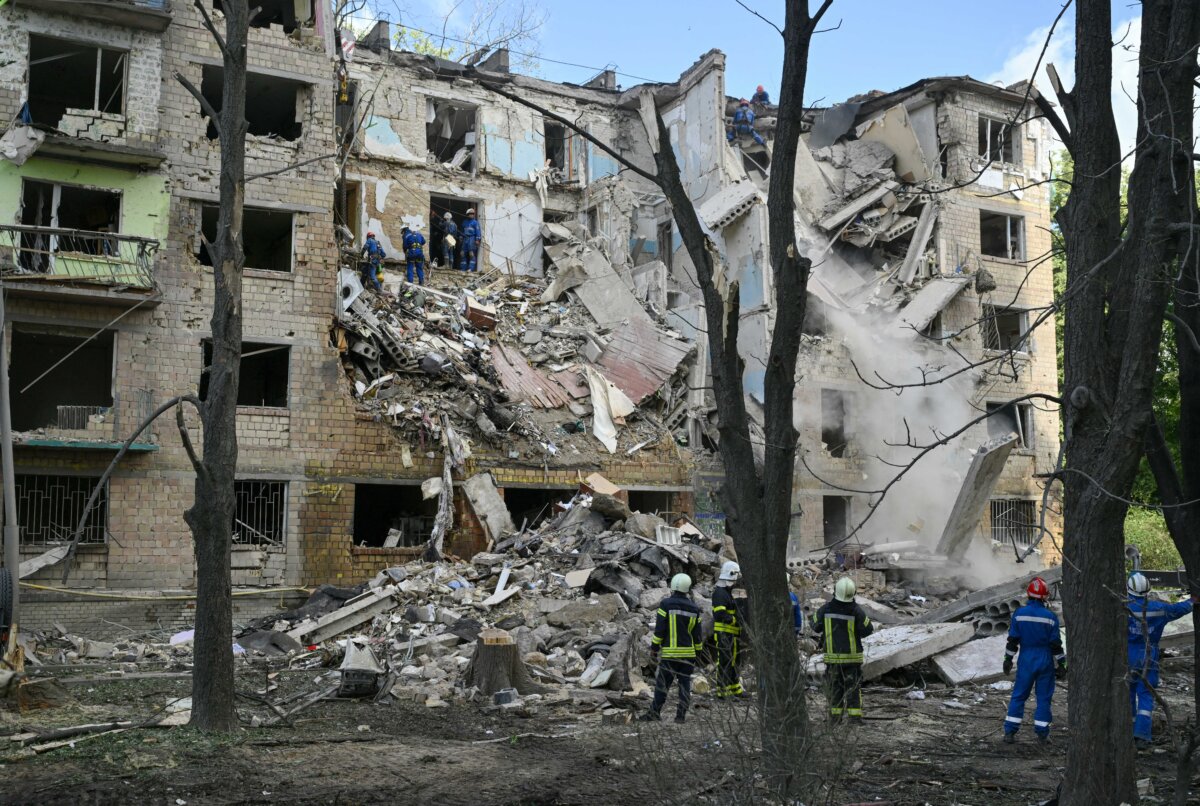

Russia launched the largest aerial assault on Ukraine since the war began overnight, leaving multiple districts of Kyiv damaged on Friday morning.
Moscow unleashed 550 drones and missiles over the country on the night of July 3–4, according to the Ukrainian Air Force, with the vast majority being Iranian Shahed UAVs.
Kyiv’s forces said they managed to neutralize 478 of the weapons launched, with air defenses downing 270 targets, including two cruise missiles, and another 208 lost from radar and presumed jammed.
However, Russia successfully hit eight locations with nine missiles and 63 drones.
Ukraine’s capital was the focus of the Kremlin’s nocturnal barrage, which resulted in at least 23 injuries, of which 14 required hospital treatment, Kyiv Mayor Vitali Klitschko said on Telegram.
He said 5 ambulances were also damaged in the attack but that so far, there were no reports of medical staff sustaining injuries.
Klitschko reported damage across at least five of Kyiv’s 10 districts, including a number of residential and nonresidential buildings.
The national rail operator reported that Ukrzaliznytsia railway infrastructure had also been damaged and warned locals to expect service delays.
Kyiv City Military Administration head Tymur Tkachenko warned residents to shut their windows due to dangerous levels of “combustion products” in the air.
“Russia, a terrorist country, has wreaked havoc,” Tkachenko wrote on Telegram.
Along with the capital, the wider Kyiv region as well as Dnipro, Sumy, Kharkiv, and Chernihiv were also hit.
On the morning of July 4, Ukrainian President Volodymyr Zelenskyy took to social media site X to discuss the attacks, pointing out that the air assault began “almost simultaneously” with media reports of a telephone conversation between Russian President Vladimir Putin and U.S. President Donald Trump.
He added that air defenses had been crucial in ensuring the attack did not result in more devastation, saying that “it is critically important that our partners continue to support us in defending against ballistic missiles. Patriots and the missiles for them are true protectors of life.”
On July 2, the United States halted shipments of some arms to Ukraine as part of a Pentagon “capability review” to ensure U.S. military aid aligns with “defense priorities.”
That move prompted Kyiv’s foreign ministry to summon Washington’s envoy to Ukraine, John Ginkel, to emphasize “the importance of continuing the delivery of previously allocated defense packages.”
Zelenskyy went on to say that the overnight attack was “clear evidence that without truly large-scale pressure, Russia will not change its dumb, destructive behavior.”
“For every such strike against people and human life, they must feel appropriate sanctions and other blows to their economy, their revenues, and their infrastructure,” he said.
“This is the only thing that can be achieved quickly to change the situation for the better. And it depends on our partners, primarily the United States.”
Moscow’s Ministry of Defense said it had struck military targets in Kyiv overnight, including drone factories, a military airfield, and an oil refinery.
Trump–Putin Phone Call
Trump on July 3 said his phone call with Putin produced no breakthrough as he continues to mediate a cease-fire between Russia and Ukraine.
“I didn’t make any progress with him at all,” Trump told reporters aboard Air Force One on the way to Iowa.
He said he discussed Iran and Ukraine with Putin, adding, “I’m not happy about that.”
“I’m very disappointed with the conversation I had today with President Putin, because I don’t think he’s there, and I’m very disappointed,” Trump said. “I’m just saying I don’t think he’s looking to stop, and that’s too bad.”
Trump is expected to speak with Zelenskyy sometime on Friday.
Putin has not publicly expressed an opinion on the call, but Kremlin aide Yury Ushakov said that the two leaders discussed the situation in Ukraine and the Middle East, among other issues, over the course of almost an hour, according to Russian state news agency TASS.
Additionally, during the conversation, the pair discussed the possibility of exchanging films that promote the traditional values shared by Russia and the Trump administration, Ushakov said.
 Friends Read Free
Copy
Facebook
Tweet
Friends Read Free
Copy
Facebook
Tweet