
Russia handed over to the United States on Jan. 2 what it said was part of a Ukrainian drone containing data proving Kyiv’s forces targeted one of Russian President Vladimir Putin’s residences.
A video posted to the Russian Ministry of Defence’s Telegram channel showed the head of the Main Directorate of the General Staff of Russia’s Armed Forces, Adm. Igor Kostyukov, handing what he called the controlling mechanism of a drone to a U.S. military attache at the U.S. Embassy in Moscow.
“The decryption of the content of the memory of the navigation controller of the drones carried out by specialists of Russia’s special services confirms without question that the target of the attack was the complex of buildings of the Russian president’s residence in Novgorod region,” Kostyukov said.
“We presume that this measure will do away with any questions and allow for the truth to be established.”
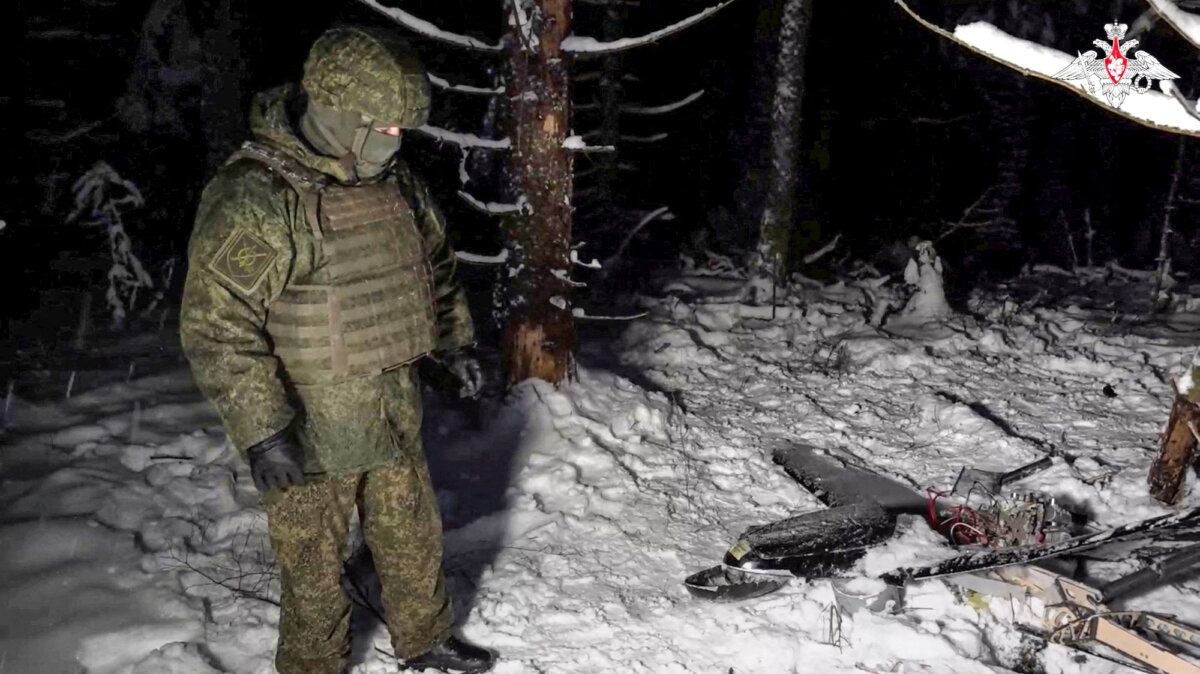
In addition to the decrypted data, the ministry also released during a Dec. 31 briefing what it said was a flight map and video footage showing the wreckage of the drones purportedly used in the attack. Footage showed black UAV fragments, wooden structural parts, and red electrical wiring scattered in the snow at what the ministry said were interception sites.
The map showed interception points in several Russian regions, including Bryansk, Smolensk, and Novgorod, with the ministry saying that no casualties or damage were reported.
Ukraine has denied carrying out such an attack, with Kyiv and several Western officials dismissing the allegation as disinformation aimed at derailing diplomatic efforts to end the nearly four-year war.
Drone Attack Claims Disputed as Peace Talks Continue
Ukraine’s foreign minister, Andrii Sybiha, in a Dec. 31 post on X, described Kremlin claims of a drone attack on Putin’s residence as “Russian manipulations and attempts to obstruct and undermine peace efforts.”
Kaja Kallas, the European Union’s foreign affairs chief, said on social media that Russia’s claims were a “deliberate distraction” and an attempt to “derail real progress towards peace by Ukraine and its Western partners.”
“No one should accept unfounded claims from the aggressor who has indiscriminately targeted Ukraine’s infrastructure and civilians since the start of the war,” she added.
The Kremlin first publicly accused Ukraine of targeting Putin’s residence on Dec. 29, warning that the alleged strike would harden Russia’s negotiating position in talks with Washington on a possible settlement. Russian Foreign Minister Sergei Lavrov described the purported incident as “state terrorism” and said it would not go unanswered.
Ukrainian President Volodymyr Zelenskyy rejected the claims, calling them a fabrication designed to justify further Russian attacks on Ukrainian cities and to undermine talks with the United States and Europe.
“This alleged ‘residence strike’ story is a complete fabrication intended to justify additional attacks against Ukraine and Russia’s refusal to take necessary steps to end the war,” Zelenskyy wrote in a post on X on Dec. 29. “Typical Russian lies.”
President Donald Trump initially appeared sympathetic to Russia’s account, telling reporters on Dec. 29 that Putin had informed him of the alleged incident and that he was “very angry.” By Dec. 31, Trump signaled a shift, sharing on social media a New York Post editorial that accused Moscow of blocking a negotiated peace in Ukraine.
The continuing controversy over the alleged drone attack on Putin’s residence comes amid a sharp exchange of drone and missile strikes over New Year’s. Ukrainian officials said Russia launched more than 200 attack drones overnight on New Year’s Eve, targeting energy infrastructure across at least seven regions, including areas far from the front line.
Russia, meanwhile, accused Ukraine of carrying out a deadly New Year’s drone strike in a Russian-controlled area of Ukraine’s southern Kherson region. Moscow-installed regional officials said three drones hit a hotel and café in the coastal village of Khorly, killing at least 24 people and wounding dozens more as civilians gathered to celebrate.
Despite the violence, diplomatic efforts to end the long-running conflict continue. Zelenskyy said in his New Year’s Eve address that Ukraine wants peace but would not accept a settlement that threatens the country’s existence or locks in what he called a “weak” agreement.
While officials on both sides have said progress has been made in the talks, major sticking points remain, including the status of occupied territories in eastern Ukraine and security guarantees for Kyiv.
Reuters contributed to this report.
 Friends Read Free
Copy
Facebook
Tweet
Friends Read Free
Copy
Facebook
Tweet