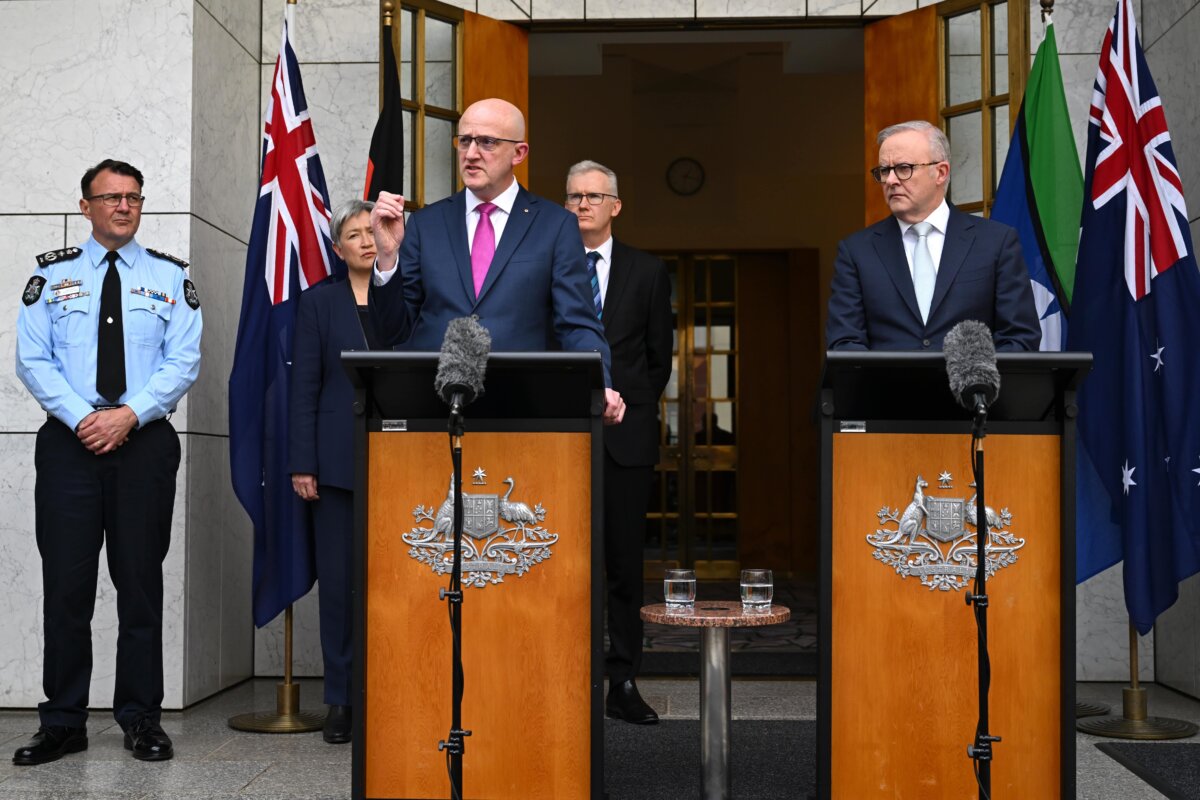

A new bill that will grant Australia’s domestic spy agency permanent access to compulsory questioning powers has passed the lower house of the federal parliament.
The Australian Security Intelligence Organisation Amendment Bill (No. 2) 2025 contains major reforms to Division 3 of Part III of the ASIO Act—the section that allows ASIO to compel people to appear and answer questions under a warrant.
The Bill, if it passes the Senate, will remove the sunset provision, which forces the agency to revisit and extend its authority
It also expands the scope of adult questioning warrants by adding new grounds, including espionage, sabotage, politically motivated violence, and promotion of communal violence.
In addition, the legislation would tighten the rules for appointing the officials who oversee ASIO’s questioning sessions, known as “prescribed authorities.”
For example, it sets out a list of professions that are ineligible for the supervisory role and expands the circumstances in which the attorney-general can remove a person from that position.
What Are ASIO’s Compulsory Questioning Powers?
ASIO can apply for a compulsory questioning warrant that requires a person to appear and answer questions relevant to a security investigation.
While adults are the primary focus, children as young as 14 can also be subjected to questioning.
A warrant must be requested by the Director-General of Security and approved by the Attorney-General.
The framework also allows police to assist in executing the warrant, including powers to apprehend a person, enter premises, conduct searches, use force in some circumstances, and seize items.
It also sets out rules for how questioning is conducted, access to legal representation, and offences for refusing to comply.
What Is the Sunset Clause?
A sunset clause is a built-in expiry date that forces parliament to revisit extraordinary powers and decide whether they should continue.
ASIO’s compulsory questioning powers were introduced in 2003 but included a sunset clause after negotiation.
Since then, parliament has extended the expiry date multiple times, keeping the powers alive through rollovers rather than making them permanent. It was last extended in 2020 for five years with the powers coming to an end in September 2025.
On Feb. 10, the Parliamentary Joint Committee on Intelligence and Security (PJCIS) tabled a report endorsing the Bill’s proposal to repeal the periodic sunsetting of the compulsory questioning powers.
However, the committee upheld that the Bill should include a safeguard requiring the PJCIS to review the changes on the third anniversary of their commencement.
It’s an area the Law Council of Australia has raised concerns about before.
“If this sunset date is removed, the Law Council has stressed the need for regular and independent reviews to assess ongoing necessity and proportionality,” the legal body wrote in a submission.
“The Law Council has also raised concern with the proposal in the ASIO Bill to expand the subject matter for adult questioning warrants and retain compulsory questioning for minors, noting that this appears to be contrary to earlier views expressed by key intelligence agencies.”
Crossbench Amendments Defeated
Crossbench MPs have tried amending the legislation, warning it would remove oversight of the agency.
Independent MP Kate Chaney moved amendments to keep the sunset clause for another five years, until March 2030, and to require a mandatory review by the PJCIS.
“This bill engages some of the most extraordinary powers in our law, compulsory questioning by ASIO,” Chaney told the House of Representatives.
“These powers are intrusive and profoundly interfere with multiple rights, including the right to silence, freedom of movement, access to legal representation and the privilege against self incrimination.”
Chaney acknowledged the security environment was challenging and that ASIO needed effective tools, but argued that “the legitimacy of those tools depends on proportionality and transparency.”
However, Home Affairs Minister Tony Burke rejected the proposal, saying the government was “very deliberately removing the sunset provision.”
“I wish the need for these powers was temporary, and history has shown us that it isn’t,” he said.
Chaney’s amendments were defeated 67–10.
A second set of amendments, moved by independent MP Zali Steggall, sought extra safeguards for minors, including requiring a minor’s representative to always be present, limiting questioning to eight hours, and creating a separate sunset clause for compulsory questioning of children.
“We don’t even consider children up to the age of 16 as being mature enough to cope with accessing social media, but we are saying ASIO can compulsory question a 14 to 17-year-old. There is so much inconsistency,” she said.
Burke said the current framework already requires legal representation and consideration of vulnerabilities, and argued the law needed flexibility in urgent situations.
He said the bill has provisions wherein the attorney-general must treat a minor’s best interest as a primary consideration when issuing a warrant.
The minister also highlighted the need to question minors about security matters, citing a counter-terrorism program involving 230 participants, 50 percent of whom are under 24, and 31 percent under 18.
Steggall’s amendments were defeated 60–9.
 Friends Read Free
Copy
Facebook
Tweet
Friends Read Free
Copy
Facebook
Tweet