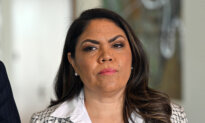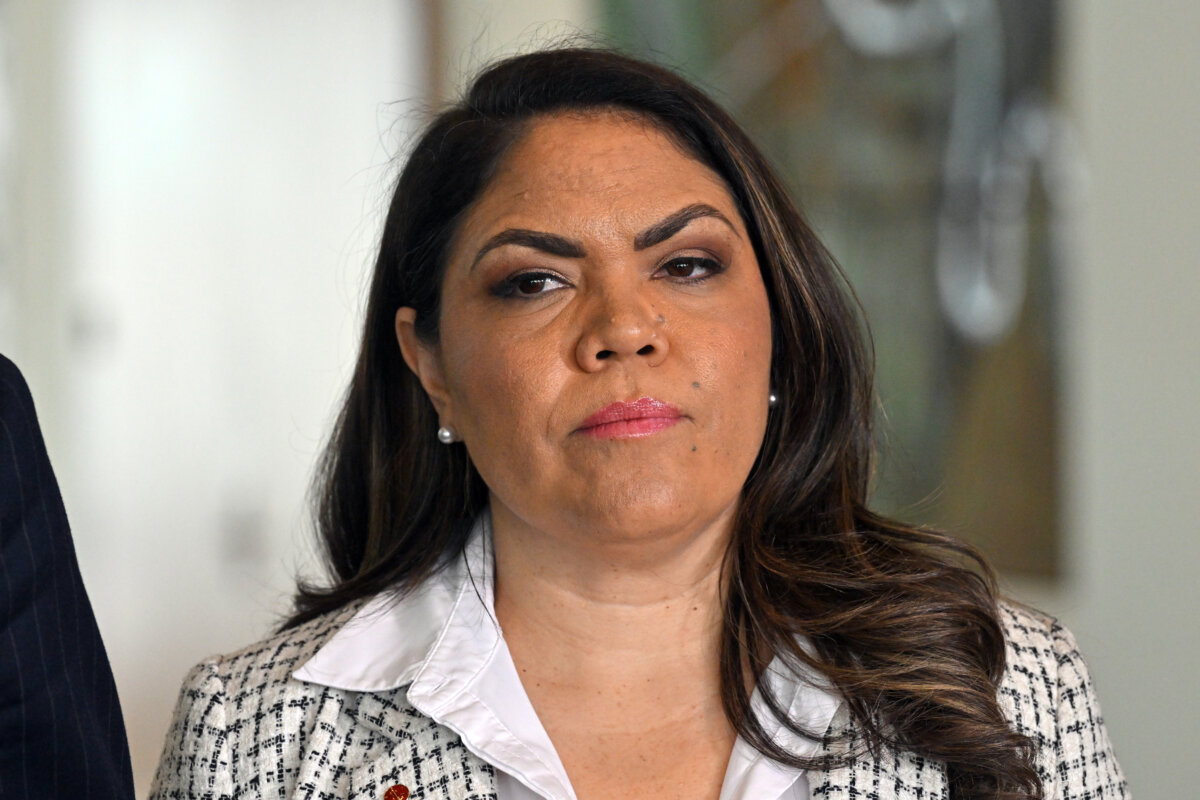
Liberal Senator Jacinta Price has probed government officials on the effectiveness of their approach to lifting Indigenous health, economic, and education outcomes.
During a Senate Finance and Public Administration Legislation Committee hearing on May 26, Price said several “Closing the Gap” targets were offtrack despite an alleged $22 billion of government funds being spent over five years.
Closing the Gap is an Australian government strategy aimed at resolving disparities between Indigenous and non-Indigenous Australians in areas like health, employment, education and life expectancy.
The senator questioned the National Indigenous Australians Agency (NIAA), which helps coordinate Closing the Gap, and Labor’s Indigenous Minister Malarndirri McCarthy.
“So NIAA’s total resourcing is around $4 billion this year,” Price remarked.
“If I add up next year’s estimate plus the actual expenditure from previous years from the 1st of July 2022, we have resourced NIAA to the tune of “$21,000,981,434,” so $22 billion, nothing has really changed.
“The measures that were getting worse in 2022 are still getting worse, with no new measures now on track. Why hasn’t this expenditure been effective over the last five budgets?”
Minister, Official Dispute Figures
Minister McCarthy refuted Price’s claim.
“We have nine targets that are getting better … employment, preschool enrolment, land rights, sea rights … Year 12, attainment, tertiary education, youth engagement in work or study—they are significant improvements that are happening through Closing the Gap …” she said.
“The areas that we are not doing well … is justice and out-of-home care, and these are the two critical areas that we remain focused on.”
Price said four targets that were not on track in 2022 and had only gotten worse since.
“So this to me suggests that the evidence is there that this isn’t working, and expenditure hasn’t been effective, so why are we just doing more of the same?” she said.
Simon Gordon, group manager for strategy at the NIAA, said he needed to confirm if Price’s claim of $22 billion was accurate, but also argued measurements could fluctuate.
“One of the targets that you referred to, that went from originally being consistent with the baseline to being on track, and then going back to now being with the baseline, refers to the healthy birth rate,” he said.
“That one thing I would note on that target is that it is highly variable, because it is based on small numbers.”
The data on healthy birth weights of Indigenous babies shows 11.1 percent of Indigenous babies are not born at healthy weights, compared to 8 percent of non-Indigenous births.
Gordon said measures were being taken to address the number, including supporting smoking reduction, improving pre-conception care, increasing breastfeeding rates, and preventing foetal alcohol disorder.
Price queried whether the government was auditing outcomes across the whole of the Indigenous portfolio, to which Gordon said it was a case of individual programs being evaluated and monitored.
Only 4 Goals on Target
According to the government’s Closing the Gap dashboard, only four goals are currently on target—employment of people aged 25-64, early childhood education enrolment, and land and sea rights.
The remaining 19 targets remain below the benchmark, are either improving but not on track, show no change, worsening, or are non-applicable due to a lack of data.
Some of the worst outcomes include:
- 33.9 percent of children reported to be “thriving;”
- 50.3 out of every 1,000 children in out-of-home care;
- 2,500 adults in prison per 100,000 people; and
- high rates of suicide with 33.9 out of every 100,000 Indigenous Australians dying.
The latest hearing comes months after a similar issue was raised at the 2025 Senate Finance and Public Administration hearing on Oct. 7.
At the time, former Greens-turned-independent Senator Lidia Thorpe said there was a lack of transparency around taxpayer money being poured into the Closing the Gap campaign and whether results were achievable.
Gary Johns, chairman of Close the Gap Research, previously told The Epoch Times that he believed funding should be directed towards educating children rather than initiatives like “community development.”
“If you don’t go to school, you cannot learn. The only way forward is to invest in people, not communities,” he said.
 Friends Read Free
Copy
Facebook
Tweet
Friends Read Free
Copy
Facebook
Tweet