
As Chinese leader Xi Jinping prepares for his meeting with South Korean President Lee Jae Myung, experts say Seoul is vulnerable to economic coercion, overcapacity, and domestic consumer backlash if the two countries continue on the path of strengthening economic ties.
Xi will arrive in South Korea on Oct. 30 for a three-day state visit—his first in 11 years.
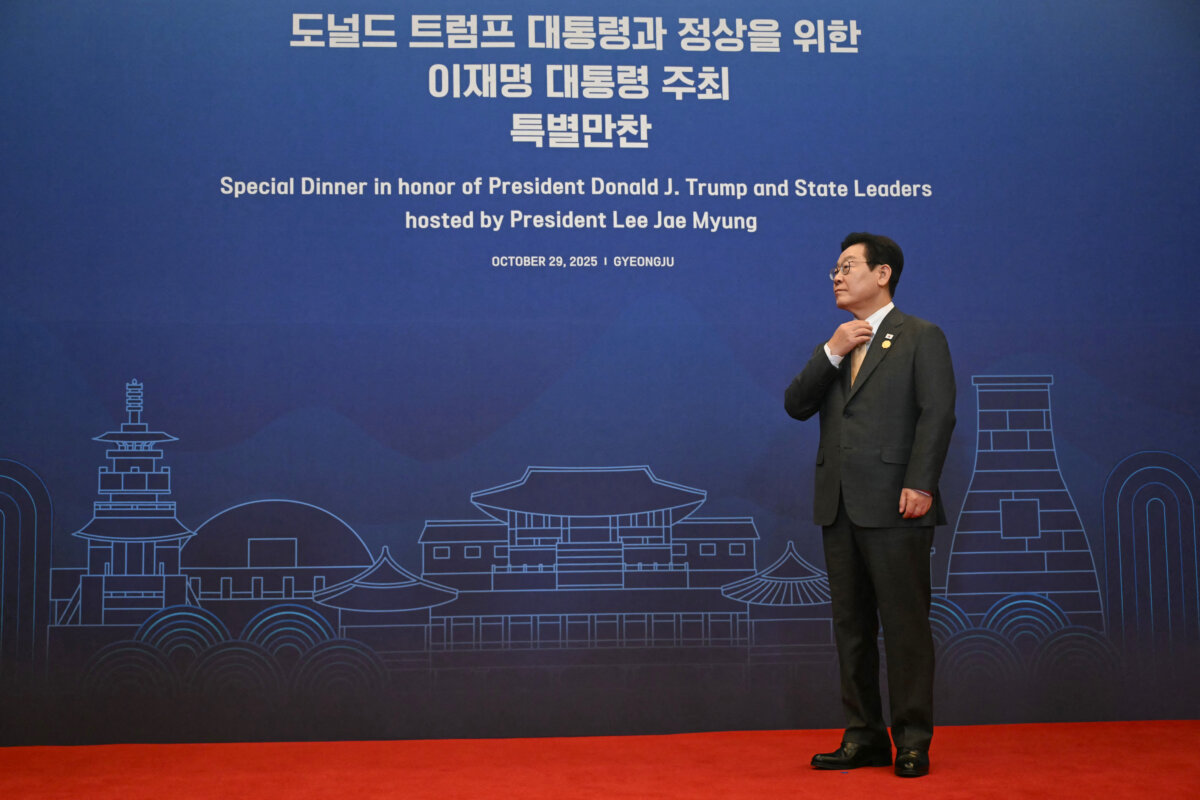
Although Xi’s trip is centered on the Asia-Pacific Economic Cooperation (APEC) meetings, he is also scheduled to meet with Lee on Nov. 1.
The South Korea-China summit may cover issues such as bilateral ties, the Korean Peninsula, supply chains, technology cooperation, market access, and people-to-people exchanges, reported The Chosun Daily, the English-language outlet of Korean newspaper The Chosun Ilbo.
China remained South Korea’s largest trading partner for the 21st consecutive year in 2024, while South Korea reclaimed its spot as China’s second-largest trading partner. Bilateral trade reached $328.08 billion that year, data from Chinese state media CGTN showed.
Korean Autos Under Threat
When Xi last visited South Korea, bilateral relations were at their strongest, and the trip resulted in the implementation of the Korea-China Free Trade Agreement (FTA) in 2015.
However, Tsai Ming-fang, a professor at the Department of Economics and Industrial Economics at Tamkang University in Taiwan, noted that South Korea’s $18 billion trade deficit with China in 2023—eight years after the FTA—signals the potential risks for Seoul in continuing on a path of deepening economic ties with Beijing.
“If South Korea seeks closer economic ties with China at this meeting, it risks becoming a new market for China’s overcapacity, as China actually needs foreign markets right now more than the other way around,” Tsai told The Epoch Times.
China’s overcapacity has already dealt a heavy blow to South Korea’s heavy and chemical industries. This decline is starkly evident in LG Chem, a leading South Korean chemical company, whose operating profit plunged from nearly 1 trillion won ($701.2 million) in 2022 to just 1.2 billion won ($842,330) in the first half of 2024.
This pressure from Chinese oversupply has also forced other major firms, including battery maker Samsung SDI and Posco Future M, the battery manufacturing arm of the Posco Group, to sell off business units to stem the losses, Business Korea noted.
Tsai said that with China’s economic outlook remaining bleak and the European Union and United States already imposing anti-dumping and anti-subsidy tariffs on various Chinese goods, this only exacerbates concerns about China’s overcapacity and flooding of global markets.
“With its access to the EU and U.S. markets restricted, China will undoubtedly seek other partners to offload its products. If South Korea becomes a target, I believe its steel and automotive sectors will face the greatest impact,” Tsai said.
He Jiang-bing, a financial commentator, also cautioned that the crushing pressure from Chinese overcapacity threatens to cripple South Korea’s flagship auto industry, which would severely undermine its export strength and market competitiveness.
“If Chinese-made electric vehicles are priced too low, as we’ve seen in Europe, local consumers will simply buy Chinese brands like BYD. As a result, South Korean domestic car sales will plummet, potentially devastating both the EV and traditional diesel markets,” He told The Epoch Times.
Rare Earths, Tourism, K-Wave Ban
With Seoul caught between Washington and Beijing, Trade Minister Yeo Han-koo said on Oct. 29 that South Korea aims to deepen cooperation with the United States while stabilizing supply chains with China, reported Reuters.
However, Seoul is grappling with recent penalties on its shipbuilders for cooperating with the United States, underscoring South Korea’s fragile position as the U.S.-China trade fight for global spheres of influence intensifies.
This vulnerability to Chinese economic pressure was clearly demonstrated in 2017, when China’s “K-wave ban”—imposed in retaliation for Seoul’s deployment of the Terminal High Altitude Area Defense (THAAD) missile system—cost Korea’s popular culture- and entertainment-related industries an estimated 22 trillion won ($15.3 billion) that year, according to The Korea Economic Daily.
He Jiang-bing told The Epoch Times that while Lee Jae Myung’s pursuit of warmer Beijing ties reduces the risk of immediate economic coercion, China could still leverage its rare earth control to constrain South Korea’s chip manufacturing if relations deteriorate.
“Rare earths are the critical leverage China holds over South Korea’s major chip manufacturers. These chips are essential for South Korea’s key industries, including high-tech, home appliances, and automotive.
“If chip production stops, these core sectors will collapse, and that’s precisely why Seoul cannot afford to alienate Beijing,” He said.
Beyond rare earths, He said Beijing holds two other trump cards that could seriously damage South Korea’s economy.
“Other possible measures include barring Chinese tourists from visiting South Korea and continuing the ban on K-dramas and K-pop artists in China, which would significantly impact South Korea’s key tourism and entertainment industries,” He said.
In response, South Korea launched a trial visa-free entry policy for Chinese group tourists in late September, and the program will run until the end of June 2026 as the country hopes to stimulate broader economic growth.
Backlash Risks ‘Vicious Cycle’
However, as Seoul’s officials welcome more Chinese tourists to boost the economy, anti-China sentiment is growing among the public, with recent incidents highlighting rising tensions between communist China and free nations.
One Seoul café drew controversy after posting online that it would refuse service to Chinese customers, while rallies have swept areas near the Chinese Embassy in recent months.
Featuring chants of “China out” and waves of Korean flags, the rising sentiment comes just ahead of Xi Jinping’s scheduled state visit.
Some 66.3 percent of respondents held an unfavorable view of China in a June survey, conducted by Korea’s JoongAng Ilbo and the East Asia Institute, reflecting the widespread negative sentiment.
The figure marks a continued upward trend, rising from 63.8 percent recorded in a similar poll the previous August.
Tom Ramage, an economic policy analyst at the Korea Economic Institute of America, said that while the survey reflects widespread public dissatisfaction with China, the long-standing trade relationship will likely prove difficult to change.
“There can be anti-China sentiment politically, but China has this power of proximity with Korea. As such a large economy, its trade relations with Korea are not easy to [make] evaporate overnight,” Ramage told The Epoch Times.
However, He Jiang-bing pointed out that in a democracy like South Korea, strong domestic sentiment will inevitably constrain government foreign policy.
“Following the 2017 THAAD incident, major Korean firms like Lotte and Samsung accelerated their withdrawal from China. Rising anti-China sentiment could now make Koreans reluctant to buy their own brands if those products are made in or invested in China, further damaging corporate interests,” He said.
But He also said that the consequences are worse for Beijing, noting that public backlash could drive more Korean firms out, further slowing any possibility of China’s economic recovery as it faces a likely deep recession or even depression, some analysts have warned.
“Samsung’s complete industrial relocation has already created massive job opportunities in Vietnam. If other major Korean firms follow suit and pull out, China’s unemployment rate will soar, housing prices will fall, and ‘involution’ will intensify, trapping the economy in a vicious cycle,” He said on China.
 Friends Read Free
Copy
Facebook
Tweet
Friends Read Free
Copy
Facebook
Tweet