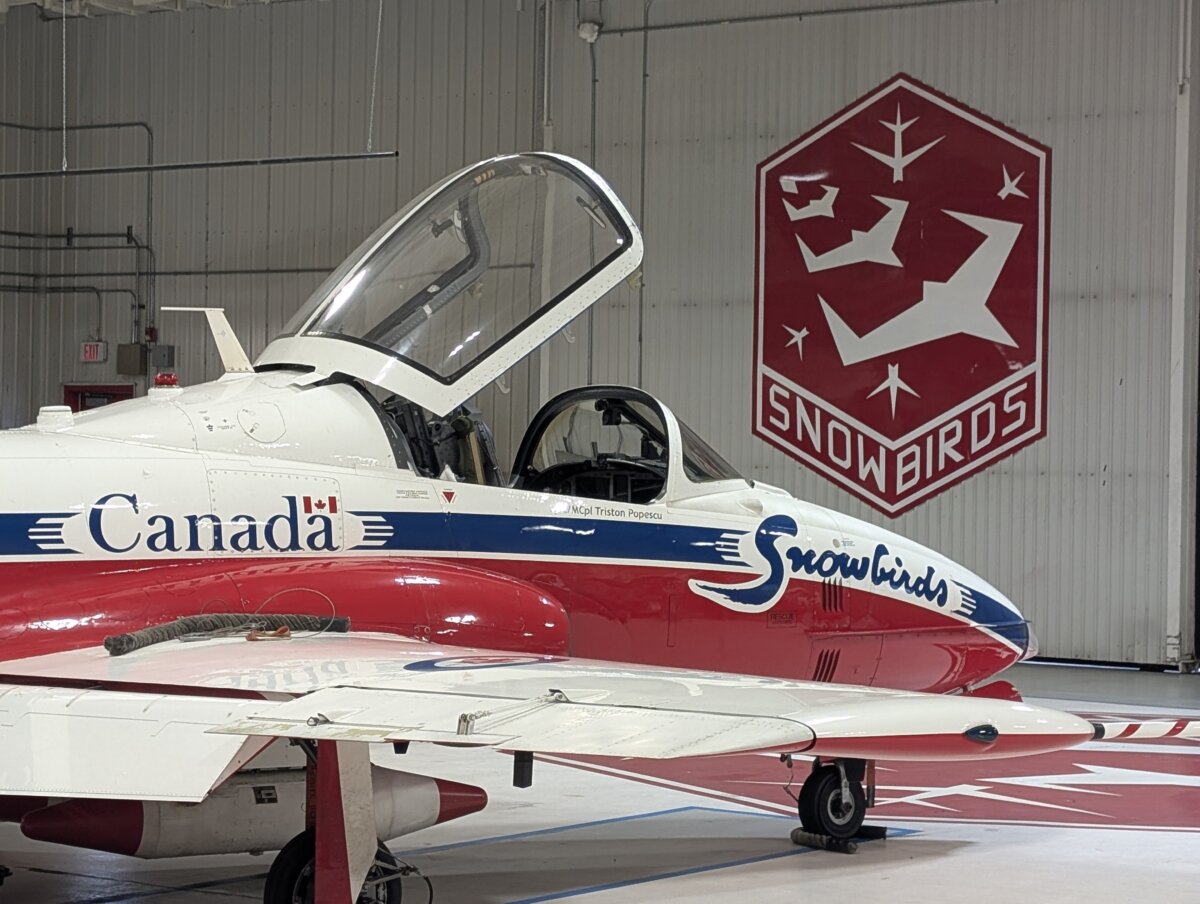

The Snowbirds’ CT-114 Tutor jet engines roared over Saskatchewan for the last time on Oct. 16, as the nine-plane team performed a final demonstration for friends and family who support them behind the scenes.
The performance at 15 Wing Moose Jaw marked the team’s final aerobatic display of the season with the 63-year-old Canadian-built jet, although a Grey Cup flyover in Calgary on Nov. 15 remains on the schedule.
The squadron livestreamed the performance as a thank-you to Canadians for nearly six decades of support. The annual event is normally closed to the public.
Team lead Maj. Maciej (Match) Hatta led the pilots through manoeuvres at 500 kilometres per hour about 100 metres off the ground.
Speaking to reporters on Oct. 15, Hatta said it was an honour to guide the team in its 55th season.
 Maj. Maciej (Match) Hatta, the lead for the Snowbirds aerial team, speaks to reporters at 15 Wing Airbase in Moose Jaw, Sask., on Oct. 15, 2026, ahead of the team’s final performance in the iconic CT-114 Tutor jet. (Courtesy Aaron Walker)
“I just work hard every day … . But you have to work hard and practice your craft in order to be proficient enough to be able to do that day in, day out when all the variables keep changing on you,” Hatta said.
Hatta said the pilots were generally too focused on performing safely to dwell on their emotions before a show, but he expected those feelings to surface once they were back on the ground with their families.
He added that he was unsure how he would feel landing the jets for the final time, but would likely be downcast once the adrenaline wore off.
The team lead said he felt sad knowing this was the final season the Snowbirds would fly the iconic red-and-white Tutor jets, adding that the pilots were well aware of the squadron’s legacy of flying the planes for 55 seasons—longer than any other aerial demonstration team has flown the same aircraft.
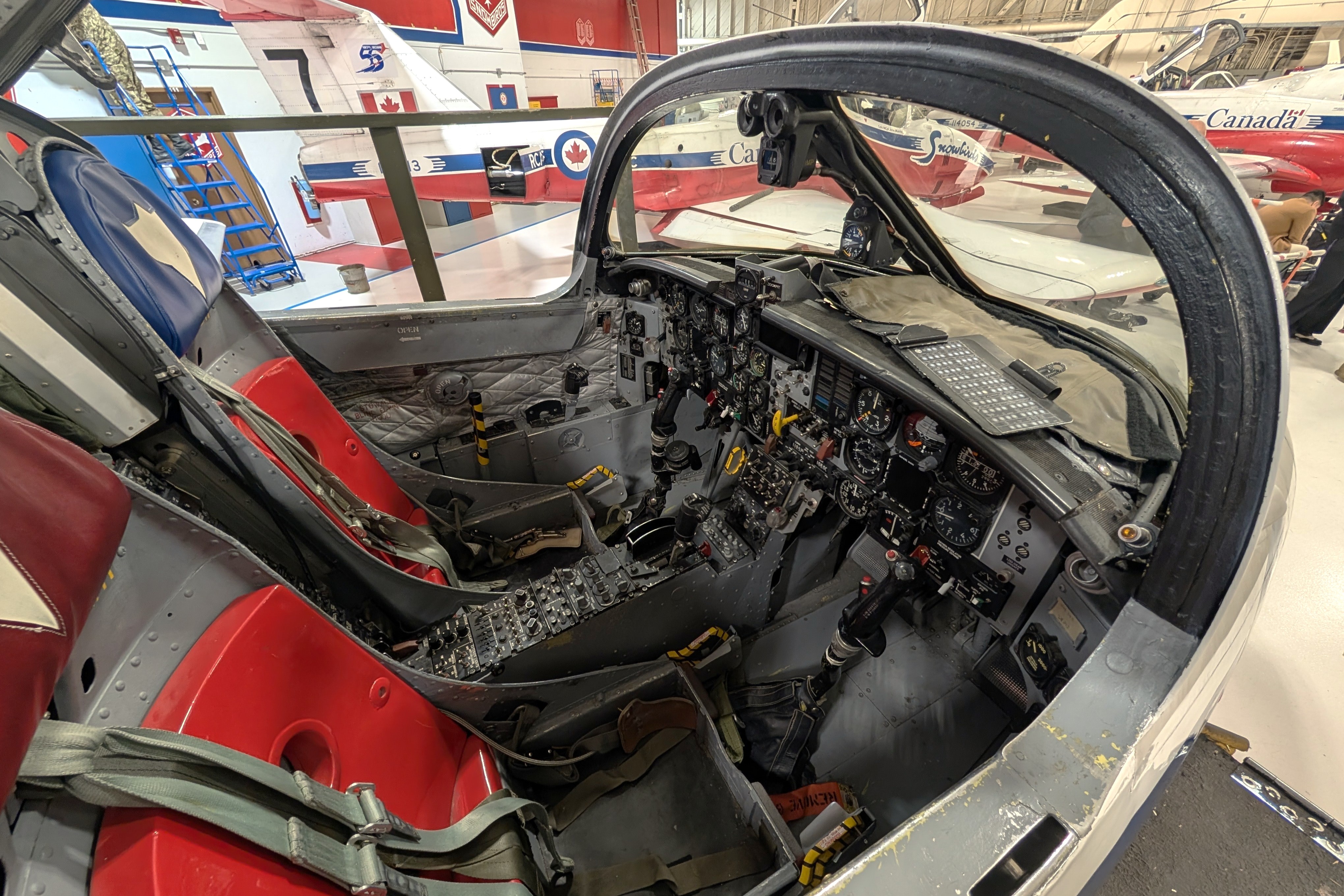 A peek inside the cockpit of the CT-114 Tutor jet, at 15 Wing Airbase in Moose Jaw, Sask., on Oct. 15, 2026. The Canadian Armed Forces Snowbirds flew the plane for 55 years. This is the team’s final year flying the machine, as Ottawa has grounded the planes because of age. (Courtesy Aaron Walker)
Hatta said the season-ending home show allows the team to pay tribute to families and spouses who supported them throughout the summer.
This was Hatta’s 25th year flying with the Royal Canadian Air Force, and his second tour with the Snowbirds, as he performed from 2014 to 2017.
The Polish-born, Ontario-raised test pilot said every team lead must have flown with the squadron previously before taking on the lead role.
“There’s a lot of nuances in flying these airplanes and just the culture of the team and how the team operates, where a boss would be struggling had they not been on the team previously as a winger in one of the wing positions,” Hatta said, recalling that his first show with the Snowbirds was in 2014 in Missouri.
Hatta said that of the 30 jets he’s test-flown, the CT-114 Tutor jet was his favourite because it had its own personality, was agile, could handle G-forces well, and could pull tight turns. He also praised the planes’ construction, given they were built in the pre-computer era, with slide rules in factories in downtown Montreal.
The Snowbirds’ final season in the Tutor jets drew thousands to airshows across the continent, the team lead said. Many people supported them from behind fences, even when the team landed only to refuel and go.
“It’s just been really heartfelt to hear their stories, not necessarily talk to them or at them, but just to hear their version of what they have to say,” Hatta added.
Cheering for the Red and White
Lt.-Col. Guillaume Paquet, commanding officer of 431 Air Demonstration Squadron, said the farewell season drew spectators eager for one more look at the red-and-white jets. Some cheered, while others grew tearful as they realized it would be their last opportunity to see the Tutor.
“The reality is we’ve been touring this country for 55 years, so everyone has a story, a childhood memory,” Paquet said, noting the team performed 55 shows in 40 locations this year, along with numerous flybys over communities.
 Lt.-Col. Guillaume Paquet, commanding officer of 431 Air Demonstration Squadron, speaks to media in Moose Jaw, Sask., on Oct. 15, 2026, ahead of the team’s final show in the iconic Tutor jet. (Courtesy Aaron Walker)
“It’s an honour for us to be able to fly the Canadian flag across the country [and], quite frankly, North America and to be able to represent your country … there’s nothing like it,” Paquet added.
The Next Chapter
The Tutor entered Royal Canadian Air Force service in 1963, and the Snowbirds have flown it since 1971.
The Department of National Defence plans to replace it with the CT-157 Siskin II, based on the Pilatus PC-21. The new demonstration capability will remain based at 15 Wing Moose Jaw and is expected to be operational in the early 2030s.
Paquet said all Tutors will be flown to IMP Aerospace in Trenton, Ont., by March 31, 2027. The company will handle their disposition, including assessing requests from organizations hoping to receive an aircraft.
Some will be preserved in museums or mounted on pedestals for display, while others will serve as training aids for aircraft maintenance apprentices in Borden, Ont.
 Friends Read Free
Copy
Facebook
Tweet
Friends Read Free
Copy
Facebook
Tweet