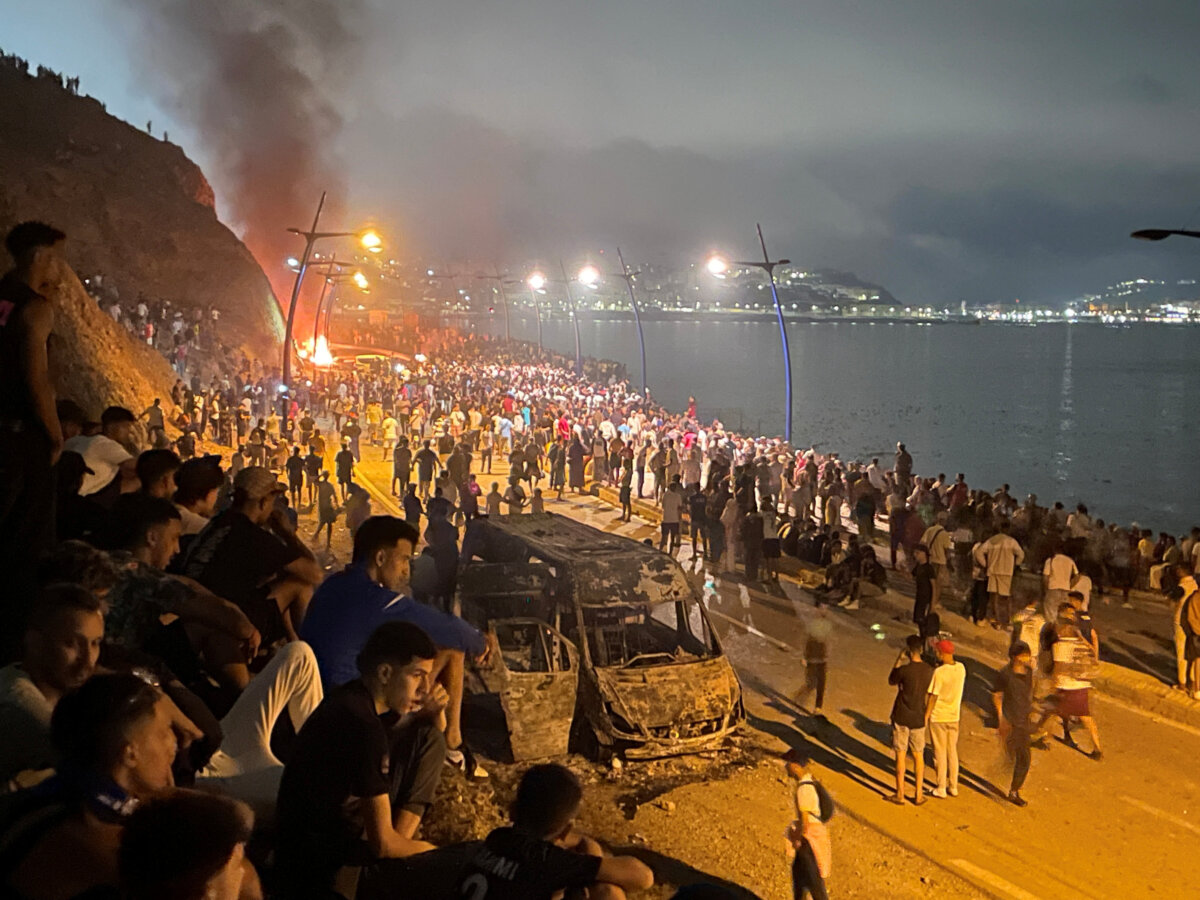

Ceuta was overwhelmed overnight as the Spanish North African exclave faced a fresh wave of nearly 60,000 illegal crossings from Morocco in a single day, Ceuta’s president said on Friday.
That figure marks a sharp increase from the 49,000 sea and land arrivals Spanish authorities reported in a single day as of Friday morning, July 31.
At least 41 migrants died trying to reach the Spanish territory of Ceuta, up from a toll of 19 reported earlier on Friday.
“The situation that Ceuta is going through is absolutely unsustainable,” Ceutan President Juan Jesús Vivas told reporters.
Rachid Sbihi, who leads a local workers association representing Civil Guard officers, called the situation a “serious humanitarian crisis.”
“People are still entering. The reinforcements that have arrived are only helping the injured and other humanitarian efforts,” he said. “It’s chaotic.”
On Thursday, Spain deployed military units to its North African exclave of Ceuta to reinforce security after thousands of illegal immigrants, mostly young men, breached its border with Morocco.
Ceuta is a Spanish autonomous city located in North Africa, like Melilla, which together represent the European Union’s only land borders with Africa, and they often face surges of illegal immigrants seeking to reach Europe.
There are only about 83,000 residents in Ceuta, according to the latest data from Spain’s National Statistics Institute.
Territorial Policy Minister Angel Victor Torres said on Friday that among factors contributing to the surge may have been a ruling by Spain’s Supreme Court on June 29 that migrants intercepted at sea while attempting to reach Ceuta or Melilla cannot be summarily returned under special rules.
Torres told a local radio station that the Spanish government had reacted immediately to the surge and would proceed to eventually return the immigrants.
In a July 30 post on X, Spain’s national police association JUPOL said that there had been too few police in place to monitor the surge.
“For days, we have been publicly warning that the situation in the autonomous city was unsustainable and denouncing the absolute lack of measures on the part of the government. Today, those warnings have been confirmed,” it said.
Spain’s Guardia Civil police association in a series of July 31 posts on X said that the town is on the “brink of collapse.”
“The civil guards have been unable to do anything,” it added.
“They are entering en masse right now. … There aren’t enough civil guards to stop that human tide,” it said.
Overnight at the gates into Ceuta, Moroccan authorities deployed water cannon trucks and pushed people back.
The charred remains of a bus and seven cars could be seen nearby from clashes with the crowds.
Spanish Prime Minister Pedro Sánchez arrived in Ceuta on Friday, according to one of Spain’s news agencies.
“Sánchez arrives at Ceuta’s heliport amid insults and clashes between protesters and the police,” Europa Press said in a July 31 post on X.
Spain’s Socialist government has a pro-immigrant stance. On April 14, Sánchez’s government issued a royal decree granting legal status to people living in the country illegally.
The proposal was first presented on Jan. 27 to allow about 500,000 illegal immigrants already living and working in Spain to obtain legal status through an accelerated process.
Nearly 1.2 million people applied by the June 30 deadline, more than double the government’s original expectation of around 500,000.
Ignacio Garriga, secretary-general of the conservative Vox party and a regional lawmaker in Catalonia, blamed Sánchez directly for the surge.
“It is an invasion and Sánchez is directly responsible,” he wrote in a July 31 post on X.
“Let us put up the walls and provide the necessary tools so that Ceuta and Melilla can be a real and secure border. It is a moral duty and an institutional obligation to the Spaniards who are terrified, have their businesses closed, and fear for their safety.”
Reuters and The Associated Press contributed to this report.
 Friends Read Free
Copy
Facebook
Tweet
Friends Read Free
Copy
Facebook
Tweet