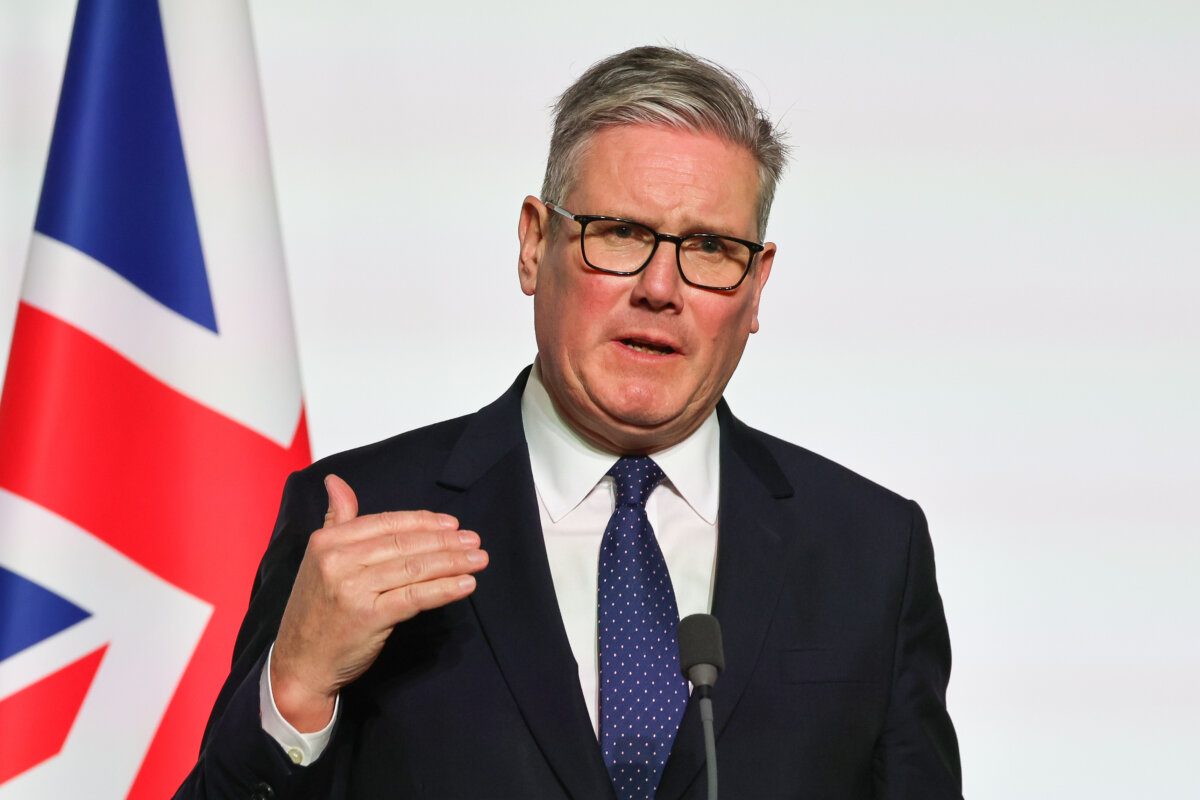

British Prime Minister Keir Starmer remained defiant on May 8 despite heavy losses for his Labour Party in local elections across England, Scotland, and Wales.
“I am not going to walk away,” Starmer told reporters in Ealing, west London, where Labour managed to retain control of the local council.
He said that voters were more frustrated by the slow pace of change than by his leadership itself.
Although Labour suffered significant setbacks, senior allies rallied behind Starmer, whose approval ratings have fallen sharply in recent months. Visiting one of the party’s few electoral bright spots, the prime minister insisted his government would continue pushing forward with its agenda.
Less than two years after securing a landslide national election victory, Labour faced a strong backlash in several traditional strongholds, particularly in former industrial regions of central and northern England.
The biggest winner was Nigel Farage’s populist Reform UK, which gained more than 350 council seats. The party could also emerge as a major opposition force in Scotland and Wales against the pro-independence Scottish National Party and Plaid Cymru.
Early results highlighted the growing fragmentation of Britain’s traditional two-party system, and analysts described it as one of the most significant shifts in British politics in decades.
Both Labour and the Conservatives lost support to Reform UK, the left-wing Green Party, and nationalist parties in Scotland and Wales.
Starmer pledged to outline new measures aimed at revitalizing Britain, signaling yet another reset for a government that has struggled to convince voters of its vision while grappling with a prolonged cost-of-living crisis worsened by conflicts in Ukraine and Iran.
The elections—covering 136 local councils in England and devolved parliaments in Scotland and Wales—represented the most important test of public opinion ahead of the next general election, expected in 2029.
“The picture has been as bad as anyone expected for Labour, or perhaps worse,” British pollster John Curtice said.
Some Labour lawmakers warned that poor performances in Scotland and Wales, combined with major losses among the roughly 2,500 council seats Labour was defending in England, could renew calls for Starmer to step down or announce a timetable for his departure.
However, Starmer’s supporters urged party unity. Defense Secretary John Healey said voters did not want “the potential chaos of a leadership election” and insisted the prime minister could still deliver results.
Farage described the election outcome as a “truly historic shift in British politics.”
Labour was heavily defeated in several early contests. In Tameside, Greater Manchester, the party lost control of the council for the first time in nearly 50 years after Reform captured all 14 seats Labour had been defending.
In nearby Wigan, another longtime Labour stronghold, the party lost all 20 seats it was defending to Reform UK.
Reform also achieved a breakthrough in London by taking control of the Havering borough council in east London, winning 30 of 43 seats.
Although governing parties often struggle in midterm elections, pollsters predicted Labour could suffer its worst local-election losses since former Conservative Prime Minister John Major lost more than 2,000 council seats in 1995 amid a series of scandals.
In the early results, Reform UK gained 367 council seats in England, while Labour lost 254 and the Conservatives dropped 146. Most remaining results, including those from Scotland and Wales, were expected later on Friday.
Reuters contributed to this report.
 Friends Read Free
Copy
Facebook
Tweet
Friends Read Free
Copy
Facebook
Tweet