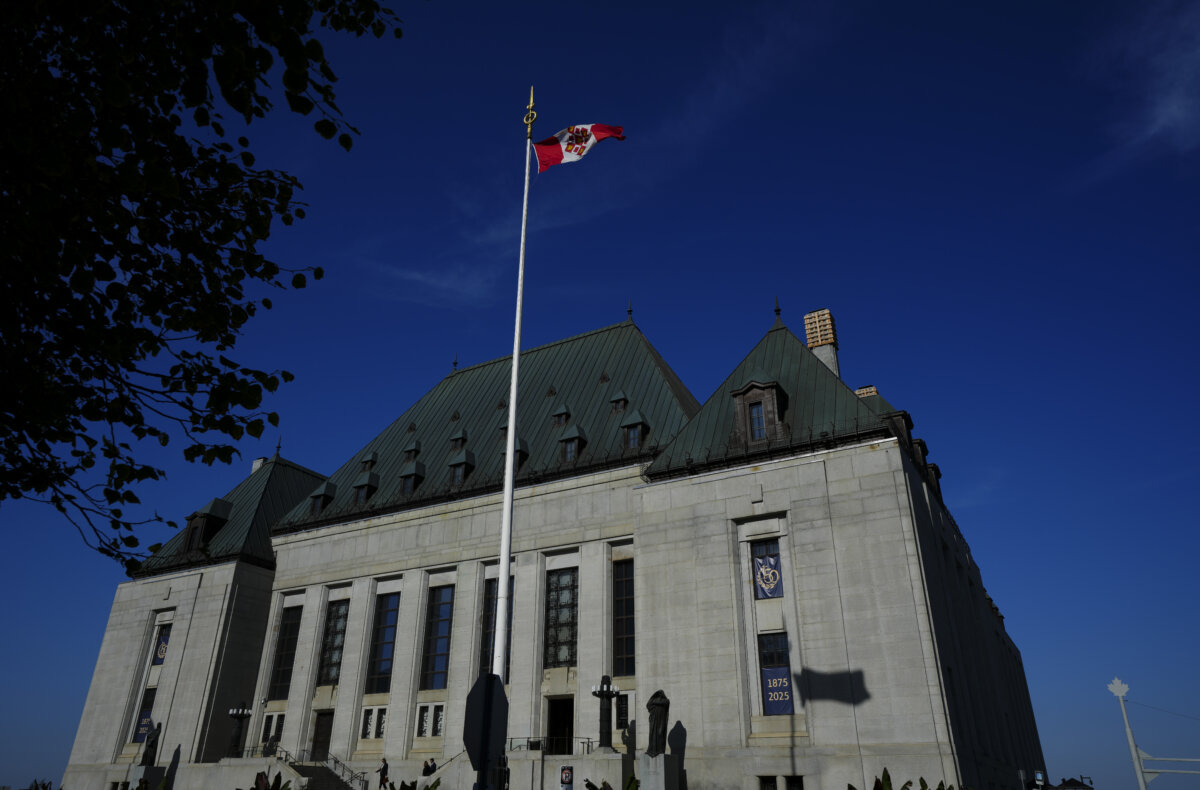

The Supreme Court of Canada has let stand a ruling in an aboriginal title case from New Brunswick that could strengthen protections for private landowners in indigenous land title disputes.
The top court on May 28 declined to hear an appeal by the Wolastoqey Nation against a decision by the New Brunswick Court of Appeal in December of last year.
The lower-court ruling found that aboriginal title claims affecting privately owned land can’t proceed if the landowners themselves are not parties to the case and therefore have no opportunity to defend their interests.
However, the New Brunswick Court of Appeal ruling did not entirely foreclose the possibility of findings related to aboriginal title on private land in the province for compensation purposes and still leaves open the possibility that courts could make findings related to aboriginal title for the purpose of compensation claims against the Crown.
The decision also suggested in several passages that aboriginal title and fee-simple ownership may be legally incompatible and unable to fully coexist over the same land.
“In my view, a declaration of Aboriginal title over privately owned lands, which, by its very nature, gives the Aboriginal beneficiary exclusive possession, occupation, and use would sound the death knell of reconciliation with the interests of non-Aboriginal Canadians,” Justice Ernest Drapeau wrote in the New Brunswick Court of Appeal decision last December, joined in support of the same decision by Justice Kathleen Quigg and Justice Bradley Green.
The Crown-Indigenous Relations Department said the Supreme Court decision will help shape legal arguments in other proceedings, such as the Cowichan case in British Columbia, adding that “private property rights are fundamental.”
Conservative MP Aaron Gunn said that the “Supreme Court of Canada refusing to hear a case does not equal the SCC ‘upholding a decision’.”
“This does not affect the law in B.C.,” he said on X on May 28. “Infer what you will, but those are two entirely different things.”
Wolastoqey Case
The Wolastoqey Nation is made up of six First Nations mainly located near the course of the Saint John River in western and central New Brunswick.
It launched an aboriginal title claim in the province’s superior court for land amounting to more than half of the province’s territory in 2021, arguing that the land comprised its traditional territory and had never been legally ceded or surrendered via treaty.
The claim sought compensation related to Crown grants and land transfers, including privately owned fee-simple property, and directly named several major private landowners as defendants, including New Brunswick forestry giant J.D. Irving and other timber and industrial companies.
In 2024, a judge of the Court of King’s Bench of New Brunswick permitted the aboriginal title claim, including the private land-related claims, to move forward to trial. However, the judge removed the private landowners as defendants, arguing that the aboriginal title claims were against the Crown as it was the party that had originally transferred and historically managed the land, including the private land.
Landowners Appeal
J.D. Irving and other private landowners appealed the Court of King’s Bench decision in an effort to stop the portions of the lawsuit involving their privately owned land from proceeding toward trial. This led to last December’s finding by the New Brunswick Court of Appeal that aboriginal title against their private lands couldn’t proceed as they were no longer party to the case.
The New Brunswick decision held that Wolastoqey could seek compensation claims against the Crown but that a declaration of aboriginal title over private land was unlawful because it would affect the rights of private landowners who were no longer parties to the case and therefore had no opportunity to defend their interests.
“No declaration of Aboriginal title over the appellants’ lands can be granted,” Drapeau wrote.
“The [previous] judge erred … in violation of their right to be heard,” he added.
Cowichan
The New Brunswick Court of Appeal ruling that aboriginal title may be unable to coexist simultaneously with fee-simple property ownership contrasts with the landmark Cowichan ruling by B.C.’s Supreme Court last summer that has cast doubt on the primacy of private property rights. In that case, Justice Barbara Young held that “Aboriginal title does not necessarily defeat fee simple title” and found that the two can “coexist.”
“Aboriginal title is a prior and senior right to land,” Young wrote in her Aug. 7, 2025, decision that recognized aboriginal title over roughly 800 acres in Richmond, B.C.
The ruling raised alarm among municipalities, developers, and property-rights advocates as it indicated that aboriginal title could legally exist alongside fee-simple ownership. The B.C. government has appealed the decision, arguing it risks creating widespread uncertainty surrounding private property rights and land ownership.
Cowichan Tribes, which is one of the member nations of Cowichan Nation, has repeatedly clarified that it was neither seeking nor planning to seek aboriginal title over privately owned land within the claimed area. However, experts such as constitutional law professor Dwight Newman said the ruling nonetheless created uncertainty over whether such claims could be brought in the future by Cowichan or other First Nations.
Cowichan Tribes applied to intervene in a Supreme Court leave application, arguing the New Brunswick case could impact aboriginal title litigation elsewhere in Canada. However, the Supreme Court dismissed the application due to declining to hear Wolastoqey’s appeal.
The Supreme Court’s decision to decline leave to appeal does not explicitly endorse the New Brunswick Court of Appeal’s reasoning and does not create a new Supreme Court precedent.
However, the New Brunswick Court of Appeal’s decision from December of last year remains binding law in New Brunswick unless overturned by another appellate court in the future or a future Supreme Court case. The New Brunswick ruling is only legally binding in New Brunswick, though it may carry persuasive influence elsewhere, according to Newman.
Writing last December after the New Brunswick Court of Appeal decision, Newman said that a Supreme Court decline of leave to appeal in the case would give “more weight” to the argument that aboriginal title and privately owned fee-simple land cannot legally coexist.
“If the Supreme Court of Canada denies leave to appeal in New Brunswick, it is not necessarily taken as fully endorsing the decision below. But it does give it a bit more weight, as the legal community assumes it would have granted leave if it considered the decision drastically wrong in the context of an important issue.”
Newman also added that the Supreme Court’s decision could affect the Cowichan case because courts in British Columbia will now likely look to the New Brunswick ruling for guidance when deciding similar cases involving aboriginal title and privately owned land.
The Canadian Press contributed to this report.
 Friends Read Free
Copy
Facebook
Tweet
Friends Read Free
Copy
Facebook
Tweet