
Conservative Leader Pierre Poilievre says the federal government needs to do more to protect property rights for homeowners in British Columbia and across Canada after the Cowichan Tribes decision last year.
The B.C. Supreme Court ruled last August that the Cowichan Nation had title to approximately 800 acres of land in the area of Richmond, B.C. The ruling declared land title grants issued by the federal and provincial governments to others to be “defective and invalid.”
The court found that fee simple private property ownership and aboriginal title can coexist, but held that aboriginal title takes precedence. Although private owners’ titles were not immediately invalidated, the ruling has created uncertainty around the future of private title in British Columbia, with homeowners in the affected area reporting facing challenges when attempting to renew their mortgage due to the uncertainty.
The province adopted the United Nations Declaration on the Rights of Indigenous Peoples in 2019, committing to align provincial law with the declaration’s principles, including recognizing indigenous peoples’ rights to their traditional lands, territories, and resources, and requiring full consultation and cooperation with First Nations on decisions affecting those lands.
The Conservatives said in an April 9 statement that while existing titles remain “technically valid,” the ruling “called into question whether those rights are fully secure and absolute.”
“That is a foundational shift in Canadian property law and creates uncertainty for homeowners,” the Tories said, adding that the Cowichan precedent could affect property rights across British Columbia.
Poilievre is calling on the federal government to argue before the appeal court that fee simple property ownership comes first and that “no other claim can supersede that ownership.”
The federal government has filed an appeal against the Cowichan decision, along with the B.C. government, the City of Richmond, the Vancouver Fraser Port Authority, Tsawwassen First Nation, and the Musqueam Indian Band.
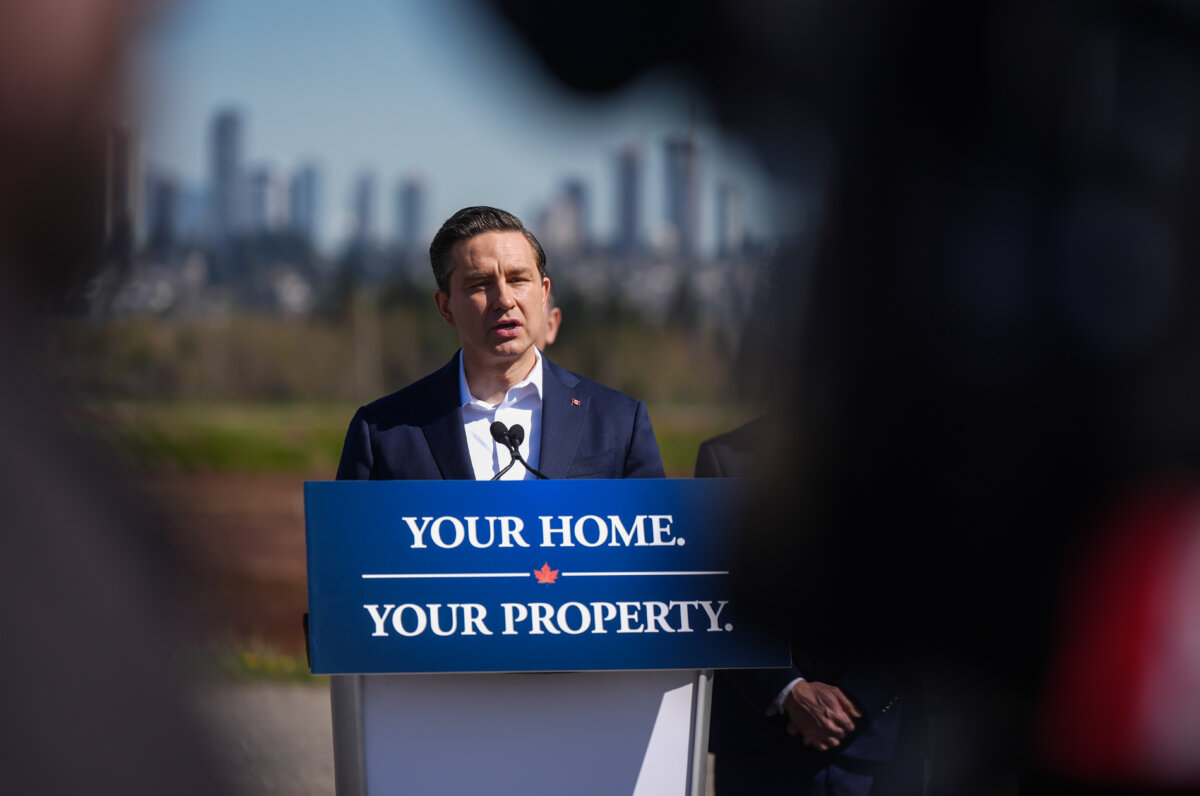
“This is not a claim that indigenous peoples have no rights. They do have rights and those rights should be upheld. At the same time, they must coexist with the rights of homeowners to keep the property that they paid for and they legitimately own,” Poilievre said at an April 9 press conference.
He said his party is also calling on the government to commit that no agreements will be signed with any First Nation without “explicit statement” that fee simple home ownership and private property come first and cannot be overridden.
Ottawa signed three agreements with the Musqueam Indian Band in February, including one that recognizes the Musqueam’s aboriginal rights within large areas of Metro Vancouver and areas at the mouth of the Fraser River under the Constitution Act.
Poilievre said the federal government’s agreement with the Musqueam fails to explicitly protect private property rights, and has deepened uncertainty.
The Tory leader is also calling on the government to release a plan within 30 days on how it intends to protect private property in light of the Cowichan ruling and the Musqueam agreement.
In addition, Poilievre called on Ottawa to convene a parliamentary committee to immediately begin an “emergency study” on what steps might be necessary to protect property rights across Canada, and particularly in British Columbia.
Some Richmond residents received a letter in October from Richmond Mayor Malcolm Brodie advising that the ruling could “compromise the status and validity” of private properties in the affected area. Representatives from the provincial government have also reached out to potentially impacted private property owners in an information campaign that started last November.
The B.C. government pledged last December to give $154 million in loan guarantees to private landowners affected by the ruling.
Paul Rowan Brian contributed to this report.
 Friends Read Free
Copy
Facebook
Tweet
Friends Read Free
Copy
Facebook
Tweet