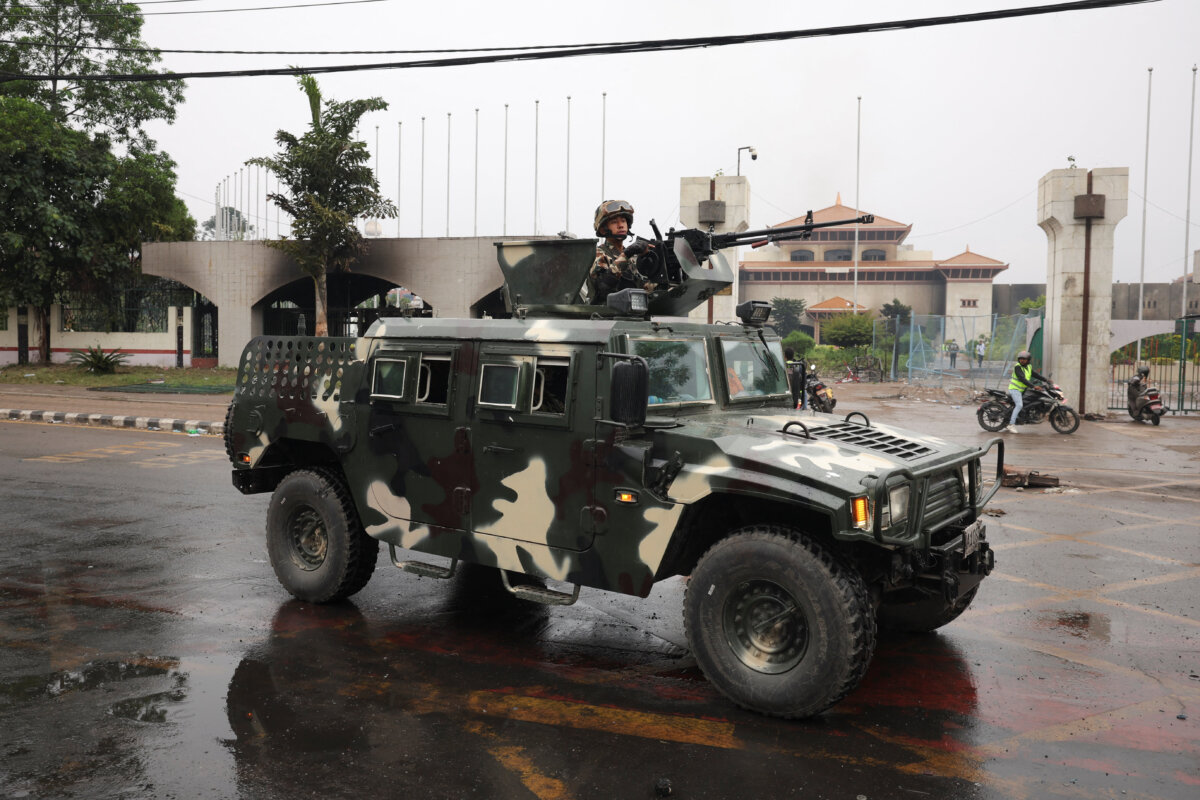

The Nepali army has deployed patrols as the country grapples with its most severe unrest in decades.
“We are trying to normalize the situation first,” army spokesman Raja Ram Basnet said on Sept. 10. “We are committed to protect the life and property of people.”
In a post on X on Sept. 10, the Nepali army stated, “To address problems arising in the aftermath of protests, we urge everyone to coordinate with the concerned authorities in time.”
“[Demonstrations] carried out in the name of protest, including vandalism, looting, arson, and attacks on persons or property, can cause irreparable damage to national assets,” it stated.
“The Army may be mobilized in coordination with local administration whenever law and order are under serious threat.”
The death toll from the protests had risen to 25 by Sept. 10, the Nepali Health Ministry stated, while 633 people were injured.
The military is rarely mobilized in Nepal and initially stayed in the barracks as police failed to control the situation, in an attempt to restore order after tens of thousands of protesters stormed and set fire to government buildings and attacked politicians.
The unrest is the worst in decades in the Himalayan country, wedged between India and China.
Nepali Prime Minister K.P. Sharma Oli, who is the chairman of the Communist Party of Nepal (Unified Marxist–Leninist), resigned on Sept. 9.
The demonstrations, called the protest of Gen Z, began after the government blocked platforms, including Facebook, X, and YouTube, to enforce stringent regulations on social media in the country to curb the spread of what it calls misinformation.
People started attacking buildings and physically assaulting lawmakers and ministers.
Fires were set at the private homes of Oli, Nepali President Ram Chandra Poudel, and former Nepali Prime Minister Pushpa Kamal Dahal, also known as Prachanda, leader of the Communist Party of Nepal (Maoist Centre).
Military helicopters were flown in to evacuate politicians to safety.
The building of Kantipur Publications, the biggest media outlet in Nepal, was also torched and damaged. No injuries have been reported so far, according to The India Times.
Americans currently visiting Nepal were advised on Sept. 9 to shelter in place until further notice because of ongoing destructive protests in the nation’s capital.
“Due to escalating political unrest and violent demonstrations, all U.S. citizens are strongly advised to shelter in place until further notice,” the U.S. Embassy in Kathmandu announced. “Avoid all travel unless absolutely necessary in an emergency.”
The embassy also shared reports that flights out of Tribhuvan International Airport in Kathmandu and Pokhara International Airport in Pokhara, Nepal, had been suspended indefinitely.
India’s security cabinet also met late on Sept. 9 to discuss the situation affecting its neighbor.
“The stability, peace, and prosperity of Nepal are of utmost importance to us,” Indian Prime Minister Narendra Modi said in a post on X on Sept. 9. “I humbly appeal to all my brothers and sisters in Nepal to support peace.”
Former King Gyanendra Shah, the last of Nepal’s monarchs, who lost the throne in 2008 when the monarchy was overthrown, said in a statement: “It is highly condemnable to kill and injure hundreds without addressing the genuine demands of the youths. This is against the values of the peace-loving Nepali society.”
Nepal’s political landscape includes several major communist parties, including the Communist Party of Nepal (Unified Marxist–Leninist), abbreviated as CPN-UML, and the Communist Party of Nepal, known as CPN.
The Chinese Communist Party (CCP) maintains formal party-to-party ties with both.
In June 2022, CCP International Department chief Liu Jianchao held video calls with the CPN and CPN-UML leaders, after which the CCP signed a memorandum of exchange and cooperation with both parties.
The Nepali leaders reaffirmed the “One China” principle, which opposes all forms of Taiwan independence, pledged not to allow “anti-China activity” on Nepali soil, and backed Belt and Road Initiative projects.
T.J. Muscaro, Reuters, and The Associated Press contributed to this report.
 Friends Read Free
Copy
Facebook
Tweet
Friends Read Free
Copy
Facebook
Tweet