
LONDON—U.S. President Donald Trump arrived in the UK on Sept. 16 for a two-day state visit, during which he is expected to meet King Charles, Prime Minister Keir Starmer, and oversee the signing of investment and partnership agreements worth tens of billions of dollars.
Trump’s last state visit to the UK took place in 2019 during his first term, when he was hosted by Queen Elizabeth II at Buckingham Palace. With this visit, he will be the first U.S. president to be invited for two state visits by a British monarch.
“My relationship is very good with the UK, and Charles, as you know, who’s now King, is my friend, and it’s the first time this has ever happened where somebody was honored twice,” Trump told reporters on Tuesday before his departure.
“They want to see if they can refine the trade deal a little bit. We made a deal, and it’s a great deal, and I’m into helping them.”
The invitation was formally extended in February, when Starmer delivered a letter from King Charles to Trump at the White House.
“This is really special,” Starmer said while holding the letter. “This has never happened before; this is unprecedented.”
“The answer is yes,” Trump said in response. “We look forward to being there and honoring the King.”
Hours later, during a joint press conference, Trump touted the invitation, calling it “historic.”
“That’s a great honor because it’s never happened before,” Trump said.
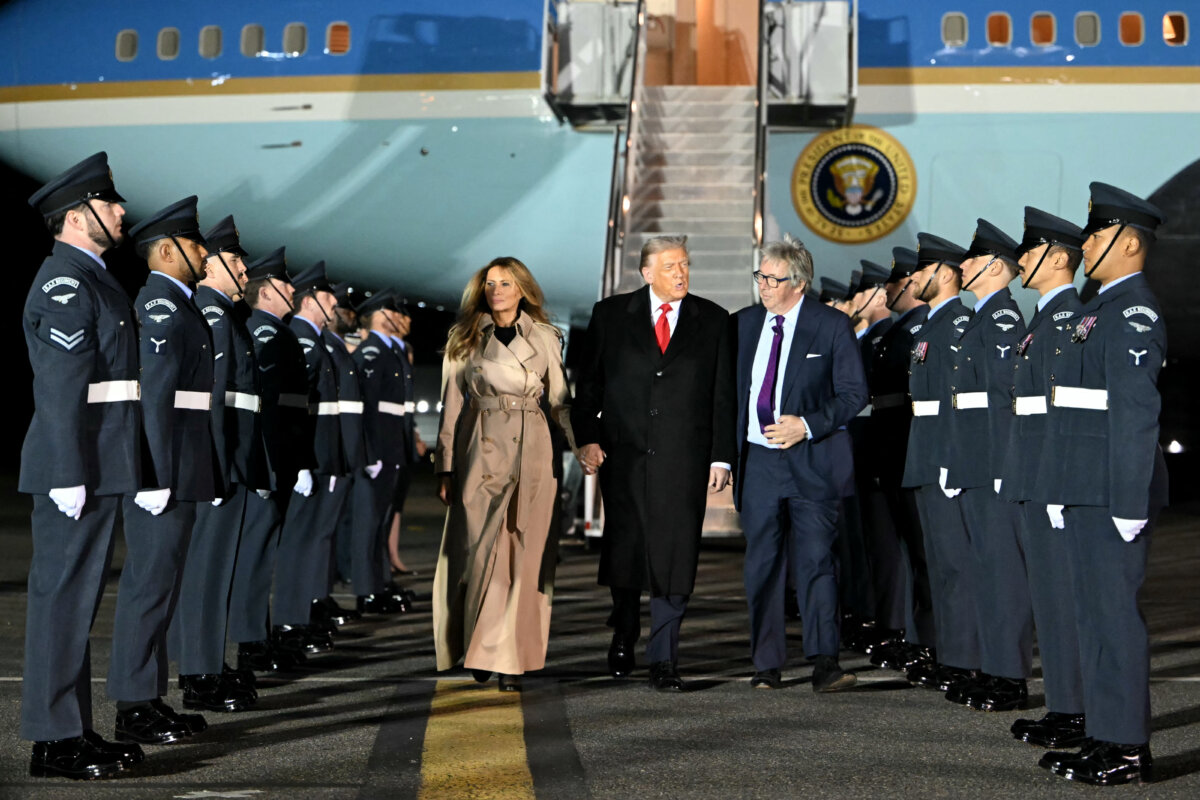
The president, accompanied by First Lady Melania Trump, touched down at London Stansted Airport at 9:07 p.m. local time on Tuesday. They will stay at the U.S. ambassador’s residence in Regent’s Park overnight.
The official program will begin Wednesday morning with a ceremonial welcome at Windsor Castle, where the royal family will host the Trumps while Buckingham Palace undergoes renovations, according to Buckingham Palace.
The president and first lady will first be greeted by the Prince and Princess of Wales, William and Catherine, before being formally welcomed by the King and Queen. The welcome ceremony will be followed by a luncheon in the State Dining Room.
Later in the day, the president and the first lady will lay a wreath at Queen Elizabeth II’s tomb. In the evening, they will attend a state banquet hosted by the royal family at Windsor Castle.
On Thursday, Trump is expected to hold a bilateral meeting with Starmer, followed by a business reception and a press conference.
“This historic second state visit is set to highlight and renew the special relationship between the United States and the United Kingdom,” a senior U.S. official said during a call previewing the trip. “At the same time, the visit will recognize and celebrate the upcoming 250th anniversary of the founding of the United States.”
The president’s delegation includes Secretary of State Marco Rubio, Secretary of the Treasury Scott Bessent, Ambassador Warren Stephens, Special Envoy Steve Witkoff, and Chief of Staff Susie Wiles.
The visit will focus on boosting cooperation in science and technology, civil nuclear power, defense technology, and strengthening ties between the two nations’ financial hubs, according to the official.
The nuclear energy deal that will be announced during the bilateral meeting aims to “achieve full independence from Russian nuclear fuel by 2028,” another senior U.S. official said.
The United States and the UK announced on May 8 that they had reached an agreement on the general terms of a trade deal after months of negotiations. On June 16, Trump and Starmer signed the agreement on the sidelines of the G7 Summit in Canada.
The deal provides increased access to the UK market for certain U.S. goods, including beef, ethanol, and some agricultural products.
Under the agreement, the United States will allow an annual quota of 100,000 vehicles imported from the UK at a 10 percent tariff rate. It also establishes a tariff exemption quota for UK-made steel and aluminum products, along with certain derivatives of these metals.
Both countries agreed to negotiate “significantly preferential treatment” for UK pharma products and establish tariff-free bilateral trade in certain aerospace products.
 Friends Read Free
Copy
Facebook
Tweet
Friends Read Free
Copy
Facebook
Tweet