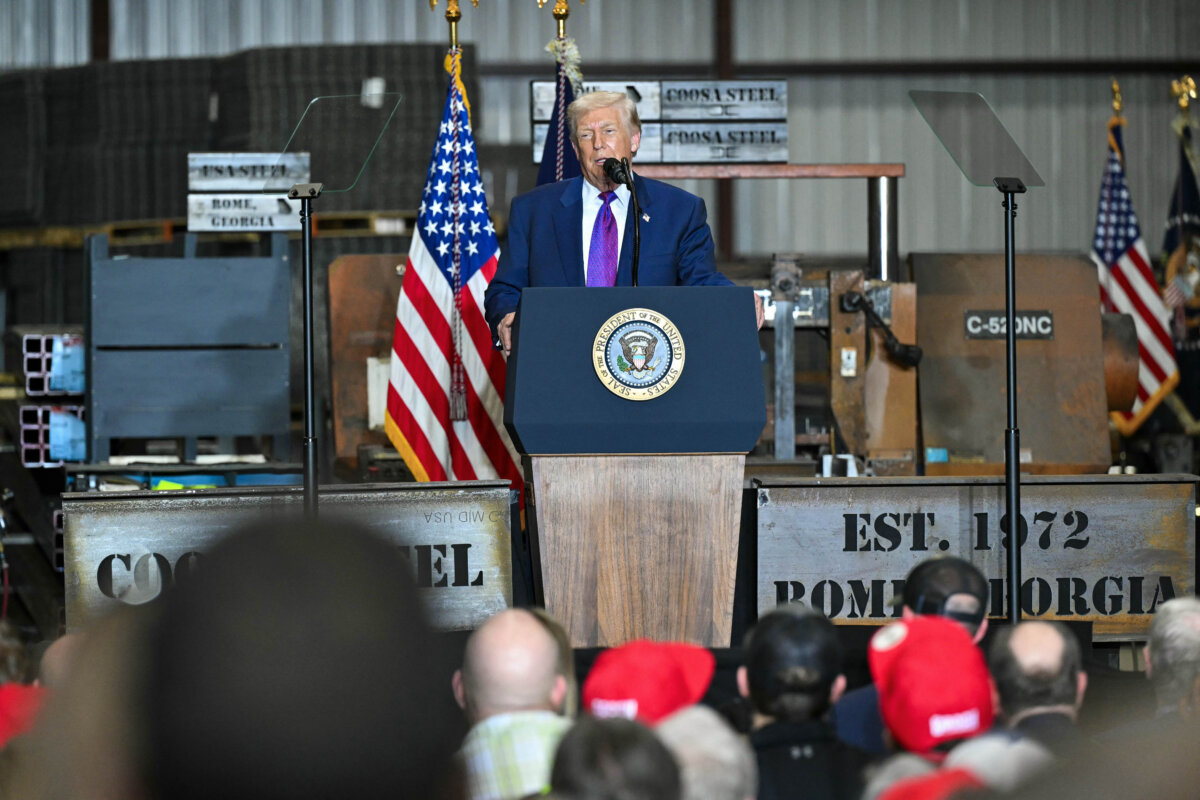

President Donald Trump committed to removing Vietnam from the United States’ list of countries to which advanced technology exports are restricted, Hanoi’s communist regime stated after Vietnamese leader To Lam visited the White House on Feb. 20.
The two leaders discussed bolstering bilateral efforts, such as trade and scientific cooperation. The meeting followed Lam’s attendance at the inaugural session of the Board of Peace in Washington, an initiative by Trump to work toward the resolution of global conflicts, including the Gaza crisis.
Lam, who serves as general secretary of Vietnam’s ruling Communist Party, was one of the first leaders to join the Board of Peace. He told Trump that Vietnam “stands ready to coordinate with the US and other members of the Board to implement the peace plan,” according to a summary of the discussion from the Vietnamese Ministry of Foreign Affairs.
According to the ministry, Trump welcomed Vietnam to the Board of Peace, saying it was demonstrative of the Southeast Asian country’s “growing role and standing in the international arena, as well as its strong commitment to global peace, stability, and cooperation.”
In the talks, Lam proposed increasing high-level exchanges and called for open dialogue on trade issues to balance interests. Trump said he would instruct agencies to remove Vietnam from the strategic export control list (D1–D3) soon, according to Vietnam’s official summary.
The president also accepted an invitation from Lam to visit Vietnam, which has become a central U.S. partner in Southeast Asia in a bid to counter a rising military threat from Beijing.
The White House did not immediately return a request for comment.
The meeting coincided with the announcements of several deals between U.S. and Vietnamese firms. Boeing said Vietnam Airlines agreed to purchase 90 of its aircraft, worth more than $30 billion, including 50 737 MAX jets, and Sun PhuQuoc Airways agreed to purchase 40 787 Dreamliners. Trump praised Vietnam’s commitment to rebalancing bilateral trade and said the contracts would provide jobs for Americans.
Hours earlier, the Supreme Court struck down Trump’s use of an emergency law to impose tariffs, including the reciprocal tariffs he announced in April 2025. Shortly after, Trump signed an executive order imposing 10 percent global tariffs under Section 122 of the 1974 Trade Act, which he increased to 15 percent on Feb. 21.
The temporary levy will last 150 days without congressional extension, and the president said his administration will be exploring alternative tariff pathways during this period.
In 2025, Trump announced reciprocal tariffs targeting countries with large trade surpluses, including Vietnam, which could have been subject to a 46 percent reciprocal rate. The two countries reached a trade deal in July that lowered the rate to 20 percent, with a 40 percent tariff on goods that are transshipped through Vietnam, often by China, to evade duties.
After the Supreme Court’s decision, Treasury Secretary Scott Bessent said in a Fox News interview that he thinks all trading partners who negotiated deals after the reciprocal tariffs were unveiled will honor their trade agreements.
 Friends Read Free
Copy
Facebook
Tweet
Friends Read Free
Copy
Facebook
Tweet