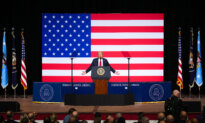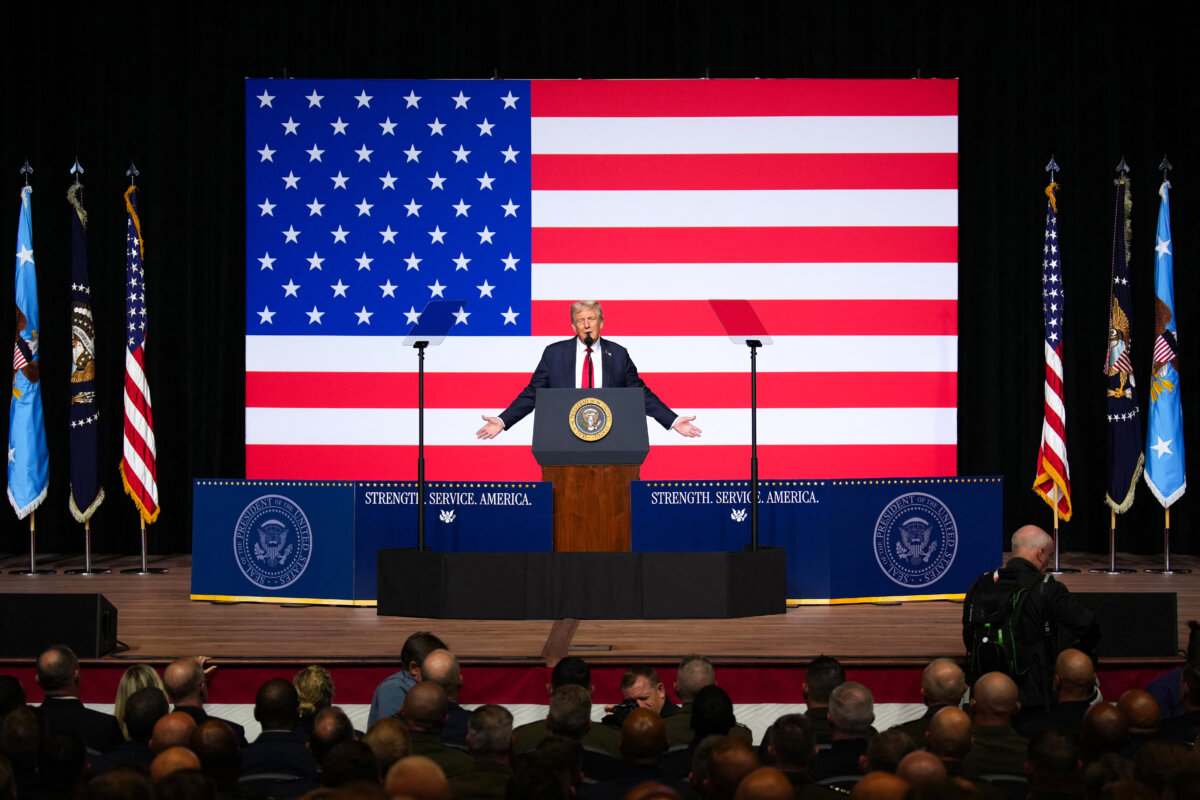

U.S. President Donald Trump addressed a rare meeting of all of his country’s top military officers in Virginia on Sept. 30, where he made a reference to Canada.
He said Canada wants to be part of the “Golden Dome,” a new territorial air defence system the United States has started to build under his watch.
“Canada called me a couple of weeks ago,” he said. “They want to be part of it, to which I said: ‘Well, why don’t you just join our country, become the 51st state, and you get it for free.'”
Trump first began speaking about Canada becoming the 51st U.S. state shortly after he won the presidential election in November 2024. This talk had mostly subsided after Trump met with Prime Minister Mark Carney at the White House in early May, shortly after Carney won the federal election.
During the May meeting, however, Trump told Carney and the global media that Canada would gain benefit by joining the United States. Carney politely disagreed, saying that would never happen.
Later in May, Trump posted on his Truth Social platform that Canada wanted to be part of the Golden Dome system and that the price tag would be $61 billion. He added it would cost “ZERO DOLLARS if they become our cherished 51st State.” Trump said Canada was considering joining the Golden Dome project, something which Carney later confirmed.
This appears to be the conversation Trump alluded to Sept. 30 as he spoke to U.S. military commanders from around the world who had been recalled to the Marines base in Quantico, Virginia.
He told them he doesn’t know whether what he told Canada about joining the United States to get the Golden Dome for free “made a big impact,” while adding “it does make a lot of sense.”
“It actually makes [sense] because they’re having a hard time up there in Canada now, because, as you know, with tariffs, everyone’s coming into our country,” said the president, in a reference to increased business investments in the United States.
Trump has wielded tariffs for a variety of purposes, including to mould the policies of foreign countries, to increase federal revenues, and shore-up domestic manufacturing. His latest round of tariffs was announced on Sept. 29 and targets timber, lumber, and derivatives.
Trump’s speech, which extended beyond an hour, listed his administration’s accomplishments and criticized his political opponents.
Addressing the name change of the U.S. Department of Defense to the Department of War, Trump said it “reflects far more than the shift in branding.” He called it a “historic reassertion of our purpose and our identity, our pride. That’s when we go with the word ‘war.'”
Trump said this change is not because his administration wants war, but rather because it has to be prepared to wage it in certain cases. Trump repeated what he said before the United Nations General Assembly last week about stopping “seven wars” since he took office in January. This includes the longstanding conflict between Armenia and Azerbaijan.
The Trump doctrine has remained to achieve peace by building a powerful military deterrent, what he calls “peace through strength.”
War Secretary Pete Hegseth spoke on that topic before Trump took the stage. Hegseth’s address focused on changing the culture and standards within the U.S. military in a bid to make it more adept at winning wars.
“This administration has done a great deal from day one to remove the social justice, politically correct and toxic ideological garbage that had infected our department, to rip out the politics,” he said. “No more identity months, DEI offices, dudes in dresses. No more climate change worship, no more division, distraction or gender delusions, no more debris. As I’ve said before and will say again, we are done with that [expletive].”
Hegseth said the military is returning to promotions on the basis of merit and that strict grooming and physical shape standards will be enforced.
 Friends Read Free
Copy
Facebook
Tweet
Friends Read Free
Copy
Facebook
Tweet