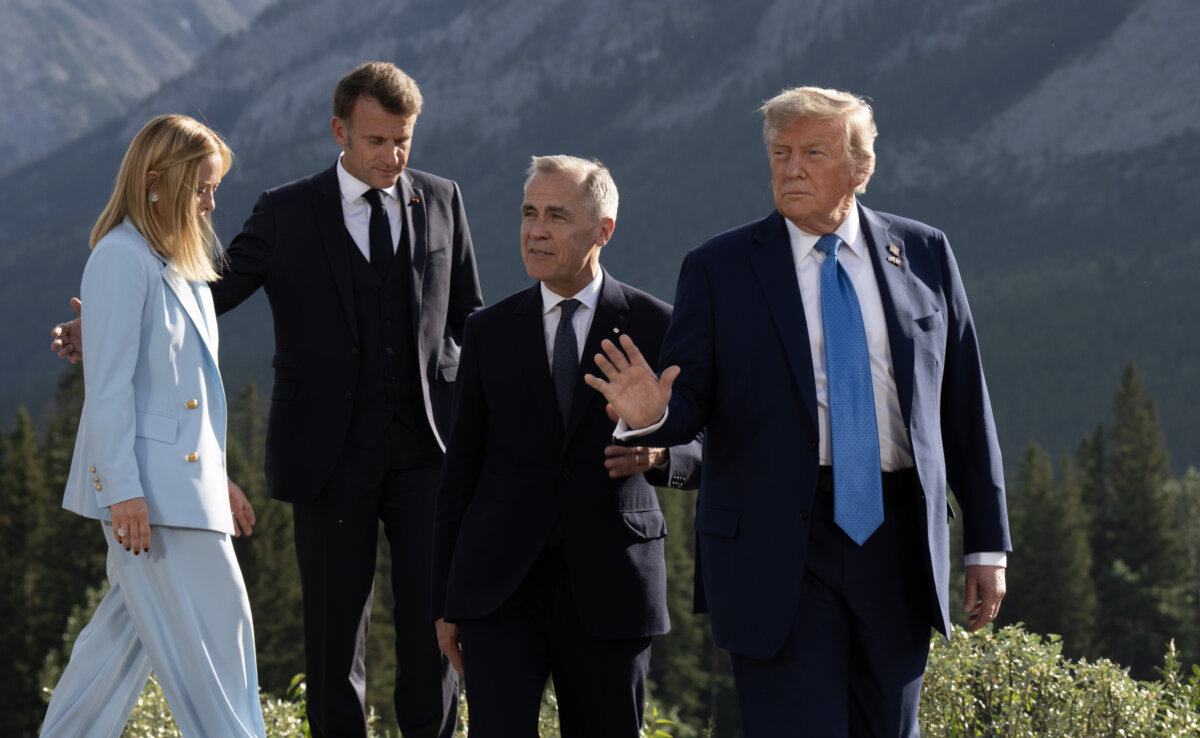
U.S. President Donald Trump said Canada’s July 30 announcement that it will recognize Palestinian statehood doesn’t please him but won’t stand in the way of the United States reaching a trade agreement with Canada.
“I didn’t like what they said,” Trump told reporters at the White House on July 31, though adding it’s “not a deal breaker.” Earlier that day, Trump had said on his Truth Social platform that Canada recognizing Palestine would make it “very hard” to reach a trade deal with them.
Trump also told reporters that he received a call from Prime Minister Mark Carney earlier in the day but hadn’t yet spoken to him.
The White House on July 31 proceeded with plans to hike tariffs on Canada from 25 percent to 35 percent starting Aug. 1, saying the new rate is due to the “flow of illicit drugs across our northern border.” Products under the United States-Mexico-Canada Agreement (USMCA) continue to be exempt from the tariffs. Canada is also subject to sectoral tariffs of 50 percent on steel, aluminum, and copper.
“They have been charging very, very high tariffs to our farmers, some over 200 percent and they’ve been treating our farmers very badly. They’ve been treating our country very badly for years. And look, we like Canada. I love Canada. I have so many friends in Canada, but they’ve been very poorly led,” Trump said July 31.
“They want a lot of things from our country. And for years, we did it. We basically protect them with our military,” Trump added.
Last week, Trump said that “we haven’t really had a lot of luck with Canada” in terms of trade negotiations, and added that “Canada could be one where they’ll just pay tariffs.”
Earlier this month, Carney said trade negotiations with the United States have been “tough” and he has not yet agreed to a deal that meets his criteria of being good for Canadians.
The same day Trump commented that a deal is still possible with Canada to avoid 35 percent tariffs, he announced that Mexico will have 90 days more in which tariffs won’t be raised following a “very successful” conversation with Mexican President Claudia Sheinbaum.
South Korea also agreed to a last-minute trade deal with the United States, announced July 30 on Truth Social by Trump, in which Seoul faces a 15 percent tariff and agrees in return to invest in various U.S. products and buy U.S. energy as well as charge zero tariffs on a number of American products including vehicles and agriculture.
Other trading partners who have also signed deals with the United States include the European Union, Japan, Vietnam, Indonesia, the Philippines, the U.K., and India.
Carney’s July 30 announcement that Canada will recognize Palestinian statehood at the UN General Assembly in September comes in the wake of France previously stating its intention to do the same, along with U.K. leader Keir Starmer saying his country will also recognize Palestinian statehood in September if Israel doesn’t agree to a cease-fire in Gaza.
Trump has said that he is “not in that camp” with Starmer and other leaders who plan to recognize Palestinian statehood, saying he believes doing so is “rewarding Hamas.”
U.S. Commerce Secretary Howard Lutnick said July 31 that Carney’s decision to recognize Palestine statehood was “tone deaf.” On the trade negotiations, Lutnick said that Canada is the only country other than China to issue counter-tariffs against the United States.
“I just don’t see the president stepping off the gas. Now, Mark Carney came down and had a really nice lunch with the president when he first got elected. You know, if he makes that call and if he starts turning on the charm and if he takes off his retaliation … and stops the silliness, maybe the president will let it down a bit,” Lutnick added. “But right now, 35 percent, that letter [Trump] sent, is surely in the cards.”
So far this year, Trump has collected an estimated US$151 billion in tariff revenues, according to the U.S. Treasury. Trump has set an Aug. 1 deadline for countries to reach trade agreements with the United States and says the date won’t be extended. Nonetheless, U.S. Treasury Secretary Scott Bessent has advised countries who don’t reach a deal by Aug. 1 to not “panic” as trade negotiations can still proceed, albeit with tariff rates potentially resetting to April 2 rates set by Trump from which various countries, including Canada, have thus far been exempted.
 Friends Read Free
Copy
Facebook
Tweet
Friends Read Free
Copy
Facebook
Tweet