
News Analysis
The United States and Israel launched a large-scale military operation against Iran aimed at overthrowing Tehran’s Islamist regime on Feb 28. The military action demonstrates that President Donald Trump is not on the path of isolationism—as some analysts had suggested—but is allowing the United States to once again assume the role of the world’s policeman.
President Ronald Reagan, supported the overthrow of Marxist-Leninist regimes to help people in foreign countries pursue freedom.
Amid negotiations with Iran and mass protests in Iran’s streets, Trump repeatedly expressed his desire to see the overthrow of the theocratic regime in Iran. On Feb. 13, Trump confirmed the deployment of a second carrier strike group to the Middle East, stating that regime change in Iran “seems like the ideal scenario.”
Trump’s Explanation
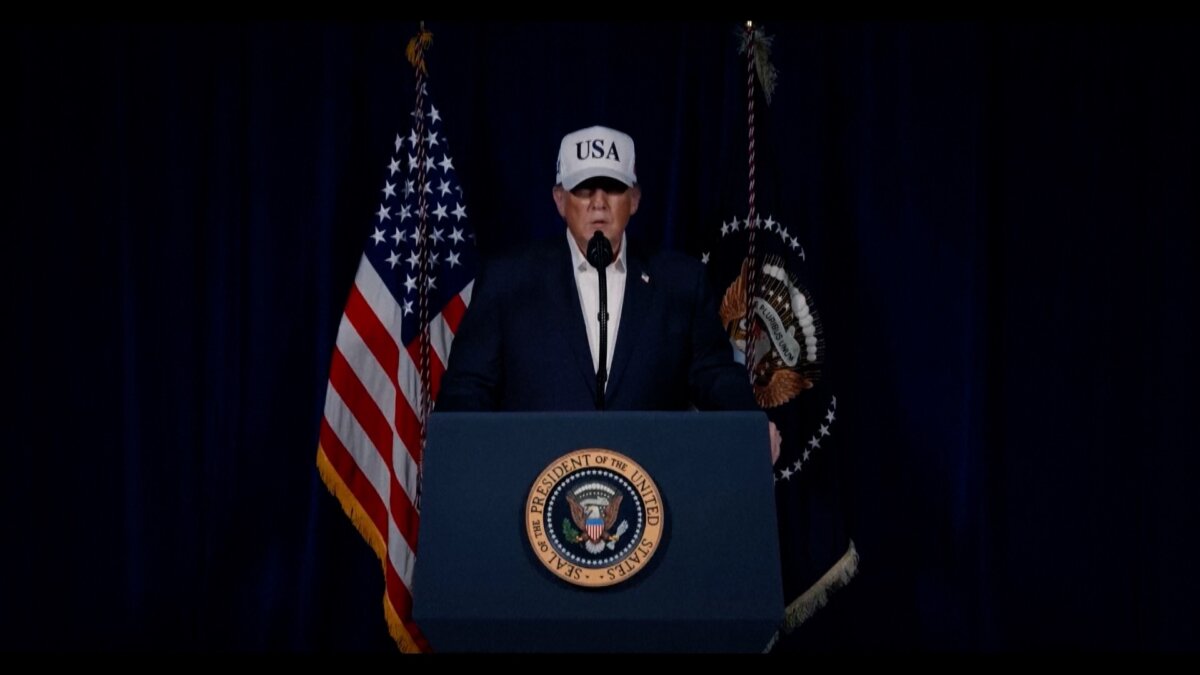
In a video address on Saturday, Trump announced that the United States had launched a “massive military operation” in Iran, vowing to destroy the Iranian Navy, the dictatorship’s terrorist proxies, and its nuclear program. Trump called on the Iranians to “take over your government.”
This appeared to be in contrast to some of Trump’s past rhetoric of “opposing regime change in the Middle East and focusing on domestic affairs.”
During his 2016 campaign, he opposed the U.S. war in Iraq and portrayed his Democratic opponent, Hillary Clinton, as an incorrigible “shoot-prone” hawk.
“We must abandon the failed policy of nation-building and regime change that Hillary Clinton pushed in Iraq, Libya, Egypt, and Syria,” Trump said at the 2016 Republican National Convention.
In 2019, Trump reiterated his “America First” position. “Our policy of never-ending war, regime change, and nation-building is being replaced by the clear-eyed pursuit of American interests,” he said at the time. “It is the job of our military to protect our security, not to be the policeman of the world.”
He posted on social media that year: “GOING INTO THE MIDDLE EAST IS THE WORST DECISION EVER MADE.”
Even in his second term, the Trump administration consistently sought to distance itself from policies aimed at “overthrowing other governments.” In a speech last December, War Secretary Pete Hegseth pledged that his department would not be distracted by democratic interventionism, undefined wars, and regime change.
Even after the U.S. attack on Iranian nuclear facilities last June, Hegseth maintained that it was not about regime change. “This mission was not and has not been about regime change.”
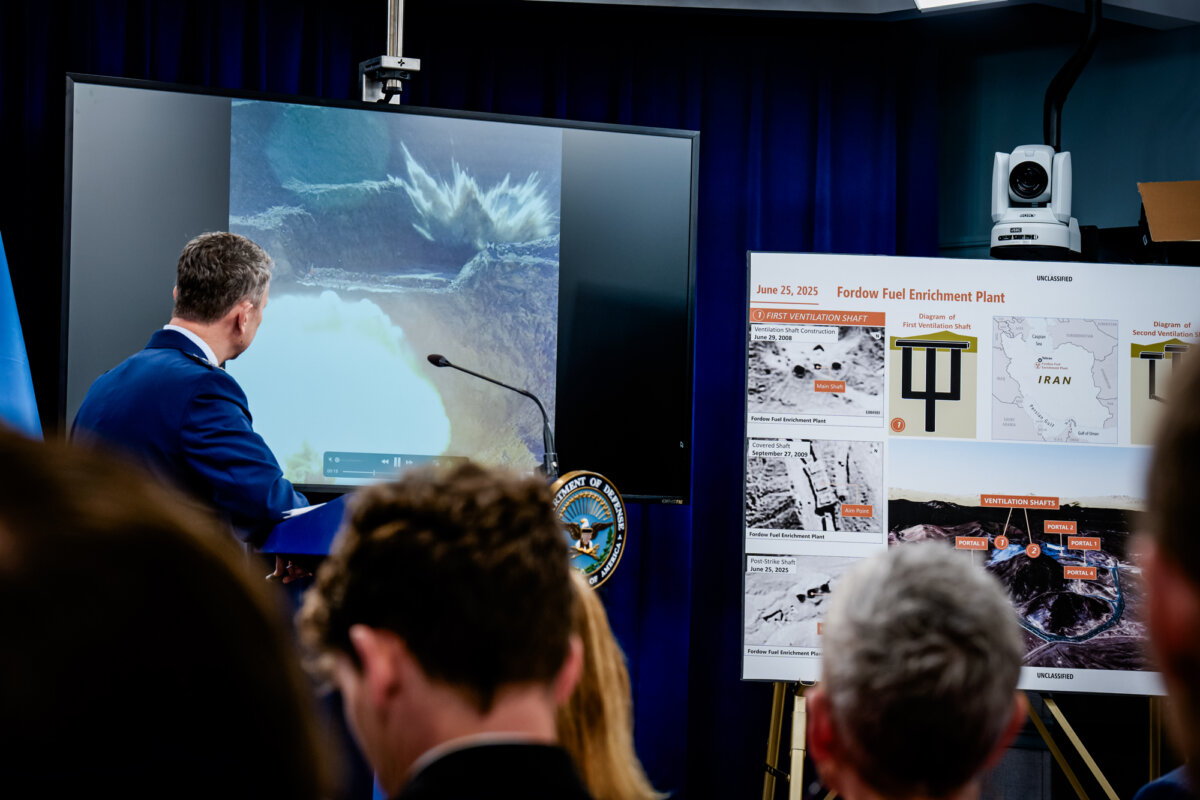
However, on Feb. 28, the United States and Israel launched attacks on Iran, seemingly hitting an area near the office of Supreme Leader Ayatollah Ali Khamenei. Iranian media reported attacks across the country. Trump called on the Iranian people to “take control of your own destiny” and rise up against the Islamic leadership that has ruled the country since 1979.
In a video address on Feb. 28, Trump explained his reasons for deciding to wage war against Iran.
“Our objective is to defend the American people by eliminating imminent threats from the Iranian regime. A vicious group of very hard, terrible people. Its menacing activities directly endanger the United States, our troops, our bases overseas, and our allies throughout the world.”
Trump has accused Iran of killing many Americans.
“Among the regime’s very first acts was to back a violent takeover of the U.S. Embassy in Tehran, holding dozens of American hostages for 444 days,” Trump said during his address. “In 1983, Iran’s proxies carried out the marine barracks bombing in Beirut that killed 241 American military personnel.”
Trump also accused Iran of being the world’s leading state sponsor of terrorism, “just recently killed tens of thousands of its own citizens on the street as they protested.” Trump said that it has always been the policy of the United States that “this terrorist regime can never have a nuclear weapon.”
Trump revealed that following the Midnight Hammer operation last June, Iran attempted to rebuild its nuclear program and continue developing long-range missiles that now threaten U.S. allies in Europe, U.S. troops stationed overseas, and missiles that could soon reach the U.S. mainland.
Therefore, Trump announced that “the United States military is undertaking a massive and ongoing operation to prevent this very wicked, radical dictatorship from threatening America and our core national security interests.” Trump said, “we’re going to destroy their missiles and raze their missile industry to the ground.”
Jacob Shapiro, John Foster Dulles Professor of International Affairs at Princeton University, told The Epoch Times that Trump’s logic for waging war against Iran, as outlined in his statement, is clear:
“First to remove threats to the U.S. and its allies and second to set the conditions for regime change in Iran. The logic for why it made sense to do this now is unclear, though the statement suggests impatience with the progress of negotiations over Iran’s nuclear and missile programs.”
Shapiro co-founded the Empirical Studies of Conflict Project, a multi-university consortium that studies politically motivated violence in countries around the world. He also leads Princeton’s Accelerator Initiative, which is working with partners on four continents to build infrastructure for scientific research on the information environment.
Why did Trump Previously Oppose Intervention in the Middle East But Now Wages War Against Iran?
Carl Schuster, former operations director of the Joint Intelligence Center in Hawaii at the U.S. Pacific Command, told The Epoch Times that Trump has never been an isolationist, and that that’s how the U.S. and European media interpret his national security views.
“He simply felt we have too many bases in too many countries and should force our allies to contribute more to their own defense,” Schuster said. “His so-called ‘isolationism’ was directed primarily at Europe, which had grown accustomed to America carrying disproportionate burden in Europe’s defense. His pressure has forced them to finally increase their contributions to their own defense.”
Schuster stated that Trump’s approach to military intervention in other countries is not one-size-fits-all; he only implements “regime change” actions against countries that meet three conditions:
The first condition is that the current regime faces strong domestic opposition; the second is that it has a cohesive society that will not disintegrate into a failed state; and the third is that the risk of instability spreading is low.
Schuster indicated that Trump believes the Noriego regime change is a model worth emulating. The change of regime under Manuel Noriega occurred in December 1989, following the U.S. invasion of Panama as part of Operation Just Cause. This invasion aimed to overthrow Noriega, a drug smuggler and alleged extortionist dictator, ultimately leading to the collapse of the Panamanian Defense Forces, Noriega’s surrender and capture, and Guillermo Ndara’s rise to the presidency, marking Panama’s move toward democratization.
“Panama has a cohesive society, an educated population, and a large business, legal, and technical class,” Schuster said. “The same can be said for Venezuela and Iran.”
In contrast, Afghanistan, Iraq, Libya, and Somalia were historically clan and tribal societies lacking a strong national identity.
“They were held together by force, or in the case of pre-Taliban Afghanistan, a loose central government that handled foreign policy and acted as an arbiter of inter-clan disputes,” Schuster said. “Afghanistan’s king had only limited authority outside Kabul and had to rule by consensus among the clans.”
Schuster stated that Trump calculates cost-effectiveness in protecting the United States, and that removing threats in cases where he can offers the most cost-effective means of protecting American security.
“By reducing, if not eliminating, distracting national security concerns (Iran, the Middle East, our border) and getting our European allies to carry the bulk of their own defense, he is freeing up resources to deal with the rising China threat,” Schuster said.
“He also is working to isolate China and Russia from their external sources of supply and reduce, if not remove, their influence and presence from regions critical to American security (Panama, the Caribbean, and the Middle East).”
Pride of Being the World’s Police Chief
While understanding Trump’s reasons for launching a war against Iran, Shapiro is concerned about the potential costs the United States might pay for overseas military action.
“Strategy is the art of making the best use of limited resources,” he said. “One has to ask whether this operation with highly uncertain outcomes against a well contained threat is worth the risk to soldiers’ lives and burning through billions of dollars’ worth of ammunition, fuel, and supplies, if things go well (orders of magnitude more if the operation takes weeks, months, or years).”
But Trump responded to these concerns in his video address.
“The lives of courageous American heroes may be lost, and we may have casualties. That often happens in war. But we’re doing this not for now. We’re doing this for the future. And it is a noble mission.”
Trump also stated that the U.S. military action would bring freedom to the Iranian people.
“Tonight that the hour of your freedom is at hand … When we are finished, take over your government. It will be yours to take. This will be probably your only chance for generations.”
In late December 2025, due to economic collapse and political frustration, the Iranian people launched protests that quickly turned into protests against the regime, which were violently suppressed. The suppression included mass arrests and a complete internet shutdown. In January 2026, the Iranian regime declared the “insurrection” over.
Reports indicate that Iranian security forces, including the Islamic Revolutionary Guard Corps and the Basij militia, used live ammunition and shotguns to suppress demonstrators. Trump has said the Iranian authorities killed over 30,000 people.
In his video speech, Trump expressed pride in assuming the role of the world’s police chief in rescuing the oppressed Iranian people.
“For many years, you have asked for America’s help. But you never got it,” Trump told the Iranian people in his speech. “No president was willing to do what I am willing to do tonight. Now you have a president who is giving you what you want. So let’s see how you respond. America is backing you with overwhelming strength and devastating force. Now is the time to seize control of your destiny, and to unleash the prosperous and glorious future that is close within your reach. ”
Reagan, who led the United States to victory in the Cold War and contributed to the collapse of the Soviet Union, supported the overthrow of authoritarian regimes to help people in other countries pursue freedom. For example, in 1985, he proposed a strategy envisioning the United States providing moral and material support to uprisings seeking to overthrow Soviet-backed regimes in Third World countries. The first signs of this “Reaganism” appeared in Reagan’s February 1985 State of the Union address.
In it, he reiterated, “We must never fail those who risked their lives—from Afghanistan to Nicaragua, across every continent—to resist Soviet aggression and defend our inherent rights. Supporting freedom fighters is self-defense.”
Following this, the U.S. government’s rhetoric on this issue increased significantly. In a Feb. 16, 1985, speech, Reagan reiterated his assumption that there was some connection between the United States and the anti-communist liberation movement.
“Time and again we have helped people around the world who fight for freedom, democracy, independence, and liberation from tyranny,” he said, adding, “In the 19th century, we supported the great liberator Simón Bolívar. We supported the Polish patriots, the French Resistance, and others seeking freedom. “
“Standing idly by is not an American tradition.”
 Friends Read Free
Copy
Facebook
Tweet
Friends Read Free
Copy
Facebook
Tweet