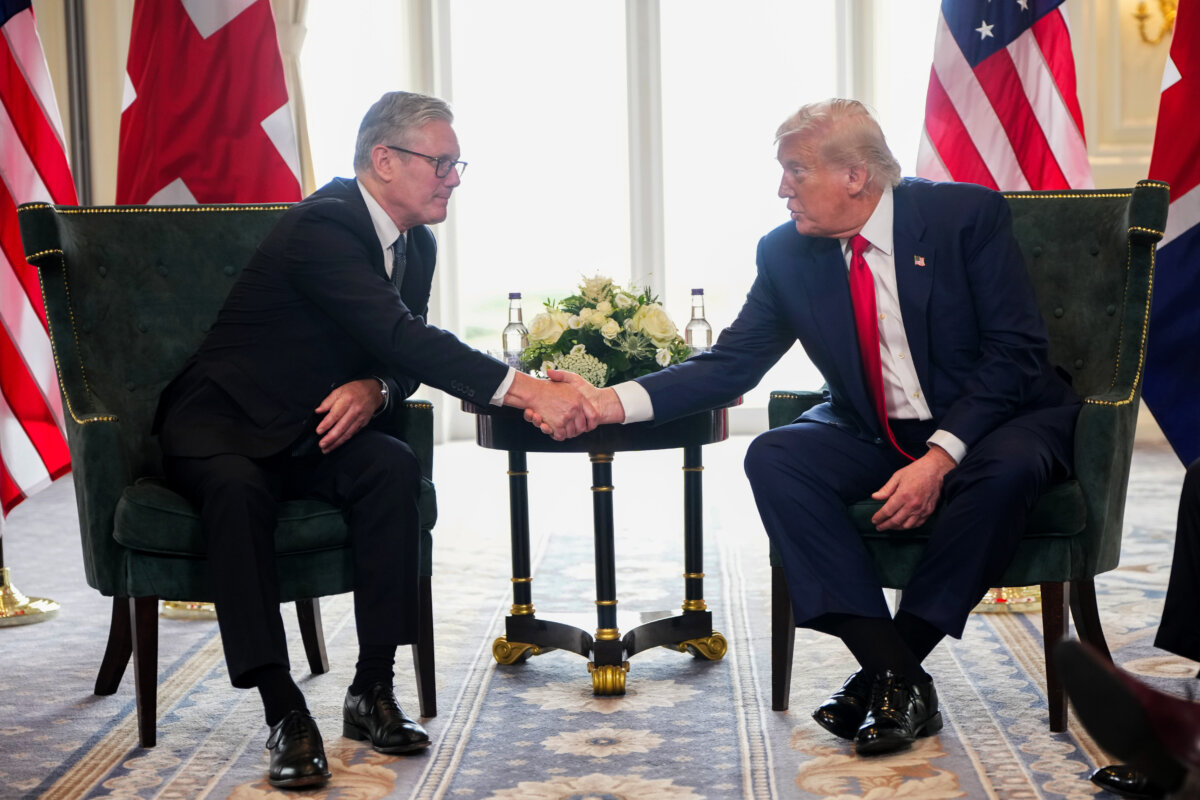

The UK and the United States announced a new nuclear energy deal on Sept. 15, ahead of U.S. President Donald Trump’s state visit to the UK on Sept. 16.
The UK Department of Energy said the move would “turbocharge the build-out of new nuclear power stations” and bring thousands of new jobs.
British Prime Minister Keir Starmer hailed the deal as a “landmark UK–US nuclear partnership” that will lower energy costs and boost the nation’s economy.
“Together with the US, we’re building a golden age of nuclear that puts both countries at the forefront of global innovation and investment,” he said.
The agreements include a partnership between U.S. firm X-energy and UK firm Centrica to build up to 12 advanced modular reactors in Hartlepool, UK, with a follow-up countrywide program.
“The agreement represents the first stage in a new trans-Atlantic alliance which could ultimately mobilise at least 40 billion pounds [$54 billion] in economic value to bring clean, safe and affordable power to thousands of homes and industries across the country and substantive work for the domestic and global supply chain,” Centrica said in a statement on its website.
Other plans include the development of advanced data centers powered by small modular reactors in Nottinghamshire in the UK’s East Midlands, with U.S. firm Holtec working as part of a triumvirate with UK company Tritax and French company EDF, a state-owned energy giant.
Further agreements revealed in the deal include a partnership between UK-based Anglo-Dutch firm Urenco and California startup Radiant to supply advanced high-assay low-enriched uranium fuel to the U.S. market.
High-assay low-enriched uranium fuel is defined as uranium enriched to greater than 5 percent and less than 20 percent of the U-235 isotope, according to the World Nuclear Association.
An agreement has also been reached between TerraPower, founded by Bill Gates, and fellow U.S. firm KBR to evaluate sites in the UK for the deployment of Natrium advanced reactor technology.
The Natrium advanced reactor is a type of nuclear reactor technology developed by TerraPower, which uses liquid sodium as a coolant instead of water, allowing for higher operating temperatures and potentially greater efficiency than traditional light-water reactors. While these reactors are not currently in commercial use, the firm hopes to bring the first of these reactors online by 2030.
“With President Trump’s leadership, the United States is ushering in a true nuclear renaissance—harnessing the power of commercial nuclear to meet rising energy demand and fuel the [artificial intelligence] revolution,” U.S. Energy Secretary Chris Wright said.
He said the deals “set up a framework to unleash commercial access in both the U.S. and UK.”
Wright’s UK counterpart, UK Secretary of State for Energy and Climate Change Ed Miliband, said, “Nuclear will power our homes with clean, homegrown energy and the private sector is building it in Britain, delivering growth and well-paid skilled jobs for working people.”
Trump is set to arrive in the UK for a state visit on Sept. 16, and during his time there will be hosted by both King Charles III at Windsor Castle and by Starmer at his country retreat, Chequers.
Trump last visited the UK in July, when he hosted Starmer at the Trump Turnberry Hotel and Resort on the west coast of Scotland.
This will be Trump’s second state visit to the UK, having previously been welcomed in 2019 by King Charles’s late mother, Queen Elizabeth II, during Trump’s first term as president.
Along with the ceremonial elements of the trip, diplomatic talks are also set to take place while Trump is at Chequers. There will be discussions about the war in Ukraine and finalizing lower tariffs on UK steel and aluminum.
The UK and the United States signed a trade deal in June on the sidelines of the Group of Seven summit in Kananaskis, Canada. However, the deal still left UK steel and aluminum subject to 25 percent tariffs, rates that the UK government is working to reduce.
The state visit comes just days after the UK ambassador to Washington, Peter Mandelson, was relieved of his post after correspondence came to light revealing the extent of his relationship with the late convicted sex offender Jeffrey Epstein.
 Friends Read Free
Copy
Facebook
Tweet
Friends Read Free
Copy
Facebook
Tweet