
Officials are finalizing the wording of a deal between Kyiv and Berlin to share technology and expertise in countering drone attacks.
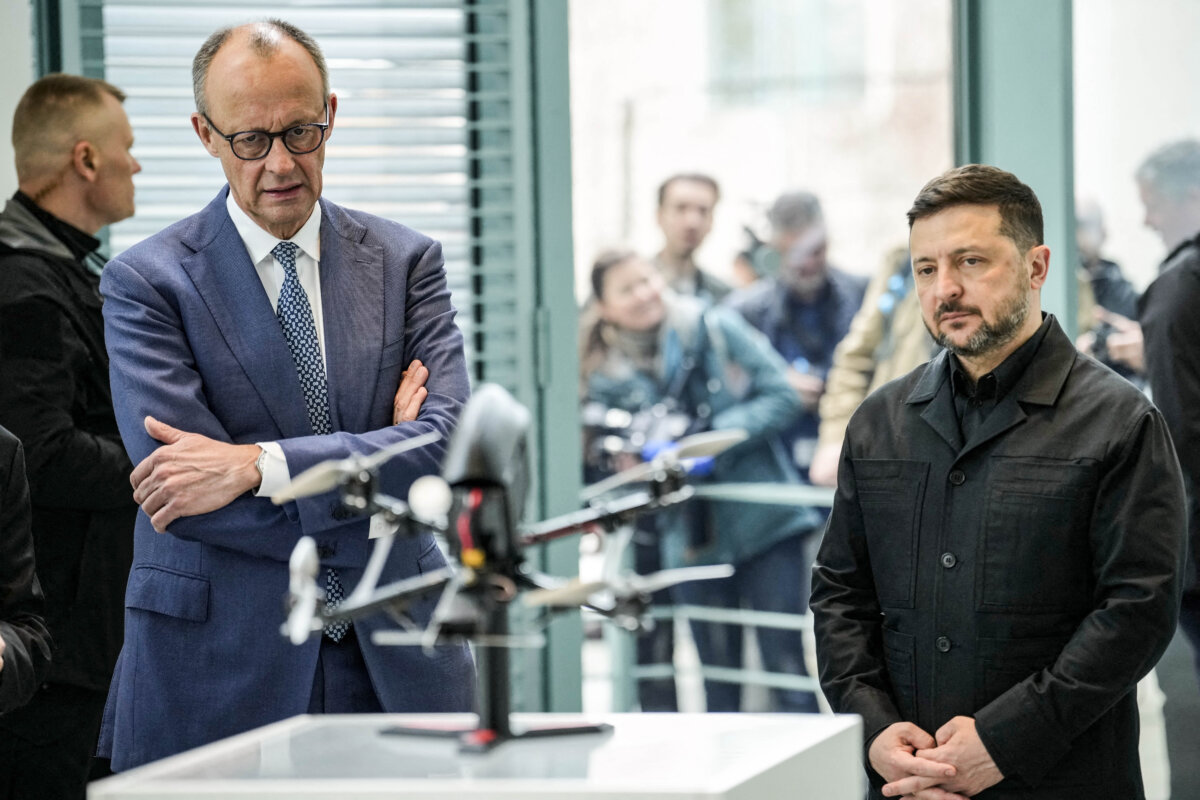
The Ukrainian presidential office said in a Sept. 2 statement that Ukrainian President Volodymyr Zelenskyy and German Chancellor Friedrich Merz discussed the agreement’s content over the phone, as well as a possible signing date.
Zelenskyy said in a post on X that the Drone Deal will “definitely provide both Germany and Ukraine with additional defense capabilities.”
The Ukrainian president said that he and Merz agreed to meet in person.
“I also thanked Friedrich for Germany’s steadfast support and leadership in protecting the lives of Ukrainians—there will be new air defense packages from Germany this month,” he said.
Merz responded to the post on X, writing that he had had a good call with Zelenskyy and that “Ukraine can count on Germany providing determined civil and military support.”
Kyiv has significantly advanced the development and deployment of drone technology—for both counter-drone defense and offensive operations—which has become critical on the battlefield for both sides in the Ukraine–Russia war.
Ukraine has begun formally exporting this technology, with Zelenskyy saying in July that he signed initial documents for an agreement to begin testing drones in the United States.
Drone Deal
While Zelenskyy did not detail the contents of the agreement with Germany, according to the National Security and Defense Council of Ukraine (NSDCU), the Drone Deal is a cooperation in which Kyiv and international partners collaborate on defense and security.
The 10-year agreements are flexible, with Kyiv tailoring solutions to the partner country’s specific security needs, such as air defense development, training programs, and drone technologies.
“Ukraine exports technologies that have been tested and proven in real combat conditions, shares military experience and expertise, and gains opportunities to scale its achievements together with its partners,” the NSDCU says.
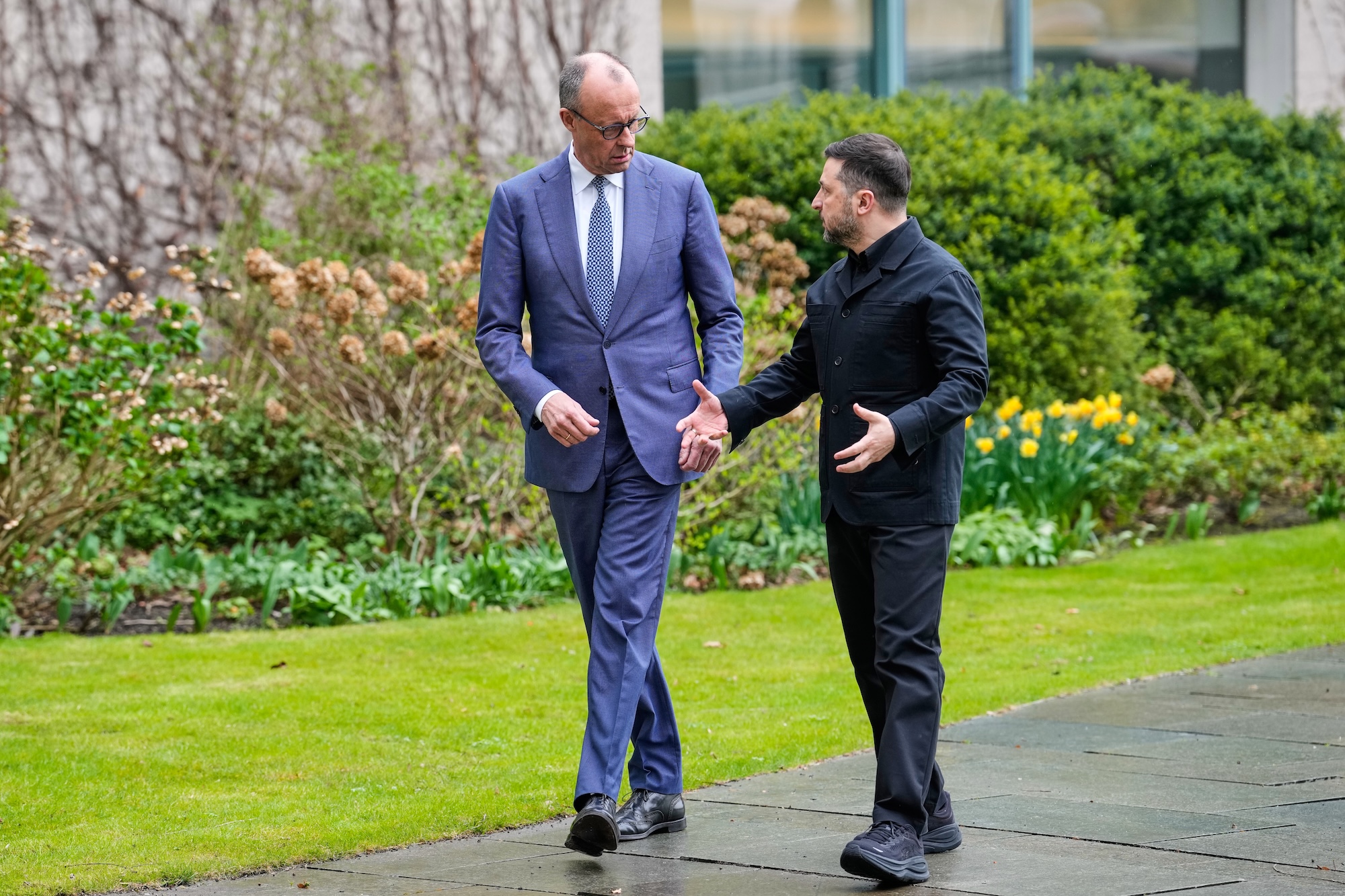 German Chancellor Friedrich Merz welcomes Ukrainian President Volodymyr Zelenskyy for German–Ukrainian government consultations in Berlin on April 14, 2026. (Ebrahim Noroozi/AP Photo)
Since the start of the Iran war on Feb. 28, Zelenskyy has also leveraged Ukraine’s expertise in drone defense systems and warfare in the Middle East. As a result, Ukraine has already signed its first 10-year agreements with the United Arab Emirates, Qatar, and Saudi Arabia, according to the NSDCU.
Requests are ongoing with several other countries, as well as negotiations with European nations, including the UK, France, and Italy, the council said.
Project Freyja
Ukraine is focusing not only on homegrown drone technology but also on anti-ballistic missile systems.
Project Freyja is a Ukrainian-led effort to develop a European anti-ballistic missile system, with a prototype expected by mid-2027.
The Ukrainian president told the heads of Ukraine’s foreign diplomatic missions on Aug. 3 that Project Freyja could become Europe’s common integrated defense system.
He said that Ukraine was capable of making the missile and launcher itself, but needed cooperation from European partners to develop the radars, sensors, and other necessary components and technologies for the anti-ballistic system.
“We already have agreements with all these companies, with all the necessary countries,” Zelenskyy said, noting that 12 manufacturers have joined the Anti-Ballistic Missile Coalition.
The CEO of Fire Point, which produces the FP7.X interceptor for Project Freyja, said on Aug. 4 that it had secured agreements with more than a dozen European defense companies for the radar, guidance, and other systems, and was beginning to integrate them.
“We’re trying to squeeze a program that usually takes 20 or 30 years into a matter of a couple of years,” Iryna Terekh said, echoing Kyiv’s goal of the system’s first successful interception to take place by mid-2027.
 Friends Read Free
Copy
Facebook
Tweet
Friends Read Free
Copy
Facebook
Tweet