
Ukraine’s power grid is facing an unprecedented challenge this winter as Russia escalates the bombardment of its infrastructure, Ukrainian Energy Minister Denys Shmyhal said on Jan. 16.
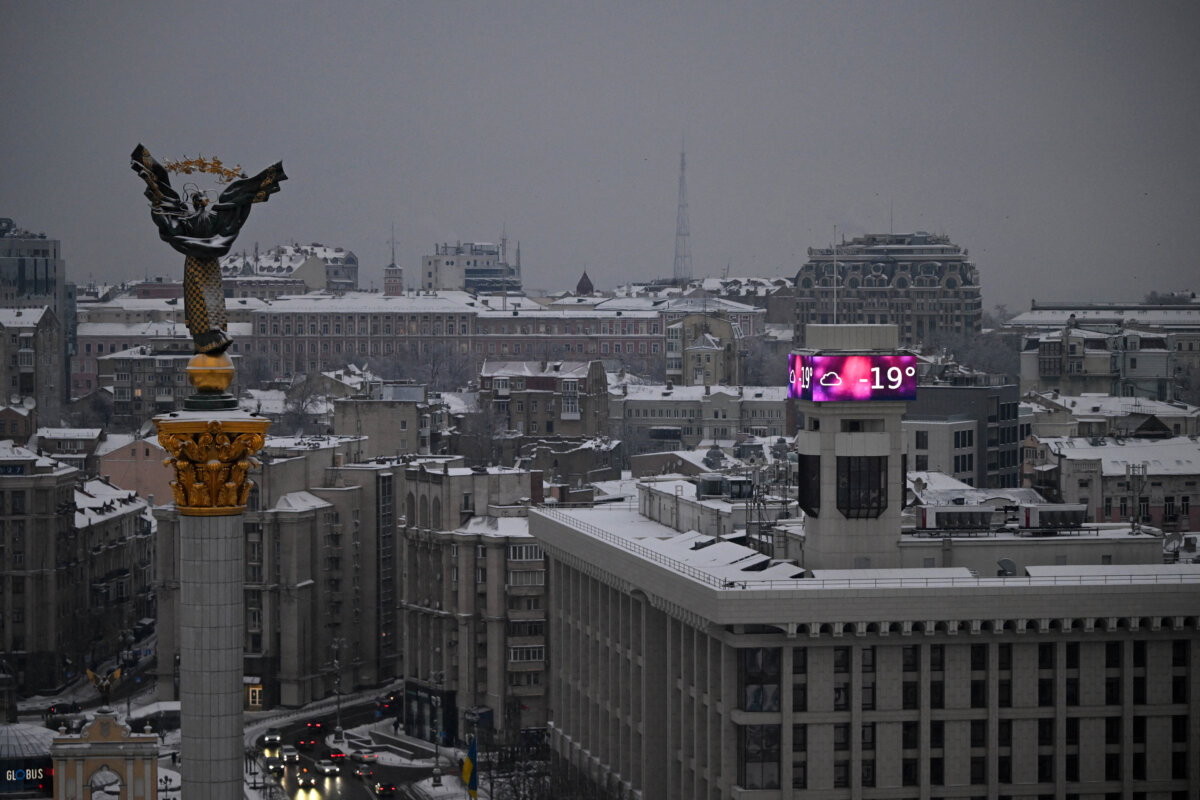
These strikes have left hundreds of thousands of Ukrainians without light or heat for days as winter bites, with nighttime temperatures forecast to plunge to minus 23 degrees Celsius (minus 9.4 Fahrenheit) on the evening of Jan. 16.
“Nobody in the world has ever faced such a challenge,” Shmyhal said in a speech at Ukraine’s parliament, the Verkhovna Rada.
“Over the past year, they have inflicted 612 targeted combined attacks on the energy sector. Now the intensity is only increasing, strikes are taking place every day,” Shmyhal, who took office on Jan. 14, said, according to Suspline Media.
“There is not a single power plant left in Ukraine that has not been hit by the enemy during the war. Thousands of megawatts of generation have been knocked out.”
The power shortage is so acute that Shmyhal has called on businesses to turn off illuminated signage and exterior decorations to conserve electricity.
“If you have spare energy, better give it to people, rather than bright advertising,” the energy minister said.
The government has introduced emergency measures, including a temporary easing of curfew restrictions to allow people to find public heating centers set up by the authorities, Shmyhal said.
Hospitals, schools, and other critical infrastructure remain the top priority for electric and heating supplies, he said, noting that officials have instructed state energy companies Ukrzaliznytsia, Naftogaz, and Ukroboronprom to urgently purchase imported electricity covering at least 50 percent of their own consumption.
When Ukrainian President Volodymyr Zelenskyy confirmed Shmyhal had taken office earlier this week, he said the most challenging situation was in the capital, Kyiv, as well as in the Odessa and Dnipro regions.
In his speech to parliament, Shmyhal said that a state of emergency had been declared in the energy sector.
“In some cities and regions, winter preparations have failed. Over the past two days in office, I’ve seen that many things are clearly stalling,” Shmyhal told parliament.
Shmyhal, who previously served as prime minister and defense minister, ordered emergency imports of electricity. He said that Ukraine needs to install 2.2-2.7 GW of electricity generation capacity by the end of 2026 to meet its consumption needs.
Regarding the gas supply, Shmyhal said that it remains under control, with imports and domestic production continuing despite the attacks.
Shmyhal added that December saw record import volumes for the past year, with more than 220,000 tonnes of fuel being delivered in 2025, leaving the country with enough reserves to sustain at least 20 days of average consumption
“I sincerely thank energy workers, heating engineers, utility services, rescuers, and police officers who continue to deliver results under extremely difficult conditions. Russia is attempting to break us through energy terrorism. We fully understand the scale of the challenges and are responding to them swiftly and effectively,” Shmyhal said at the conclusion of his address.
Russia has bombarded Ukraine’s power grid, especially in winter, throughout the war, in a strategy Kyiv officials have previously labeled “weaponizing winter.”
“This is a critical moment,” Jaime Wah, the deputy head of the Kyiv delegation of the International Federation of Red Cross and Red Crescent Societies, said on Jan. 16.
“This is the hardest winter since the escalation of the conflict: punishing cold temperatures and the lack of heating and electricity are affecting millions who are already pushed to the edge by years of violence and economic strain,” Wah told a briefing in Geneva.
The Associated Press contributed to this report.
 Friends Read Free
Copy
Facebook
Tweet
Friends Read Free
Copy
Facebook
Tweet