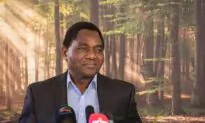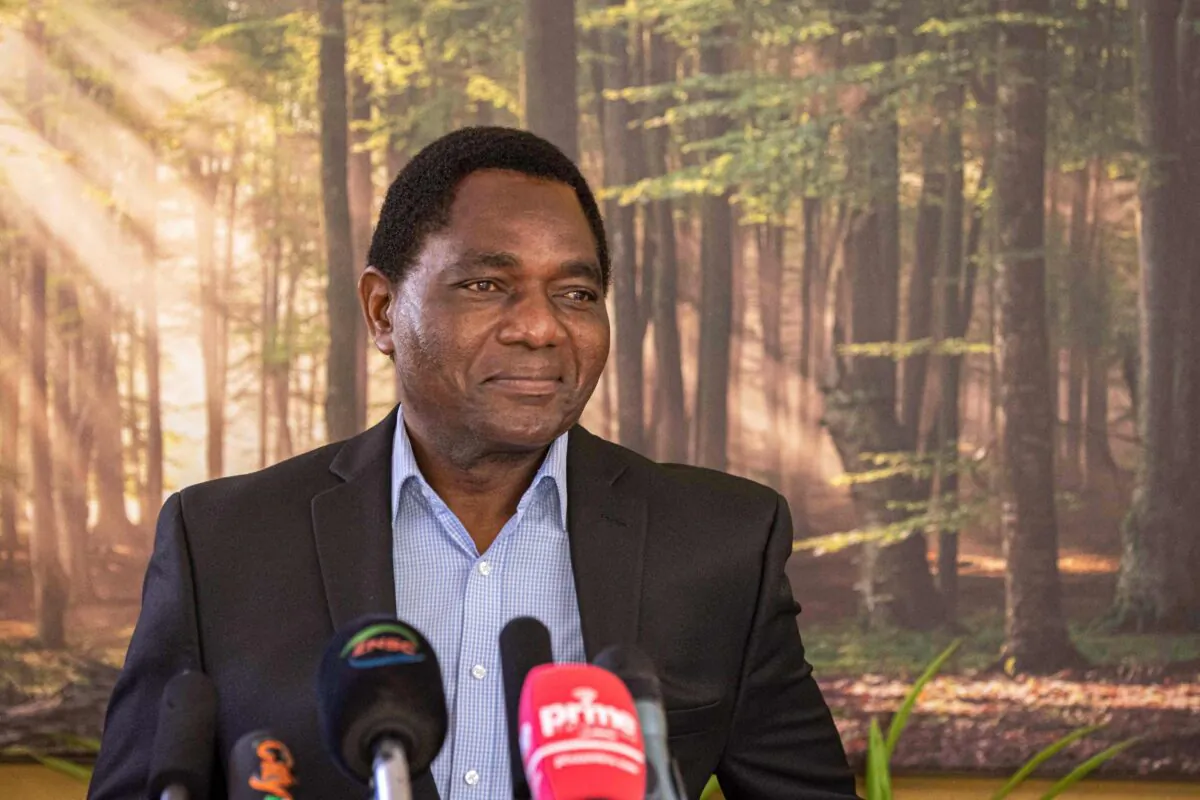
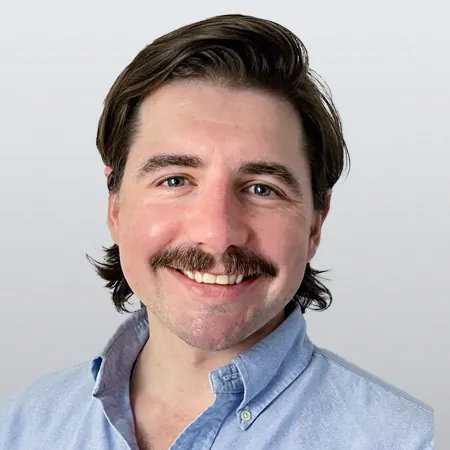
U.S. international aid cuts were “long overdue,” Zambian President Hakainde Hichilema said in comments printed on Oct. 8.
Hichilema said that the reductions from Washington, the abolition of the U.S. Agency for International Development (USAID), and cuts to other international handouts had given the southern African nation the opportunity to take care of its own affairs.
“It forces us to grow our economies and to do the things we should have been doing,” he told the Financial Times, although he acknowledged that it was “painful for now,” as the “instantaneous” cut left his government very little time to adjust.
“There is a shock,” he said. “But longer term, it’s a good thing.”
Zambia, a copper-rich former British colony of nearly 22 million people, which experienced its worst drought in four decades in 2024, has been undergoing extensive economic restructuring since it defaulted on its sovereign debt in 2020.
The country, which Hichilema has led since 2021, previously depended on U.S. aid for about a third of its health budget, according to the U.S. ambassador to the country, Michael Gonzales.
“Because of our commitment to Zambia and the Zambian people,” Gonzales said in May when he announced the cuts, “in recent years the United States has invested roughly $600 million a year—that’s nearly 17 billion Zambian kwacha annually—toward our shared goals of economic development and improved health and wellbeing.
“Roughly one in every three kwacha spent on public health in Zambia comes as assistance from the American people.”
He said that most of that aid went to “buy medications to treat HIV, malaria, and tuberculosis, as well as to provide technical and operational support for Zambia’s national health supply chain.”
However, he said that Washington would now be cutting $50 million from the annual donation to the country because of the “country-wide, systematic theft” of the medications and supplies being provided and the lack of “tangible action” by the Zambian government to deal with that larceny.
Last month, Zambian Finance Minister Situmbeko Musokotwane announced a 13 percent hike in spending on health care, to $1.1 billion, accounting for 11 percent of total state spending, to cover the gap left by the withdrawal of international aid.
He also vowed to crack down on the “pilferage” of donated medicine, adding that “commitment to provision of essential drugs and medicines remains unwavering.”
The cuts of the aid to Zambia came amid sweeping reductions in international aid across the globe by the United States, brought in by the Trump administration earlier this year.
In February, the U.S. government moved to shut down USAID, which was, at that point, the largest foreign aid agency on the planet.
Secretary of State Marco Rubio then confirmed on July 1 that the shutdown of the USAID had been completed.
In a blog post on the State Department’s website at the time, Rubio wrote that foreign assistance provided by USAID had failed to deliver results for Americans and also said that the agency was part of the “globe-spanning [nongovernmental organization] industrial complex” that was funded by taxpayers.
“USAID has little to show since the end of the Cold War,” Rubio said. “Development objectives have rarely been met, instability has often worsened, and anti-American sentiment has only grown. On the global stage, the countries that benefit the most from our generosity usually fail to reciprocate.”
Established in 1961, USAID managed the distribution of U.S. aid and other financial assistance to foreign nations.
The agency’s initiatives include humanitarian response to natural disasters worldwide, global health initiatives, climate and environmental programs, and an array of other programs related to economics, governance, and education.
In 2023, the most recent year with full data available, USAID distributed about $36.8 billion in global aid, roughly half of all foreign aid the U.S. distributed.
 Friends Read Free
Copy
Facebook
Tweet
Friends Read Free
Copy
Facebook
Tweet