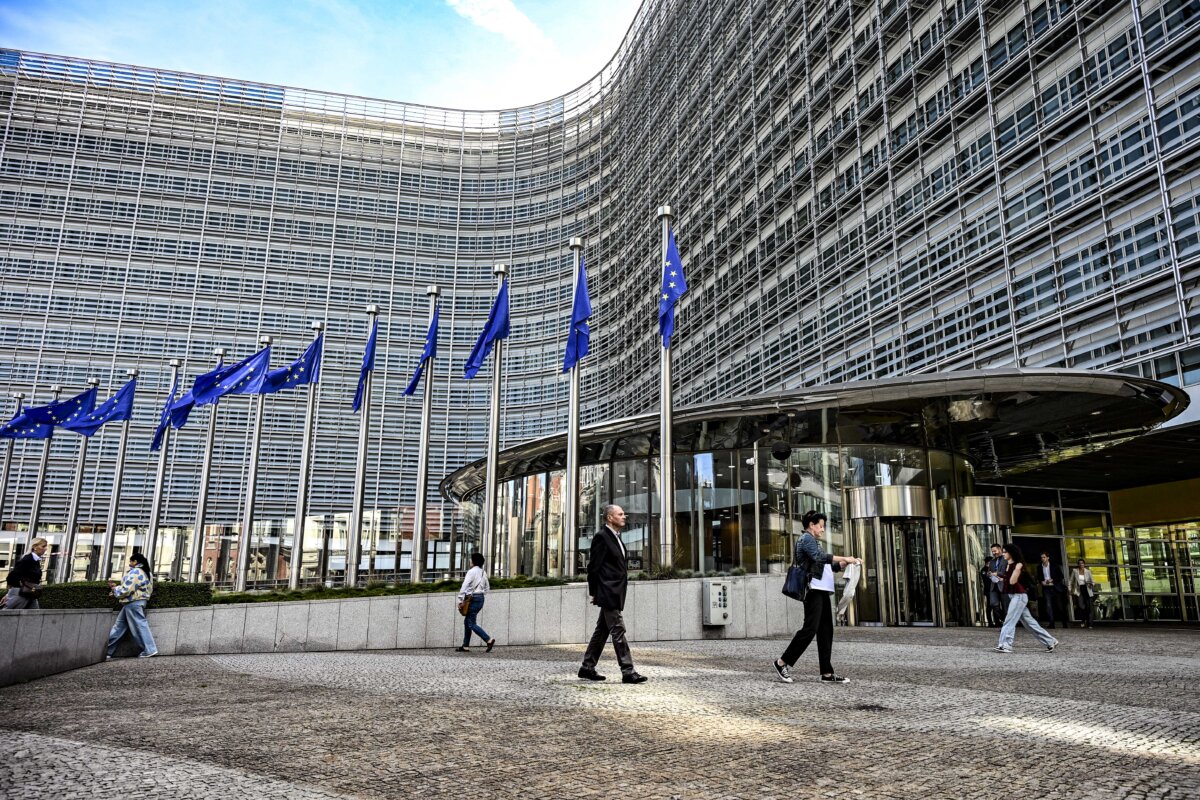

European companies could face “devastating” retaliation from Washington if Brussels restricts American tech rivals, the U.S. ambassador to the European Union said on Oct 19.
Ambassador Andrew Puzder told the Financial Times that European businesses should be wary of possible retaliatory measures, given the size of the U.S. market.
Puzder questioned whether restricting American competition would improve the competitiveness of European companies.
“If the purpose is to make the United States less competitive, I think that that’s not a legitimate goal,” he told the FT.
“You don’t make European companies more competitive by making U.S. companies less competitive.
“We have best-in-class products in this area. They’re reliable products, they’re trusted products. We don’t need some kind of synchronised mediocrity.”
The European Commission is pushing for technological sovereignty.
It proposed new rules in May for allocating the 2 GHz frequency band, which supports satellite communications and emerging services allowing mobile phones to connect directly to satellites.
It does not explicitly propose banning SpaceX or all American operators.
On Oct. 19, four European telecommunications companies—Deutsche Telekom, Orange, Telefónica, and Vodafone—announced that they had signed a letter of intent to explore a joint bid for European satellite spectrum.
The ambassador also questioned the motive behind the EU’s enforcement of its Digital Markets Act (DMA).
“You start to wonder, are we trying to deal with the competition in the digital marketplace or are we trying to generate revenue from American companies to benefit Europe?” he said.
The DMA regulates large digital gatekeepers, including American companies such as Alphabet, Amazon, Apple, Meta Platforms, and Microsoft.
Separately, the Digital Services Act (DSA) requires major online platforms to address illegal content and certain systemic risks.
Last month, French European Affairs Minister Benjamin Haddad suggested that proceeds from fines imposed on Google should reduce member states’ contributions to the EU budget.
“This is a new revenue source for the European Union—worth €4.6 billion—that should automatically lower the contributions of all member states,” Haddad told Franceinfo on Sept. 29.
The ambassador urged Europe “to let go of this regulatory mindset where they’re going to try and stop things because we’re in a race with China” both on AI and on quantum computing.
He added the U.S. can win that race, “but it’d be a lot easier if we were working with Europe instead of fighting Europe.”
The Epoch Times contacted the EU Commission for comment.
Ukraine and Starlink
The transatlantic dispute comes amid a separate issue over restrictions on SpaceX’s Starshield satellite communications system used by Ukraine’s military.
Starlink supports battlefield communications and drones used to attack Russian targets.
Ukrainian President Volodymyr Zelenskyy claimed in an Oct. 18 interview that a restriction on Starlink satellite internet that disrupted Ukrainian combat missions and threatened defenses against Russian drones for three days was a “message” from America’s government.
Serhiy Beskrestnov, an adviser to Zelenskyy, said on Oct. 14 that the restrictions affected terminals using the Starshield military service package when traveling faster than 100 mph.
Ukraine’s defense forces received no advance notice, he said, and several missions were disrupted.
British Defense Secretary Wes Streeting confirmed on Oct. 15 that Ukraine’s access to SpaceX’s Starlink and Starshield services had been restored following a temporary disruption.
Following a meeting with U.S. Secretary of War Pete Hegseth on Oct. 15, Streeting told the BBC that he was “reassured directly” by Hegseth that Ukraine’s access to Starlink and Starshield had been restored.
On Sunday, Zelenskyy said that the United States has resumed its sharing of important intelligence with Ukraine to help defend the country against Russia.
Separately, on Oct. 19, U.S. Secretary of State Marco Rubio denied Zelenskyy’s assertion that U.S. intelligence sharing with Ukraine had temporarily been suspended.
“There’s been no pause,” Rubio told reporters during a visit to Uzbekistan.
Tom Gantert, Timothy Frudd and Reuters contributed to this report.
 Friends Read Free
Copy
Facebook
Tweet