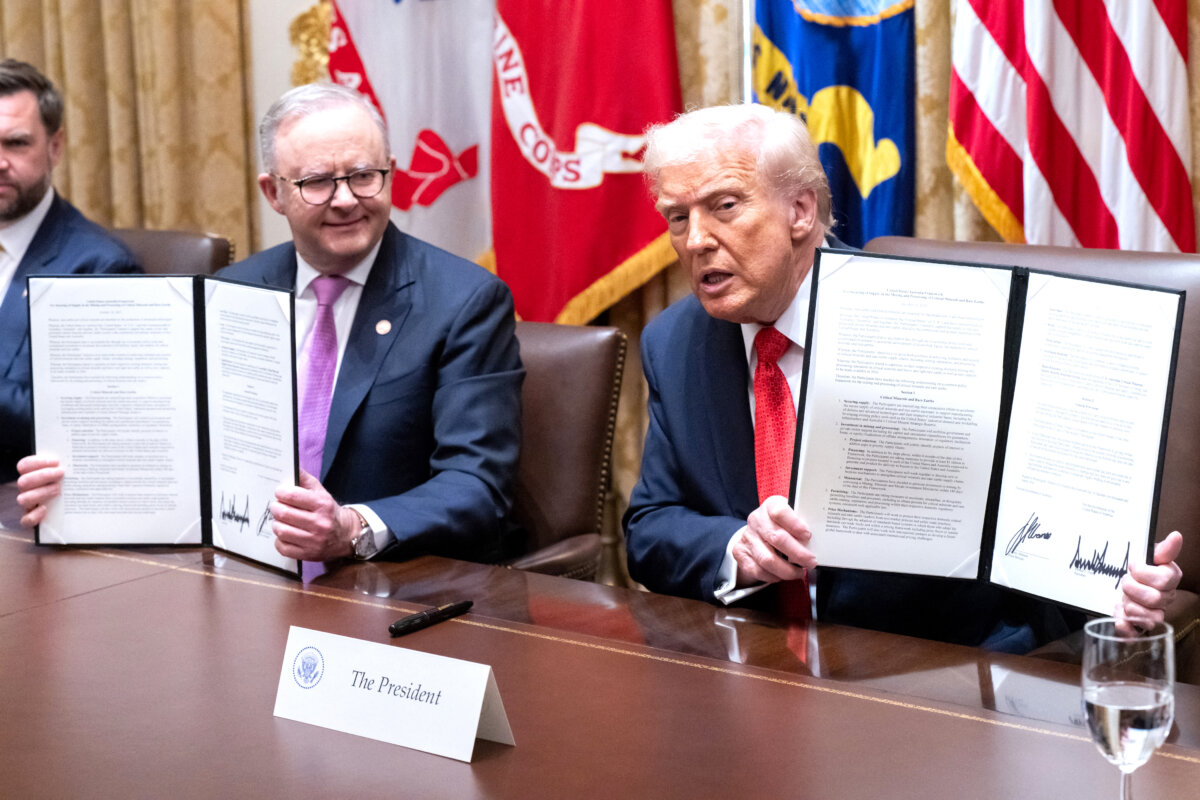


Canberra’s $3 billion critical minerals partnership with Washington has been called a “strategic inflection point” by American Chamber of Commerce in Australia CEO April Palmerlee.
“It signals a shared recognition by Australia and the United States that economic security is national security,” the head of one of the country’s biggest business chambers, told The Epoch Times.
“By jointly investing in critical minerals, we are reducing exposure to monopolistic supply chains and reinforcing sovereign capability. It’s not just about minerals—it’s about values: transparency, rule of law, and trusted trade.”
China still refines about 90 percent of the world’s heavy rare earths and dominates the processing of other key minerals such as gallium, graphite and lithium—materials that are essential for electric vehicles, defence systems, and renewable energy technologies.
This near-monopoly gives Beijing enormous leverage: by controlling the middle stages of production, China can influence global prices, supply stability and even the pace of technological development in rival economies.
The U.S.–Australia pact is meant to counter this dominance through the creation of an alternative network of supply chains.
The White House has pegged the potential value of recoverable resources from joint projects with Australia at about US$53 billion.
The U.S. Department of War will join with the Australian government to invest in a gallium refinery capable of producing 100 metric tons a year, which will be co-located at Alcoa’s Wagerup alumina refinery in Western Australia.
Further, Prime Minister Anthony Albanese’s government will invest up to US$100 million into Arafura’s Nolans Rare Earths Project in the Northern Territory.
“With the right policy settings and investment in processing and manufacturing, Australia stands to capture a significant share of the economic upside, including jobs, royalties, and downstream innovation,” according to Palmerlee.
The CEO said the partnership was structured to avoid the traditional “dig-and-ship” model that has long defined Australia’s mining sector—where companies extract raw minerals and export them overseas for processing and manufacturing, leaving most of the value-added gains offshore.
“Australia’s designation as a domestic source under U.S. defence law opens the door to co-production, not just extraction,” Palmerlee explained.
Graham Young of the Australian Institute of Progress says there was also limited financial risk.
“The government is loaning and investing money in various projects and will get an investment return. As the manufacturers are mostly in the United States, and the price of the minerals will be guaranteed, we’ll get a good return at lower risk,” he told The Epoch Times.
Young also highlighted the benefits for local government, pointing to Arafura’s Nolans rare earth project in the Northern Territory accounting for US$35.9 billion of the slated $53 billion resource value estimate.
“The Australian government is a major shareholder, so should reap substantial benefits from it directly from profits, and indirectly via taxes on the company and workers.
“The Territory government will get royalties. That’s better than it gets for most mining projects,” Young said, saying it was similar to the Norwegian model for oil and gas, which involves stronger state control and for most revenues to be channeled into a national sovereign fund.
 Friends Read Free
Copy
Facebook
Tweet
Friends Read Free
Copy
Facebook
Tweet