
The United States and Chile have signed two agreements on critical minerals and security, underlying cooperation on economic resilience and combating organized crime.
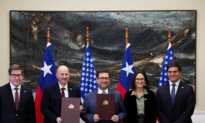
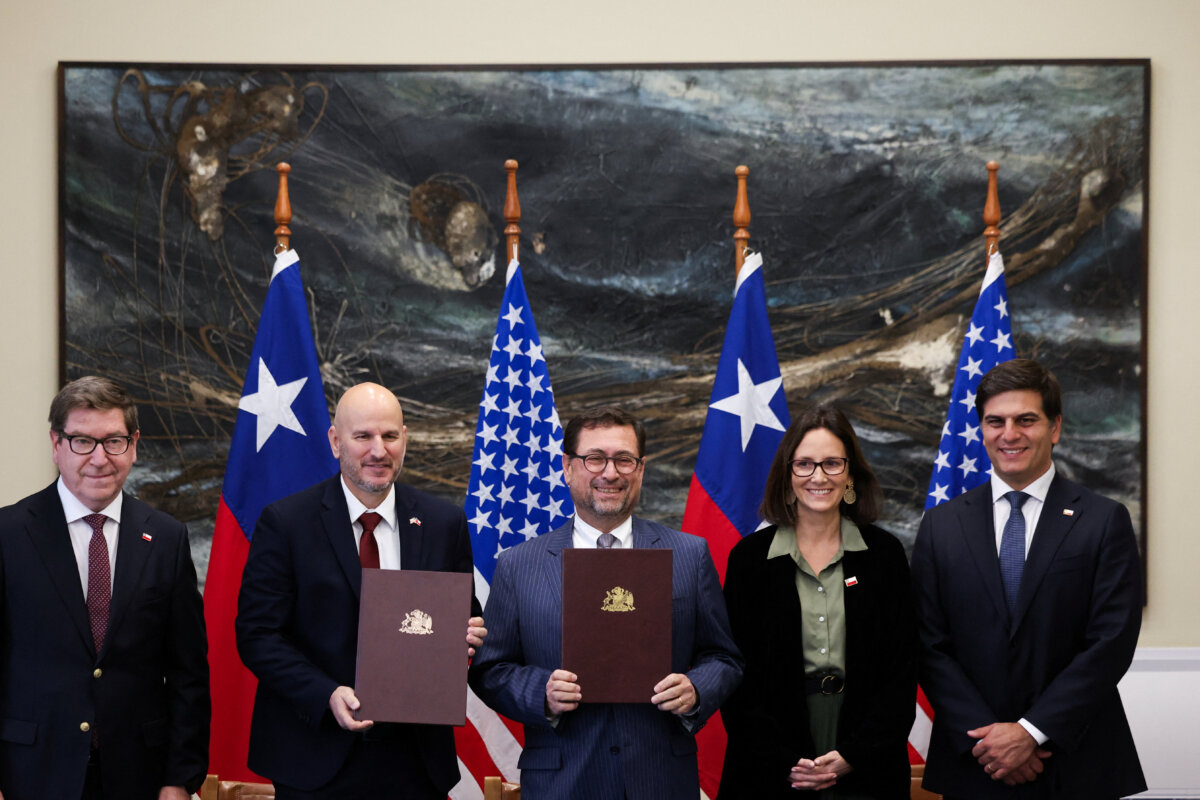
The agreements, finalized in Santiago, include a memorandum of understanding on critical minerals and an amendment to an existing security accord, according to an April 20 statement from the Chilean Foreign Affairs Ministry.
The memorandum of understanding on critical minerals, signed by U.S. Ambassador to Chile Brandon Judd and Chilean officials, establishes a framework to promote capacity-building across the supply chain, from critical minerals exploration to processing.
Judd said in an April 21 post on X that the memorandum also aims to “boost investment in critical minerals.”
The Chilean foreign ministry said the memorandum doesn’t create binding obligations or preferential rights and will be implemented under each country’s legal frameworks.
Still, it reflects Chile’s broader strategy to deepen international partnerships and attract investment.
Over recent years, Chile has entered similar agreements with a wide range of countries, including Germany, Japan, China, and the European Union, reflecting what the ministry described as an “open, diversified and non-exclusionary foreign policy regarding critical minerals.”
The push comes amid rising global demand for minerals such as lithium and copper, which are essential for advanced technologies, renewable energy systems, and electric vehicles.
Chile—one of the world’s largest producers of lithium and copper, according to the U.S. International Trade Administration—is seeking to position itself as a reliable supplier amid a shifting geopolitical landscape.
In March, Chile and the United States signed a separate joint declaration on critical minerals and rare-earth elements. It reaffirmed that “mutual support in the supply of critical minerals is fundamental for the national security and commercial industries of both countries,” according to a Chilean government statement at the time.
Officials from both nations are expected to meet regularly, at least once a year, to review progress and coordinate efforts, with initial consultations planned within 15 days of the March agreement.
Security Agreement
On security, Washington and Santiago signed an amendment to their existing agreement on narcotics control and law enforcement cooperation.
The updated agreement aims to enhance Chile’s capacity to confront transnational organized crime, including drug trafficking, cybercrime, and money laundering, according to April 20 comments by Chile’s Public Security Minister, Trinidad Steinert.
It will facilitate technical cooperation, training, and improved coordination among agencies.
The ministry also noted that the agreement would enable the purchase of investigative equipment such as vehicles and computers, helping law enforcement tackle complex crimes more effectively.
The agreements were signed during a visit by Thomas G. DiNanno, U.S. undersecretary of state for Arms Control and International Security, who is traveling in Chile and Argentina from April 17 to April 25.
During his visit, DiNanno met with senior Chilean officials to discuss “regional security threats, shared law enforcement interests, and opportunities to deepen bilateral and regional security cooperation,” the State Department said on April 17.
In an April 20 post on X, DiNanno highlighted broader areas of collaboration, writing, “By deepening space cooperation with Chile, we’re defending a free, secure space domain for everyone and pushing back against malign activities.”
He also met with Chilean Defense Minister Fernando Barros, stating on April 20 that the discussions focused on “expanding military relations” between the two nations and reinforcing the United States as a “strategic security partner.”
The visit reflects Washington’s broader effort to strengthen ties in Latin America amid increasing geopolitical competition, particularly in sectors such as critical minerals, where supply chains have become a strategic priority.
 Friends Read Free
Copy
Facebook
Tweet
Friends Read Free
Copy
Facebook
Tweet