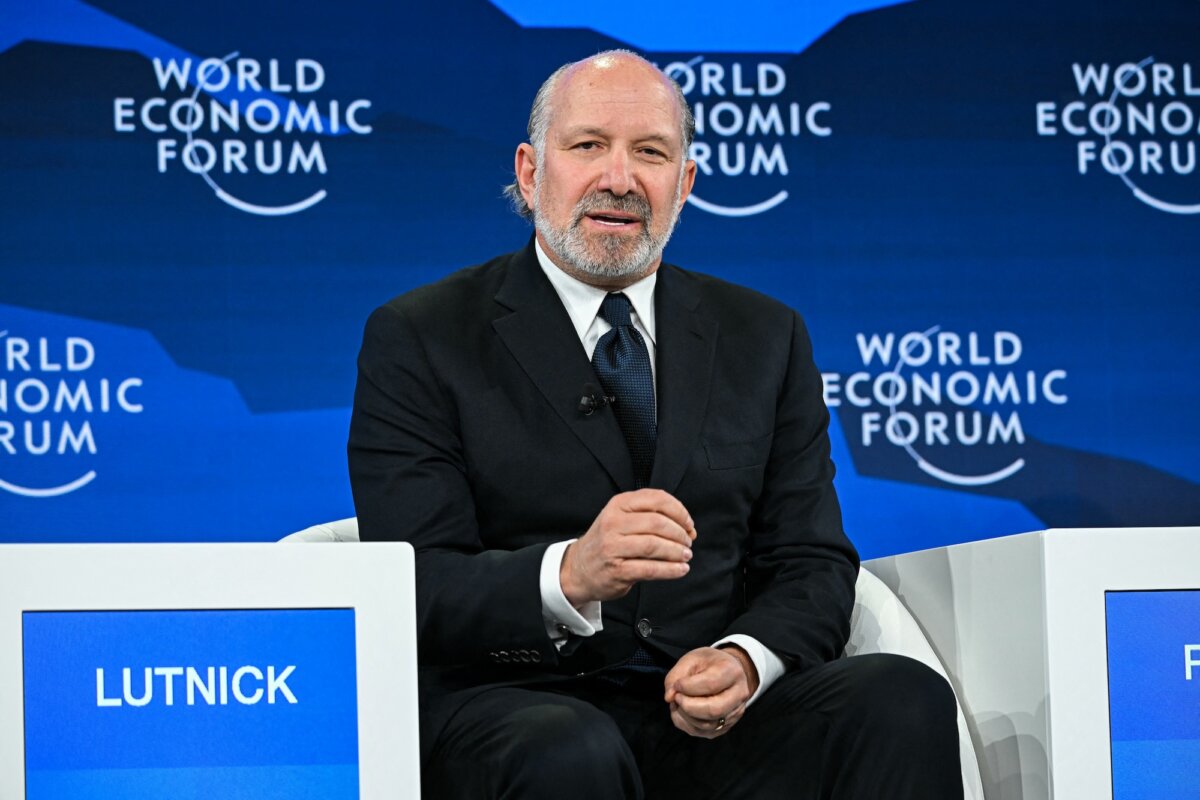

U.S. Commerce Secretary Howard Lutnick says Ottawa could risk jeopardizing the upcoming renegotiations of the United States-Mexico-Canada Agreement by getting closer to China and opening the Canadian market to more Chinese products.
Lutnick’s remarks come after Prime Minister Mark Carney delivered a speech on Jan. 20 at the annual meeting of the World Economic Forum (WEF) in Davos, Switzerland, urging countries and companies not to comply with unspecified “great powers” that he said are using “coercion.”
Without naming the United States, Carney said the international order is undergoing a “rupture” due to powers that have begun “using economic integration as weapons; tariffs as leverage.” Carney had also said that facing this situation, Canada is striking “new strategic partnerships,” including with China. During his trip to Beijing before Davos, Carney agreed to slash Canadian tariffs on Chinese electric vehicles (EVs) up to a certain quota in exchange for China cutting tariffs on Canadian products until at least the end of the year.
Lutnick told Bloomberg reporters in Davos on Jan. 22 that Canada is taking its trade relationship with the United States “for granted” by saying there’s “two hegemonic powers in the world and we’re going to decide which one we’re going to work with.”
“Really? You’re going to either work with the United States of America, where 75 percent of your economy is totally tied to it, or China?” he said. “Why would you say that?”
He said Canada is going down a “political path” by opening its markets to China and welcoming in Chinese EVs, despite Canada having what he called “the second-best deal in the whole wide world” with the United States under the USMCA, after Mexico. U.S. tariffs related to border security concerns have a 25 percent rate on Mexico and 35 percent rate on Canada. Goods compliant with the USMCA are exempt from the tariffs in both cases.
Lutnick’s commented further Carney’s EV deal with Beijing, which slashes the previous 100 percent tariff rate to 6.1 percent on up to 49,000 Chinese EVs imported per year, in exchange for China lowering tariffs on canola seeds from 85 percent to 15 percent starting in March until at least the end of 2026.
“China is delighted to sell to him, but do you think China is going to open their economy to accept exports from Canada? This is the silliest thing I’ve ever seen,” Lutnick said.
“When the USMCA gets renegotiated this year… do you think the president of the United States is going to say you should keep having the second-best deal in the world?”
Carney had himself called the USMCA the “best deal” with the United States compared to all other countries in the world, noting that 85 percent of cross-border trade is tariff-free because of the free trade agreement.
U.S. President Donald Trump also commented on Carney’s speech during his own address at the WEF on Jan. 21, saying it “wasn’t so grateful.” He said Canada “gets a lot of freebies” from the United States, and that the country “should be grateful also, but they’re not.”
“Canada lives because of the United States. Remember that, Mark, the next time you make your statements,” Trump said.
Lutnick said Carney is “marketing well” for politics, but not for Canada’s long-term “fundamental economics.”
“I think if we take it correctly, we should look at it as just political noise coming out of a prime minister, and maybe this is working for his election, right? Because I don’t think it can be real,” Lutnick said, adding that “no one would vote for changing” Canada’s trade relationship with the United States, with 85 percent of cross-border trade tariff free under the USMCA.
In an address to the nation on Jan. 22, Carney rebuffed Trump’s remarks that Canada “lives because of the United States,” saying Canada “thrives because we are Canadian.”
“Canada and the United States have built a remarkable partnership in the economy, in security, and in rich cultural exchange. But Canada doesn’t live because of the United States,” Carney said in a televised speech in Quebec City.
Matthew Horwood and Noé Chartier contributed to this report.
 Friends Read Free
Copy
Facebook
Tweet
Friends Read Free
Copy
Facebook
Tweet