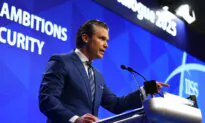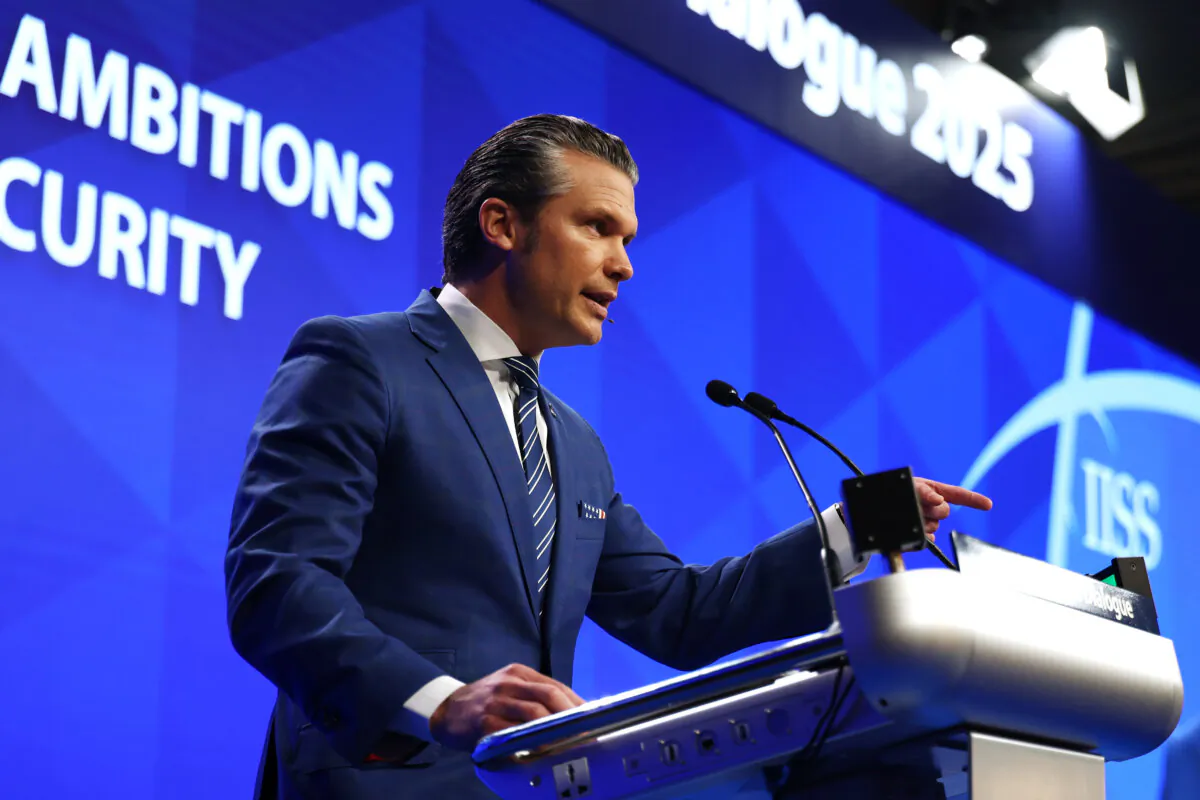

U.S. Defense Secretary Pete Hegseth has urged Australia to substantially boost its defence spending to align more closely with the United States’ strategic objectives in the Pacific region.
During a meeting with Australian Defence Minister Richard Marles on the sidelines of the Shangri-La Dialogue on May 30, Hegseth said the investment would help “maintain peace through strength” in the Indo-Pacific.
“On defence spending, Secretary Hegseth conveyed that Australia should increase its defence spending to 3.5 percent of its GDP as soon as possible,” a statement from the Pentagon read.
The ministers also discussed other key priorities for the U.S.-Australia alliance, including accelerating U.S. defence capabilities in Australia, strengthening defence industrial base cooperation between the two countries, and creating supply chain resilience.
The push from Hegseth comes after Elbridge Colby, Trump’s undersecretary of defense policy, told a U.S. Senate Committee that Australia needed to up its spending to at least 3 percent of GDP.
“The main concern the U.S. should press with Australia, consistent with the president’s approach, is higher defence spending,” Colby wrote in a submission (pdf).
“Australia is currently well below the 3 percent level advocated for NATO, by NATO Secretary General Rutte, and Canberra faces a far more powerful challenge in China [compared to the Europeans against Russia].”
The concerned push to bolster Western defences in the Indo-Pacific comes as the Chinese Communist Party (CCP) continues ongoing military activities in the region sparking concerns.
In February, three Chinese warships circumvented the Australian coastline without explanation, and carried out a live fire exercise with minimal warning, forcing 49 commercial airplanes to alter their course.
Australian Government’s Response
During a press conference on June 1, Marles acknowledged Hegseth’s request.
“On Friday, in our bilateral meeting, Secretary Hegseth did raise the question of increased defence expenditure on the Australian side,” he told reporters.
While the defence minister did not disclose the exact increase asked by the United States, he said the two countries had been working on the issue.
“Of course, we have already engaged in the last couple of years in the single biggest peacetime increase in defence expenditure in Australia’s history. So we are beginning this journey.”
Marles then cited the AUKUS trilateral defence partnership with the United States and the UK as an example of Australia’s efforts to increase its defence capabilities in recent years.
“We will continue to have the conversation with the United States, and we understand, and we’re up for it,” he said.
According to the 2025 federal budget, Australia’s defence spending currently stands at 2.05 percent of GDP, up from 2.03 percent in the previous fiscal year.
In May 2025, the Australian government announced that it would raise the annual defence budget from the current $53 billion to $100 billion by 2033-34.
This would increase defence funding as a proportion of GPD to 2.3 percent over the next decade.
 Friends Read Free
Copy
Facebook
Tweet
Friends Read Free
Copy
Facebook
Tweet