
The Pentagon’s May 1 announcement that it would withdraw 5,000 U.S. troops from Germany fits a longer pattern of U.S. force repositioning, experts told The Epoch Times.
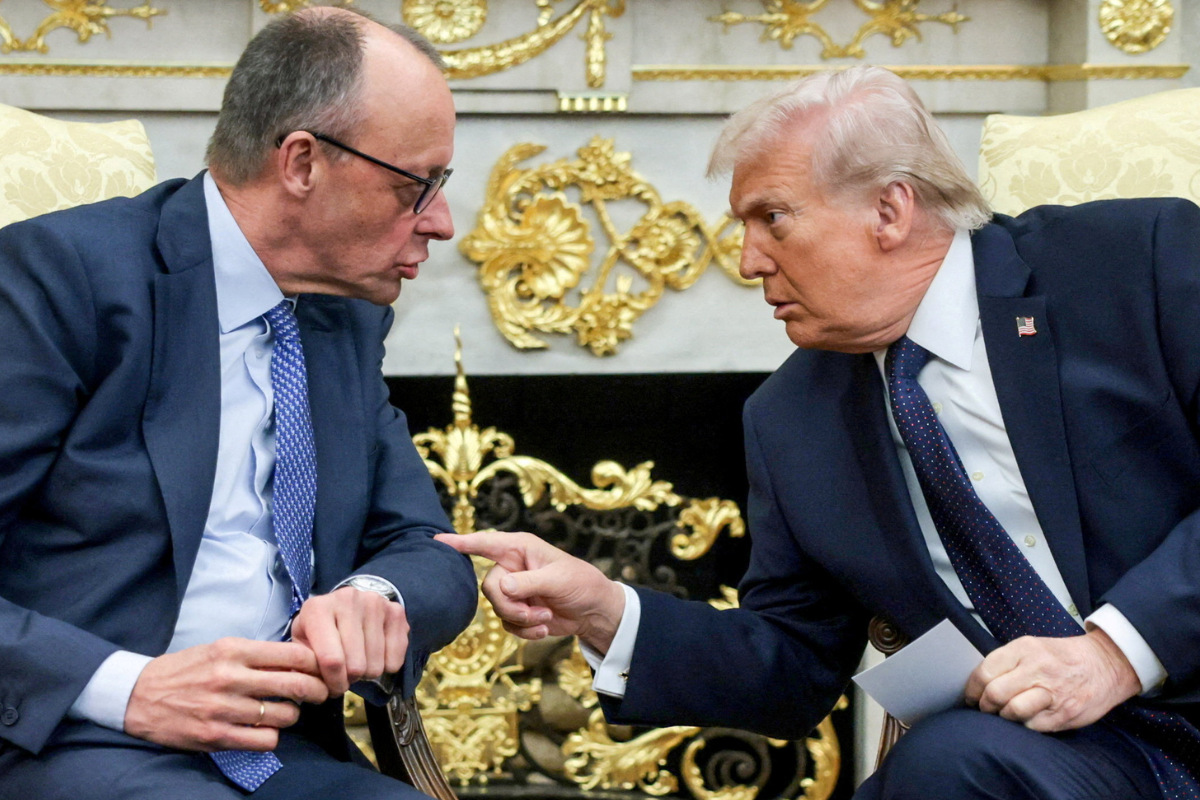
The decision came days after German Chancellor Friedrich Merz declared that the United States had “no strategy” in the war against Iran and that Tehran was “humiliating” Washington.
A Decision With Antecedents
Pentagon spokesman Sean Parnell said that the drawdown would be completed in six to 12 months and that it follows a review of U.S. force posture in Europe.
The cut eliminates one Army brigade and reverses a Biden-era plan, agreed to at the 2024 NATO summit in Washington, to deploy a battalion of long-range conventional missiles in Germany.
About 85,000 American troops remain on the continent. Officials said the aim was to redirect military assets toward the Indo-Pacific and the Western Hemisphere.
The decision follows the removal of an American combat brigade from Romania last year, and U.S. President Donald Trump has signaled that similar reductions could affect Spain and Italy.
In 2020, Trump’s first administration drew up plans to remove nearly 12,000 troops from Germany, framing the move as both a strategic repositioning and a sanction for Berlin’s failure to meet NATO defense spending commitments. President Joe Biden halted that withdrawal in 2021.
“The discussion about a withdrawal of American troops from Germany is not new,” Ulrich Pfeil, a German historian and professor of German civilization at the University of Lorraine, told The Epoch Times.
“Donald Trump jumped on the opportunity because he was irritated by Friedrich Merz’s remarks, but the issue is far from new.”
What 5,000 Troops Change
Pfeil told The Epoch Times that the 5,000 troops are infantry, “which modern armies need less, since wars are now waged with drones and missiles.” Berlin does not regard the cut as catastrophic, he said, although he noted logistical consequences.
“Ramstein Air Base serves as the hub for U.S. operations in the Middle East, while [the U.S. Army Garrison] Stuttgart oversees missions across Africa,” he said.
In his view, the reversal of the long-range missile deployment carries greater weight.
“The most sensitive issue, in my view, is Trump’s plan to halt the deployment of long-range missiles in Germany,” Pfeil said.
Berlin considers those weapons central to deterrence in the event of a Russian attack on Lithuania, where the Bundeswehr deployed a brigade of more than 1,000 soldiers earlier this year.
A Reorientation Toward Asia
Henri Ménudier, a specialist on post-1945 Germany and honorary professor at the Sorbonne Nouvelle in Paris who has taught at seven German and French institutions, told The Epoch Times that the move reflects both the immediate dispute and a longer-term shift.
“Trump has been irritated by Chancellor Merz’s criticism that Washington lacks a clear strategy on Iran,” he said. “But this announcement is not entirely new. American foreign policy is shifting toward Asia, at Europe’s expense.”
He summed up Trump’s message to European capitals: “Defend yourselves. We won’t abandon you completely, but you’ll have to carry more of the load so I can focus on Asia.”
The Iran War and Its Aftermath
Both scholars said Merz, in office since May 2025, had mishandled the Iran question.
“It was extremely imprudent of Merz to make such remarks,” Ménudier said.
“He has been chancellor for a year and should have learned from his contacts with Trump how rapidly and forcefully the president reacts.”
Pfeil compared the chancellor’s remarks to what tennis players call “unforced errors.”
“Merz does not always control himself, and some of his remarks later require damage control,” he said.
The German historian noted that regardless of the chancellor’s intentions, Germany’s postwar constitution forbids the country from waging offensive war.
“The German army is only allowed to defend Germany,” he said.
In Berlin, the response since May 1 has aimed at containment.
German Foreign Minister Johann Wadephul said the matter was being discussed within NATO bodies “in a spirit of trust.” German officials said Ramstein Air Base and U.S. Army Garrison Stuttgart, the major U.S. hubs in the country, would not be affected.
On Capitol Hill, Rep. Don Bacon (R-Neb.), a retired Air Force brigadier general, said the decision weakened NATO, pleased Russia, and amounted to a “knee-jerk reaction.”
Other lawmakers in both parties have raised concerns about deterrence. The Trump administration has stated that the U.S. military posture in Europe must be adjusted to current strategic priorities.
A European Defense Debate Revived
The chancellor’s parallel declaration that Germany would build “the most powerful conventional army in Europe” by the end of the decade has met with skepticism among specialists.
“The idea of the largest army in Europe seems hazardous to me,” Pfeil said. “The Poles, too, are making considerable efforts, and the largest army on the continent remains, as a matter of fact, the Ukrainian army.”
Ménudier said: “It’s a statement.
“Will it actually translate into action? I’m much less certain. These are the kind of sweeping pronouncements the press picks up, that play well in the media, but with no guarantee of follow-through.”
A first uncertainty, according to the specialist, concerns Merz’s longevity in office. After a year as chancellor, the Christian Democratic Union leader “is currently the most unpopular chancellor since 1949.”
According to a recent Forsa poll, just 13 percent of Germans say they are satisfied with Merz’s performance, while 85 percent express dissatisfaction. More broadly, only 11 percent approve of the government’s overall performance, while 87 percent view it negatively.
Ménudier pointed to a structural handicap. Merz arrived at the chancellery without previous government experience, and “governing is no easy task in Germany, given the extent to which power depends on political parties, the Länder [German states], and the Constitutional Court,” Ménudier said.
The ruling coalition between the Christian Democratic Union and the Social Democratic Party compounds the difficulty.
“The disagreements are so significant that people are wondering whether this coalition can even last four years,” Ménudier said.
A collapse before the three-year mark is, in his words, “possible, and even likely.”
Both scholars said the cut is nonetheless likely to accelerate a debate over European defense investment that successive U.S. administrations have urged.
“The European Union is gradually becoming aware of its dependence on the United States, and at the same time of the necessity to reduce it,” Ménudier said.
 Friends Read Free
Copy
Facebook
Tweet
Friends Read Free
Copy
Facebook
Tweet