

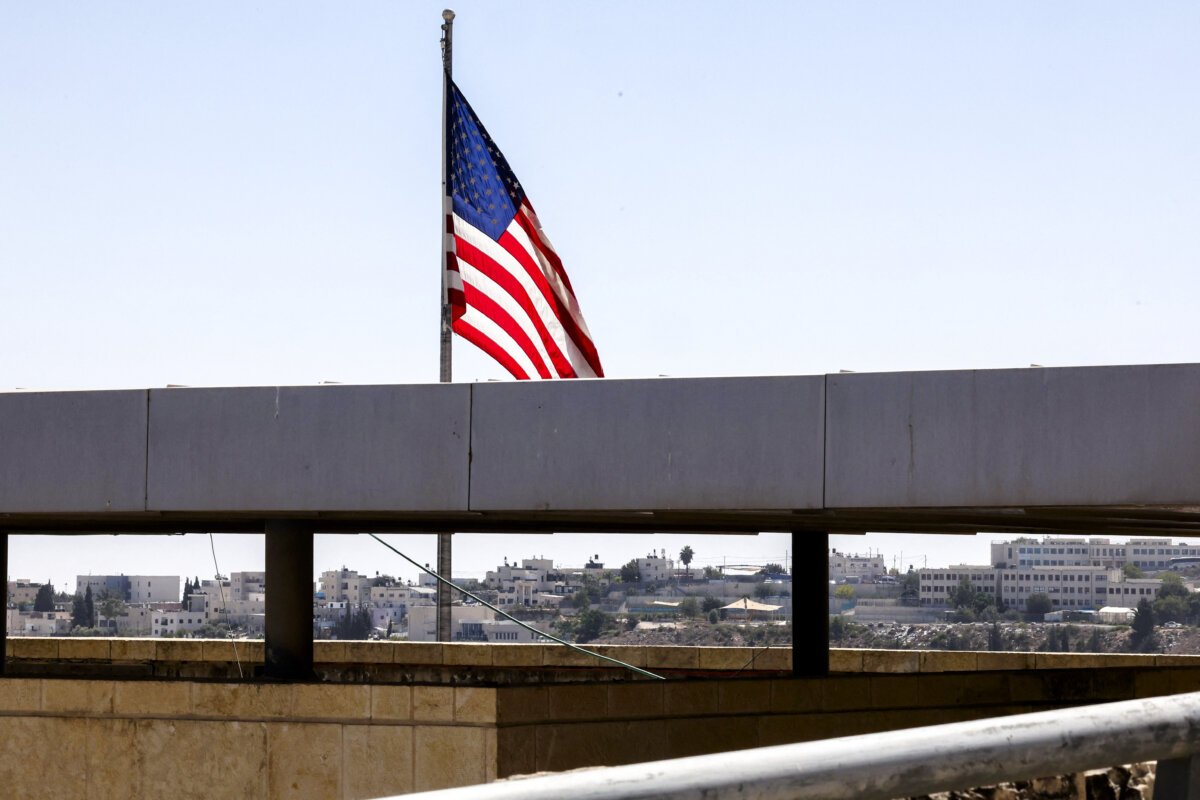
The U.S. Embassy in Jerusalem has said it is unable to evacuate American citizens from Israel, with the ambassador advising citizens to evacuate via the Sinai Peninsula.
“The U.S. Embassy is not in a position at this time to evacuate or directly assist Americans in departing Israel,” the U.S. Embassy in Jerusalem said in a March 2 statement.
It continued to offer guidance to Americans on making their own security plans, such as using the Israeli Ministry of Tourism’s shuttle service to the Taba Border Crossing.
The embassy said the land crossing into Egypt in the Sinai Peninsula is scheduled to be open 24 hours a day.
The embassy said that it “cannot make any recommendation (for or against) the Ministry of Tourism’s shuttle.”
“If you choose to avail yourself of this option to depart, the U.S. government cannot guarantee your safety. The information is provided as a courtesy to those wishing to leave Israel,” the embassy said.
It reminded U.S. citizens still in the country to continue to be cautious and aware of their personal safety, including the location of the nearest shelters, “in the event of a red alert as security incidents, such as mortar, rocket, and missile fire, and unmanned aircraft system (UAS) intrusions, often take place without any warning.”
Limited Options
In the early hours of March 3 local time, U.S. Ambassador to Israel Mike Huckabee wrote in a post on X that the embassy was receiving many requests regarding evacuation and that embassy staff were currently sheltering in place.
He said that options for Americans in Israel are “very limited,” recommending that U.S. nationals use the shuttle bus service to Taba and get “flights from there or going on to Cairo for flights back to the US.”
Huckabee said he did not recommend leaving via Jordan at this time.
“Flights are not consistent and access across the Allenby crossing has limited hours,” he said.
The ambassador said he was not sure when Ben Gurion Airport in Tel Aviv would reopen, but when it does, “there will be VERY limited flights with priorities to those who already were ticketed by El Al. Doubtful that other airlines will fly in/out for a while.”
Americans Urged to Leave
Thousands of flights across the Middle East have been canceled or delayed following the joint U.S. and Israeli strikes on Tehran.
El Al said in a March 3 statement posted to its website that due to the closure of Israel’s airspace, all flights with El Al and its subsidiary Sundor to and from Israel that were scheduled to depart through March 5 are canceled.
“We are preparing for an operation to bring Israelis back home as soon as Ben-Gurion Airport reopens for activity,” it said.
The embassy’s advice comes after the U.S. Department of State on March 2 urged Americans currently in more than a dozen Middle Eastern regions and countries to leave immediately, due to “serious safety risks,” as the Iran war enters its fourth day.
U.S. citizens in Bahrain, Egypt, Iran, Iraq, Israel, the West Bank, the Gaza Strip, Jordan, Kuwait, Lebanon, Oman, Qatar, Saudi Arabia, Syria, the United Arab Emirates, and Yemen should depart now through any available commercial transportation, the State Department said in a travel security fact sheet shared in a post on X by Mora Namdar, the U.S. State Department’s assistant secretary for consular affairs, on March 2.
Namdar said any Americans who need assistance can call the agency 24 hours a day.
The number to call from inside the United States or Canada is +1-888-407-4747, while any Americans staying abroad should call +1-202-501-4444.
Jacob Berg contributed to this report.
 Friends Read Free
Copy
Facebook
Tweet
Friends Read Free
Copy
Facebook
Tweet