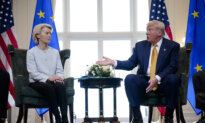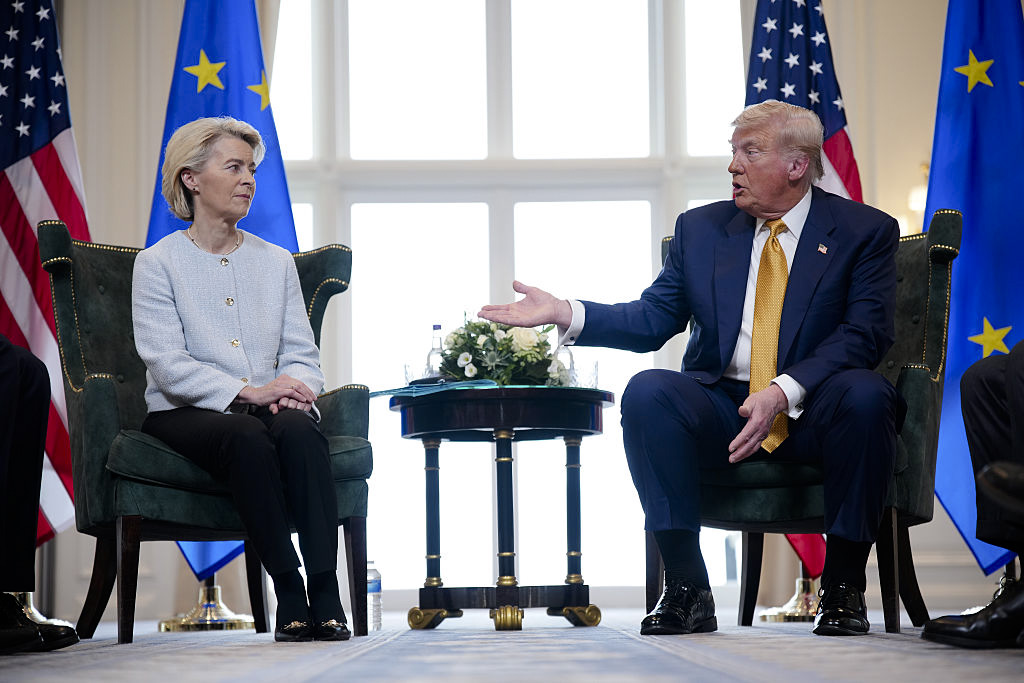

President Donald Trump announced on July 27 that the United States reached a trade agreement with the European Union after months of tough negotiations.
Before meeting with European Commission President Ursula von der Leyen, Trump told reporters that there was a “50–50 chance” of establishing a deal. European leaders had prepared for a no-deal situation ahead of the Aug. 1 deadline.
Ultimately, both sides of the Atlantic agreed on a framework that would facilitate $1 trillion in annual trade, accounting for one-third of global commerce.
Here are the key takeaways of the U.S.–EU trade deal:
Tariffs
The United States will impose a 15 percent tariff on most European goods. The 15 percent is not added to existing tariff regimes.
While this is lower than the president’s previous proposal of 30 to 50 percent levies, it is higher than the 10 percent baseline tariff unveiled on April 2.
“We’re doing them on the low end, not the high end, because we don’t want to hurt anybody,” Trump said.
“This is probably the biggest deal ever reached in any capacity—trade or beyond. It’s a giant deal with lots of countries.”
Moving forward, the United States and the EU will establish zero-for-zero tariffs on several products, including aircraft and their components, semiconductor-making equipment, certain chemicals and pharmaceuticals, and natural resources and critical minerals. Several agricultural products will be exempt from tariffs, excluding beef, ethanol, poultry, rice, and sugar.
The automobile industry will also experience relief as import taxes are set to decline from 27.5 percent to 15 percent, mirroring the rates Japan received last week.
European steel will be subject to 50 percent levies, but Brussels and Washington are discussing the creation of a quota system.
“On steel and aluminium, the EU and the U.S. face the common external challenge of global overcapacity,” said von der Leyen, likely referring to China’s dumping of these products in Western markets. “We will work together to ensure fair global competition. And to reduce barriers between us, tariffs will be cut. And a quota system will be put in place.”
Investments
Like other recently announced trade deals, the EU will be making massive investments in the United States over the coming years.
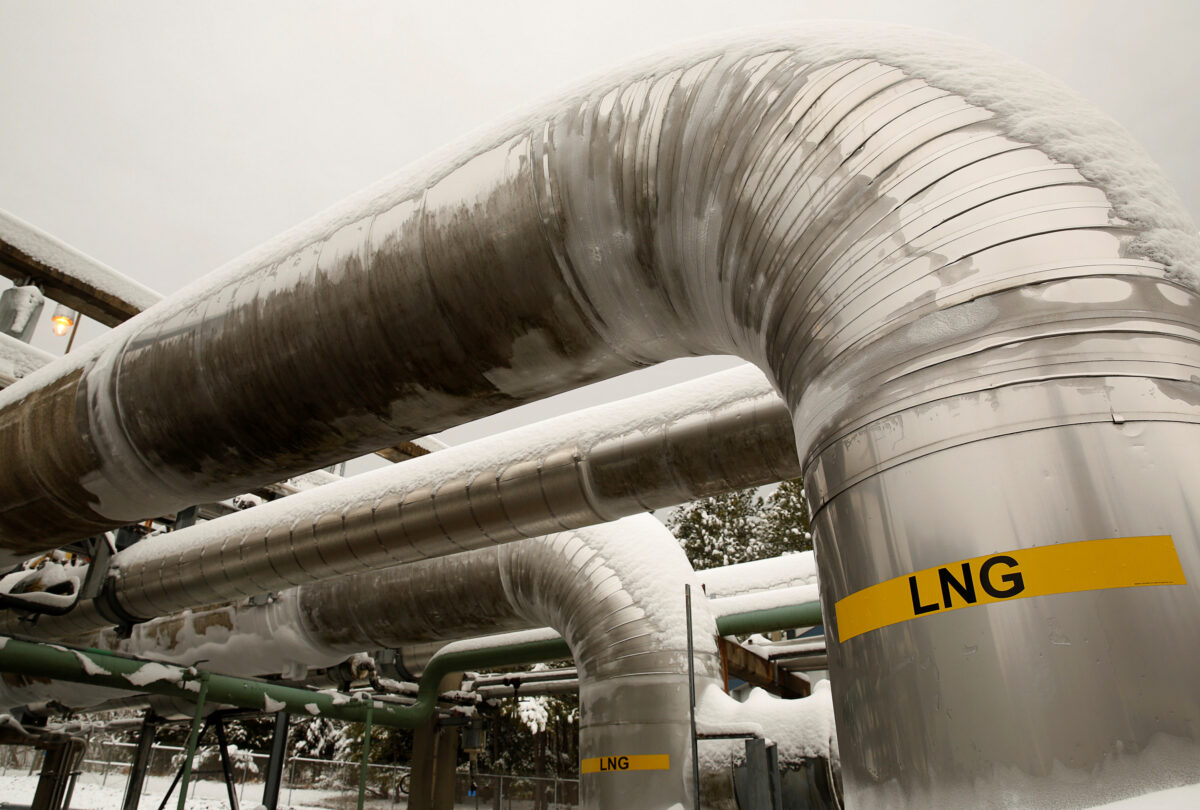
The EU has committed to investing $600 billion in the U.S. economy. The 27-member bloc will also purchase $750 billion worth of U.S. energy products, including liquefied natural gas, nuclear fuel, and crude oil, over the next three years.
Aligning with NATO’s defense spending goals, the EU has pledged to purchase hundreds of billions of dollars in U.S. military equipment.
Reuters)
This has been a significant facet of many of these trade deals.
The White House states that Japan will be investing $550 billion in the U.S. economy, enabling the administration to allocate this cash infusion across various sectors, including manufacturing, semiconductors, and pharmaceuticals.
In the U.S.–UK agreement announced in spring, IAG, the parent company of British Airways, committed to purchasing $13 billion worth of airplanes from U.S. aerospace giant Boeing.
Non-Tariff Trade Barriers
In addition to tariffs and investments, the U.S.–EU trade deal addresses important nonmonetary trade barriers, said U.S. Trade Representative Jamieson Greer.
“We do cover quite a bit of ground in this agreement, and we expect this great impact on reducing our deficit and trying to increase U.S. exports to the European Union,” Greer said in a July 28 interview with CNBC’s “Squawk Box.
Last year, the U.S. goods trade deficit with the EU was $235.6 billion, up 12.9 percent from 2023, according to the Trade Representative’s Office.
According to Greer, European officials will collaborate with the United States on recognizing telecommunications and cybersecurity standards. Similar to other trade agreements, the EU will also streamline the certification processes for dairy and pork.
“There are a lot of technical details in here,” he said.
What’s Next
The latest trade blueprint will require the approval of EU member countries.
Ambassadors are scheduled to meet on July 28 for a debriefing from the European Commission. This will enable all member states to break down technical discussions and refine additional details.
“Details have to be sorted out, and that will happen over the next week,” von der Leyen said at a press briefing shortly after meeting with Trump. “This is something which has to be sorted out in the next days.”
Investors Shrug Off Deal
U.S. stocks were little changed to kick off the trading week.
The tech-heavy Nasdaq Composite Index rose by as much as 0.4 percent. The blue-chip Dow Jones Industrial Average and the broader S&P 500 ticked up about 0.1 percent.
Overseas, European stocks were in the red. The German DAX fell by about 1 percent, the London FTSE dropped by close to 0.6 percent, and France’s CAC 40 Index fell by 0.4 percent.
Investors widely expected that the EU would make a deal, particularly as the U.S.–Japan bilateral trade pact was announced days before, said Jamie Cox, managing partner for Harris Financial Group. The next major development will be China, he said.
“The biggest piece in the trade deal puzzle still remains, and the Chinese are unlikely to be as willing to fold,” Cox said in a note emailed to The Epoch Times. “The next big durable theme in markets is security, and the EU deal only accelerates it.”
Top Trump administration officials, including Greer and Treasury Secretary Scott Bessent, are scheduled to meet with Chinese officials in Stockholm on July 28. This is the third round of trade negotiations since April 2.
“I don’t expect some kind of enormous breakthrough today, what I expect is continued monitoring and checking in on the implementation of our agreement thus far,” Greer said.
The world’s two largest economies are currently in a 90-day pause on tariffs, which is set to expire on Aug. 12. Bessent, talking to Fox Business last week, suggested that Beijing and Washington will likely work out an extension.
 Friends Read Free
Copy
Facebook
Tweet
Friends Read Free
Copy
Facebook
Tweet