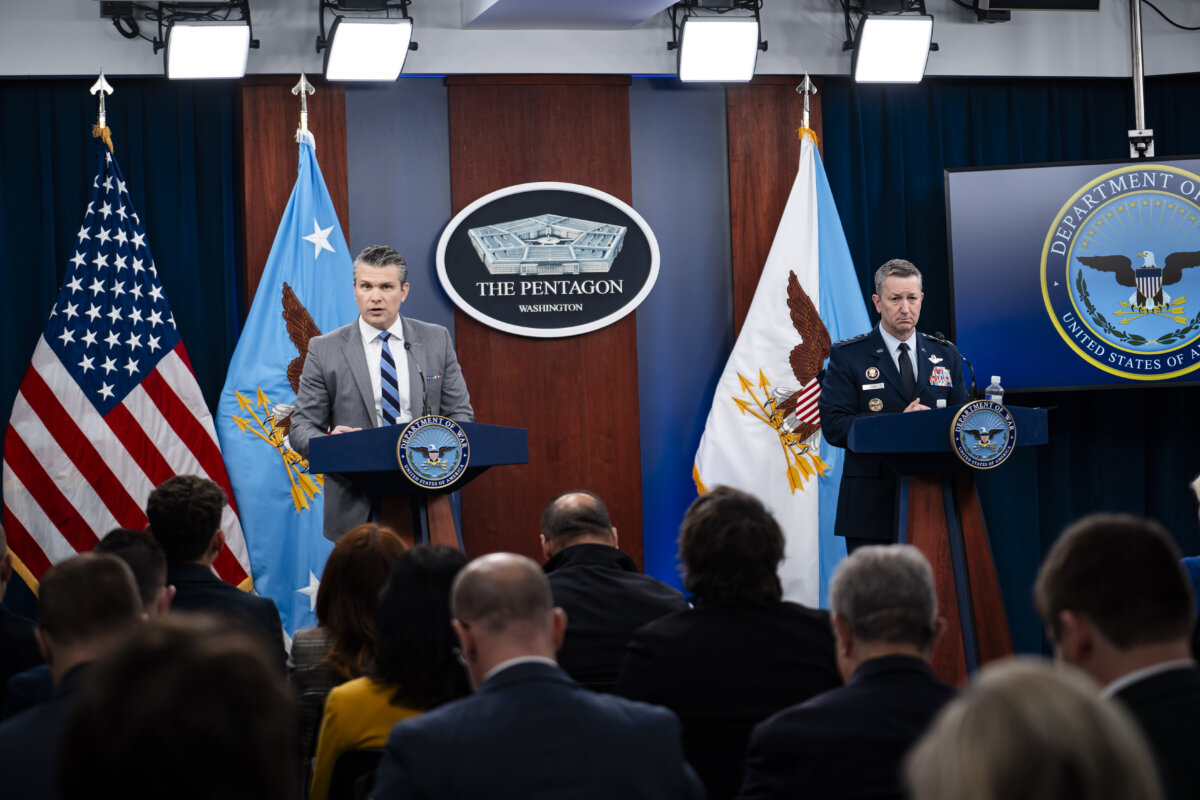
Thirty-four vessels have been turned back since the United States imposed a naval blockade to and from Iranian ports in the Gulf of Oman and the open oceans, according to Secretary of War Pete Hegseth.
Speaking at an April 24 Pentagon briefing alongside Joint Chiefs Chairman Dan Caine, Hegseth provided an update on the conflict with Iran, which is currently paused under a ceasefire agreement.
“Every ship that the U.S. believes, meets our criteria, either Iranian ships or to and from Iranian ports, has been turned around,” Hegseth said. “As of this morning, 34.”
Additionally, Hegseth emphasized that the blockade is both expanding and intensifying.
“Not only is the blockade growing, in fact, a second aircraft carrier will join the blockade in just a few days,” he said, adding that “this growing blockade has also gone global.”
This week, the United States seized two Iranian dark fleet ships in the Indo-Pacific region that had left Iranian ports before the blockade went into effect, according to Hegseth.
Caine confirmed that U.S. military operations would continue beyond the immediate region.
“We’re enforcing the blockade across the board against any ship of any nationality that is transiting to or from an Iranian port or territory,” Caine said.
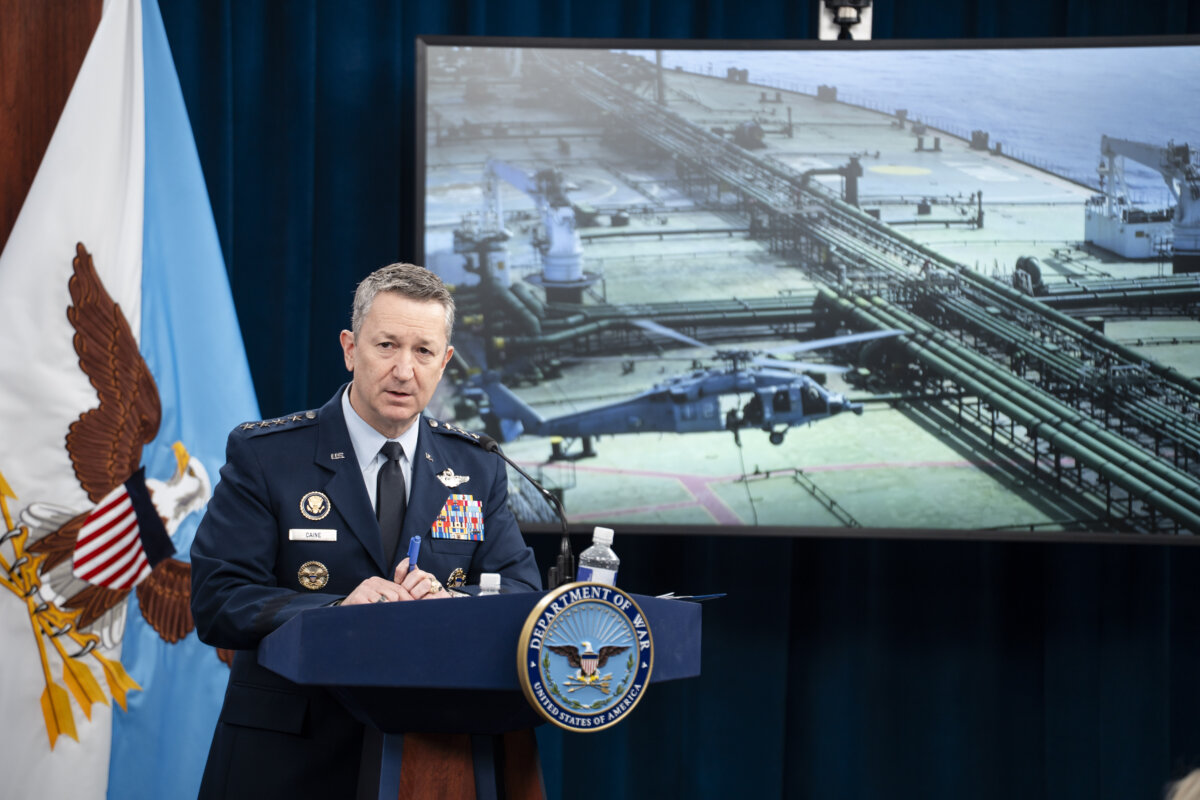
He added that U.S. forces are actively monitoring ships linked to Iran, including those that were outside the blockade zone when it was first announced.
“We’re closely tracking vessels of interest headed towards Iran and those moving away from Iran that were outside the blockade area when this blockade was ordered, and … we’re prepared and postured to intercept them,” he said.
The U.S. naval blockade of Iranian ports began on April 13.
Hegseth also warned that any attempt by Iran to deploy naval mines in the Strait of Hormuz would violate the ceasefire agreement.
“Transit [of the Strait of Hormuz] is occurring, much more limited than anybody would like to see and with more risk than people would like to see, but that’s because Iran is doing irresponsible things with small, fast boats … with weapons on them,” Hegseth said.
According to data from Lloyd’s List Intelligence, seven vessels passed through the strait between April 22 and early April 23, six of which were involved in Iran-related trade.
The disruption in the Strait of Hormuz has had far-reaching consequences. The partial closure of the strait—one of the world’s most critical energy corridors—is affecting a corridor through which roughly 20 percent of global oil and liquefied natural gas (LNG) supplies travel, contributing to a growing global energy crisis.
Meanwhile, hundreds of ships and approximately 20,000 seafarers remain stranded in the Gulf. War risk insurers and energy companies are closely monitoring the situation for signs of stabilization that would allow safe passage to resume.
Reuters contributed to this report.
 Friends Read Free
Copy
Facebook
Tweet
Friends Read Free
Copy
Facebook
Tweet